
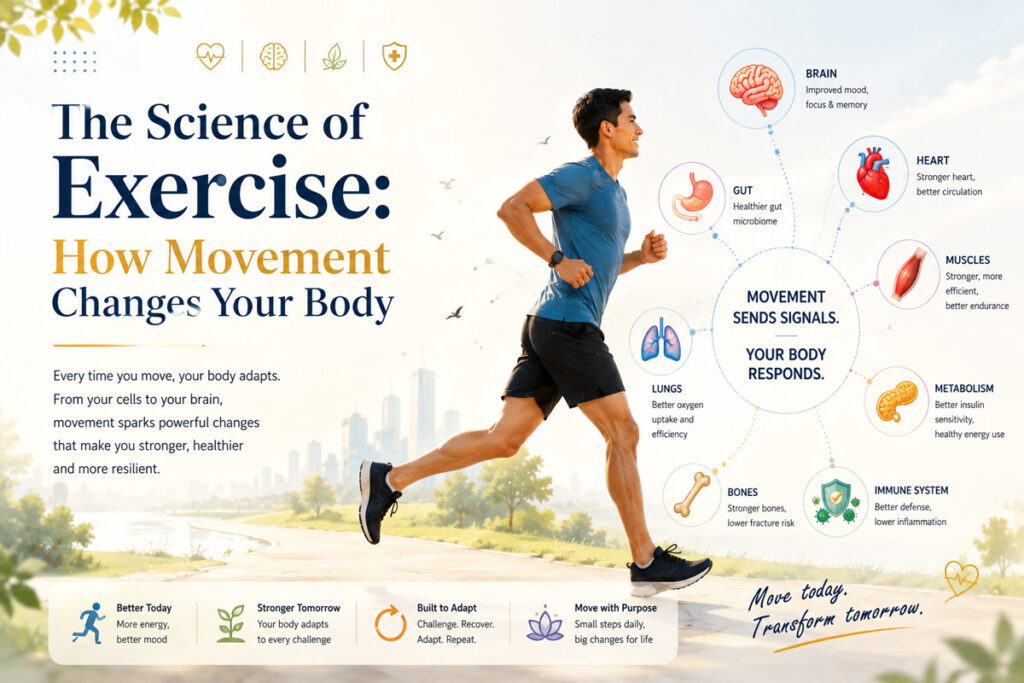
Most of us think of exercise as something extra.
Something we do before breakfast, after work, at the gym, or whenever we finally find some free time. And when life gets busy, exercise is often one of the first things to be postponed. There is always another meeting, another deadline, another reason to start tomorrow instead.
For many people, exercise is also tied to a few familiar goals: losing weight, building muscle, improving stamina, or looking fitter. If none of those goals feels urgent, movement can start to seem optional. After all, if we can get through an ordinary day without exercising, how necessary can it really be?
But movement has been part of human life for far longer than gyms, workout plans, and fitness trackers have existed. For most of our history, walking, carrying, climbing, lifting, running, and travelling weren’t forms of exercise. They were simply part of staying alive. Our bodies evolved in an environment where movement was difficult to avoid.
Modern life has changed that environment remarkably quickly. We can work, travel, eat, shop, communicate, and relax while moving very little. Technology has made life easier in countless ways, but our biology hasn’t changed nearly as quickly as our surroundings have.
And yet, every time we move, the body responds. The heart changes how it pumps blood. Muscles demand more energy and release chemical signals. Blood vessels adjust. The brain responds. Cells change the way they handle energy. Bones and other tissues adapt to repeated physical demands.
The more we understand the science of exercise, the harder it becomes to see exercise as simply a way of burning calories or improving appearance.
Exercise is a biological signal.
And understanding that signal changes the question completely.
Instead of asking only, “How much exercise should I do?” we can ask something much more interesting:
What is my body learning every time I move?
Why We Think Exercise Is Only About Fitness
Think back to how exercise was usually presented to us.
Lose weight.
Build muscles.
Improve stamina.
Stay fit.
None of these ideas is wrong. They are simply the most visible part of the benefits of exercise—the part we can easily see or measure.
When you walk to the market, climb a staircase, cycle somewhere, play football, or lift a weight, your physical activity isn’t merely about spending calories. Your heart has to deliver more blood. Your lungs have to bring in more oxygen. Your muscles need energy. Blood vessels adjust to changing demands, while the nervous and hormonal systems coordinate the whole process.
And the interesting part is that the story doesn’t end when you stop moving.
After the activity, the body begins recovering. Energy stores are replenished, tissues repair themselves, and the systems that were challenged begin adjusting. If the same kind of demand keeps appearing, those adjustments can gradually become more permanent.
The walk that once left you tired becomes easier. The stairs that once required a pause become ordinary. Your muscles can produce more force, and your cardiovascular system becomes better prepared for physical demand.
This is the basic principle behind fitness:
The body adapts to what we repeatedly ask it to do.
So exercise isn’t merely something that changes the body from the outside.
It tells the body how to change itself.
What Really Happens When You Move
Consider something completely ordinary: you decide to climb a staircase.
The moment you take the first few steps, your leg muscles begin demanding more energy. Your heart responds by pumping faster, while your breathing becomes deeper to bring more oxygen into the body. Blood vessels adjust the flow of blood towards the tissues that need it most.
You don’t have to consciously instruct any of this.
You don’t think, “My muscles need more oxygen, so perhaps my heart should increase its output now.” Your body simply recognises the increased demand and responds automatically. Your nervous system, hormones, heart, lungs, and muscles coordinate thousands of small changes in the background.
Then you reach the top.
The immediate demand disappears, but the biological response doesn’t simply switch off. Your breathing gradually settles, your heart rate comes down, and the body begins restoring what was used during the activity.
With repeated exercise, something else happens.
The body starts preparing for the next time.
The systems that were challenged become better equipped to handle the same demand. Energy production improves, muscles become stronger, cardiovascular capacity increases, and recovery can become easier.
This is why exercise produces changes that last far beyond the workout itself.
The workout is the challenge. The adaptation is the lasting change.
And some of the most interesting parts of that adaptation happen through conversations taking place inside the body—conversations we cannot see.
The Hidden Science of Exercise
Exercise doesn’t suddenly make someone smarter, but regular movement and brain health are increasingly understood as closely connected.
It changes the way muscles communicate, how cells handle energy, how the body responds to stress, how efficiently cells produce energy, and even how the brain adapts.
The scientific terms can sound complicated at first. But behind each one is a surprisingly simple idea.
Let’s look at five of the most interesting.
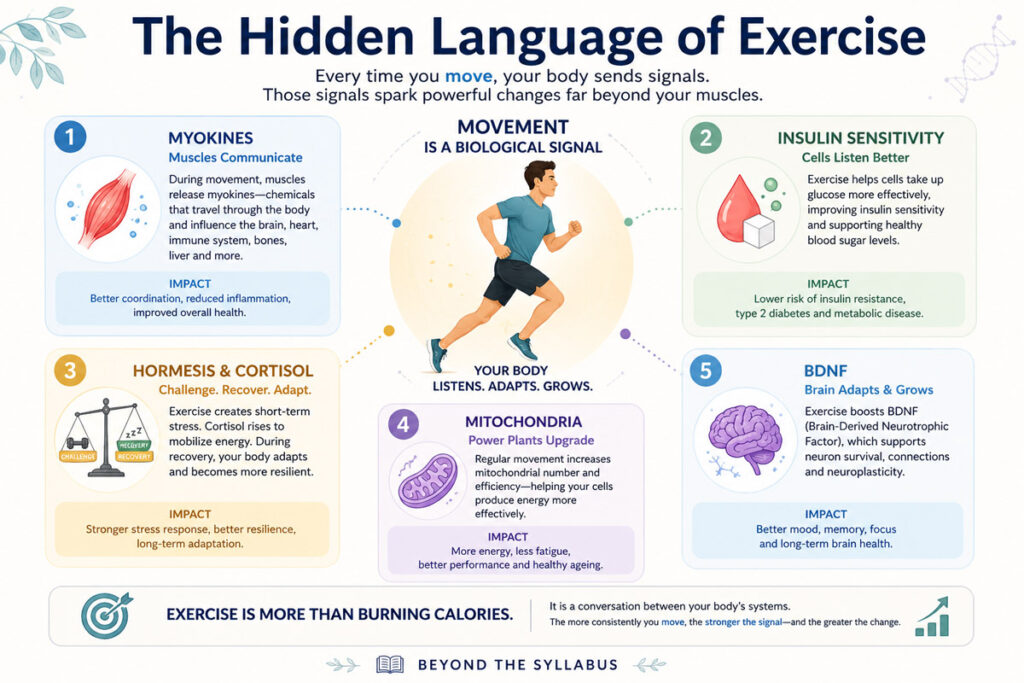
i. Muscles Are Chemical Factories
You finish a brisk walk and naturally think about what your legs have just done. They carried you forward, worked harder, and used more energy.
But your muscles were doing something else too.
When muscles contract, they release chemical messengers called myokines. These signals can travel through the body and influence processes involving metabolism, inflammation, immune activity, and the brain. Research into this muscle–organ communication has helped scientists understand why the effects of exercise can extend far beyond the muscles themselves.
You don’t need to remember the word itself to understand the idea.
Think of myokines as messages sent by your muscles to the rest of your body.
This means that when you exercise, you’re not simply training the muscles you can see in the mirror. Those muscles are also communicating with other parts of you.
Your muscles don’t just move your body. They talk to it.
ii. Exercise Teaches Cells to Listen Again
Think about what happens after lunch.
Food is digested and glucose enters your bloodstream. Your body releases insulin, which helps signal cells to take up that glucose and use or store it.
When this system works properly, the conversation is straightforward: insulin sends the message, and cells respond.
But sometimes cells become less responsive to insulin. This condition is known as insulin resistance.
Regular exercise can help improve insulin sensitivity, making it easier for cells to respond to insulin. When muscles contract, they can take up glucose, and repeated exercise can make them better at responding to insulin over time. This connection between exercise and insulin resistance is one reason regular movement matters even when weight loss isn’t your goal.
In practical terms, exercise helps make the body’s energy-management system work more effectively.
That’s important even if you’re not trying to lose weight.
Exercise isn’t only about burning the energy you have today. It can help your body become better at handling energy tomorrow.
iii. Why Small Challenges Make Us Stronger
Anyone who has started exercising after a long break knows the feeling.
The first few sessions can leave your muscles tired and your body asking for recovery. It might seem strange that something uncomfortable could eventually make you stronger.
But that is exactly where adaptation begins.
Exercise temporarily stresses the body. When the challenge is manageable and followed by enough recovery, the body responds by becoming better prepared for a similar challenge in the future. This principle is called hormesis.
Cortisol is part of this story. It is often called the “stress hormone,” but cortisol itself isn’t harmful simply because it rises during stress. It helps the body respond to demands and mobilise energy. The bigger problem is prolonged stress without enough recovery.
Exercise therefore follows a simple biological pattern: challenge, recovery, adaptation.
The goal isn’t to create as much stress as possible.
The goal is to give the body a useful challenge and enough time to respond to it.
iv. Your Cells Build Better Batteries
Why does the same staircase feel easier after a few weeks of regular exercise?
One part of the answer lies inside your cells.
Your cells contain tiny structures called mitochondria, which play a major role in producing the energy your body needs. When you exercise regularly, your muscles can adapt by improving their capacity to produce and use energy.
That change doesn’t happen during one magical workout.
It develops through repetition.
The same physical demand is encountered again and again, and the body gradually becomes better equipped to handle it. What once felt exhausting begins to feel ordinary.
That’s why improved fitness isn’t simply about becoming “tougher.”
Your cells themselves are adapting to the work you’re asking them to perform.
You’re not just using energy. You’re training your body to handle energy better.
v. Your Brain Learns Through Movement
We often separate exercise from learning.
One belongs to the gym, playground, or sports field. The other belongs to the classroom, library, or desk.
But the brain doesn’t make that distinction.
Movement can influence a molecule called BDNF, or brain-derived neurotrophic factor, which is involved in maintaining neurons and supporting the brain’s ability to adapt.
That ability of the brain to change in response to experience is known as neuroplasticity.
This helps explain why regular physical activity is associated with benefits for memory, mood, attention, and cognitive function. This is also why exercise for brain health has become an increasingly important area of research. Exercise doesn’t suddenly make someone smarter, but it can support the biological environment in which a healthy, adaptable brain functions.
So movement isn’t only something your body learns from.
Your brain is listening too.
And once we realise that muscles, cells, and the brain are all responding to movement, the next question becomes obvious: how far does this conversation actually reach?
5. Why Exercise Affects Almost Every Organ
The heart is probably the first organ we think about when we exercise. It has to pump more blood, and over time regular activity can help the cardiovascular system become better equipped to meet physical demands.
But the heart isn’t working alone. This wider effect is what makes the benefits of exercise so interesting: movement begins with a physical demand, but the response can spread across systems that seem completely unrelated to the muscles doing the work
Bones respond to mechanical loading. Walking, running, jumping, and resistance exercise give the skeleton physical demands that can help maintain its strength.
The immune system responds too. Physical activity changes the movement and activity of immune cells, while regular moderate exercise can support healthy immune regulation.
Then there is metabolism. Working muscles use glucose, and regular movement can improve insulin sensitivity—one reason the relationship between exercise and insulin resistance has become such an important area of health research.
The conversation reaches further still. Exercise is associated with changes in the gut environment, while regular physical activity can also support sleep and influence the brain through changes in chemistry and blood flow—another reason exercise for brain health deserves attention.
None of this means exercise is a cure-all. Health is shaped by many factors, and scientists are still studying exactly how different systems interact.
But the larger picture is becoming difficult to ignore.
A movement that begins in your muscles can create a response throughout your body.
Your Body Was Built for Movement
Think about an ordinary modern day.
You wake up and walk a few steps to the bathroom. You sit down for breakfast. Perhaps you sit in a car or on a bus to work. Then you spend several hours at a desk, sit during lunch, sit again during the journey home, and eventually settle down in front of a screen.
By the end of the day, you may realise that you have spent most of it sitting.
None of those individual moments seems particularly unusual. That’s exactly why the pattern is so easy to overlook.
For most of human history, daily life looked very different. Finding food required movement. Carrying water required movement. Travelling required movement. Working with the hands, climbing, lifting, and walking were ordinary parts of survival.
Our bodies evolved under those demands, which helps explain why the benefits of exercise extend far beyond fitness or appearance.
Modern technology has changed that environment dramatically, making it easier than ever to get through an entire day with very little physical activity. Cars replaced many walks. Elevators replaced stairs. Machines replaced physical labour. Screens replaced many activities that once required us to move.
None of this makes modern technology the enemy. These changes have made life safer, easier, and more productive in countless ways.
But our biology responds to the environment we actually live in.
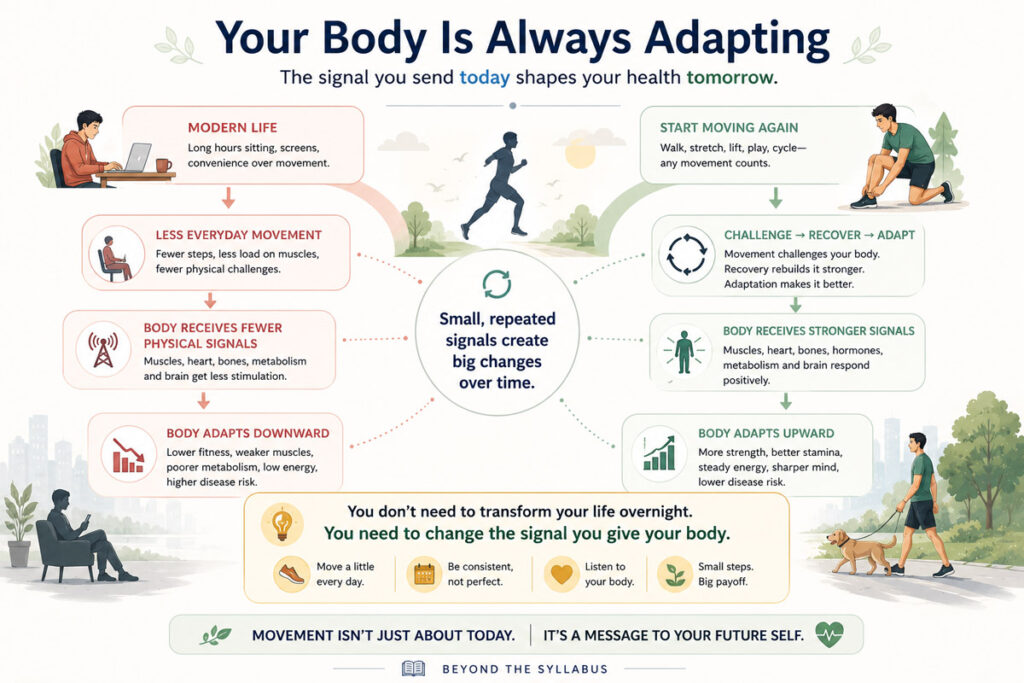
If we repeatedly challenge the body, it adapts to those demands. If we repeatedly remove the demands, it adapts to that environment too.
The body is always adapting.
Modern life hasn’t made movement unnecessary.
It has simply made it optional.
The Cost of Modern Inactivity
There is an important distinction that is easy to miss: exercising regularly and being physically active throughout the day are not exactly the same thing.
Someone can spend thirty minutes exercising in the morning and then remain almost completely still for the next ten hours.
That workout still matters. But the rest of the day matters too.
When muscles remain inactive for long periods, they aren’t being regularly challenged through physical activity to use energy or handle glucose. Over time, prolonged inactivity can contribute to poorer metabolic health, reduced muscle strength, and declining physical capacity.
The effects aren’t limited to muscles. Regular movement also provides signals that influence circulation, bones, mood, metabolism, and sleep.
This doesn’t mean that sitting for an hour suddenly makes the body unhealthy.
The real issue is the pattern.
A quiet afternoon is harmless. A lifestyle built around years of very little movement is something else entirely.
Modern life has made it incredibly easy to avoid physical activity without ever making a conscious decision to do so.
And because the body adapts to what we repeatedly give it, it can gradually become very good at living a sedentary life.
The encouraging part is that adaptation works in both directions.
Can You Reverse Years of Inactivity?
If you’ve spent years being inactive, the first step can feel surprisingly difficult.
You don’t need to run five kilometres.
You don’t even need to join a gym.
You might simply begin with a walk.
At first, the walk may feel longer than expected. A few weeks later, the same distance feels easier. Perhaps you begin taking the stairs. Then you add some simple strength exercises. Gradually, movements that once felt demanding become part of ordinary life.
Nothing dramatic happened overnight.
Your body simply received a new signal repeatedly and began responding to it. That response can include improvements in the way muscles handle glucose, which is part of why exercise and insulin resistance are so closely connected.
That is adaptation working in your favour. It is also a reminder that many of the benefits of exercise are not reserved for people who have always been active; the body can continue responding when we give it a better signal.
But this is also where patience matters. Muscles, joints, tendons, and the cardiovascular system all need time to adjust. Trying to make up for years of inactivity in a few weeks can create more stress than the body is ready to recover from.
A better approach is simple: start where you are, challenge yourself gradually, and give your body time to respond.
You don’t need to erase the past.
You only need to change the signal you’re giving your body now.
Small Everyday Habits That Help Your Body Adapt
The good news is that you don’t need an ambitious workout plan to begin experiencing the benefits of exercise. It can begin with an ordinary day.
Move more
Take the stairs when practical. Walk short distances instead of automatically reaching for a vehicle. Stand up during long periods of work. Take a short walk after a meal or between tasks.
None of these activities needs to feel like a workout.
They simply make physical activity a little less optional. And those small choices matter for more than fitness; over time, they can become part of a lifestyle that supports exercise for brain health as well as the rest of the body.
Build strength
Walking is valuable, but your muscles also need reasons to produce force. Resistance training, bodyweight exercises, climbing stairs, or carrying everyday loads can provide a stimulus that also supports healthy glucose regulation.
You don’t need to begin with heavy weights.
The important part is giving your muscles a challenge they can gradually adapt to.
Challenge yourself gradually
If you haven’t exercised for years, starting with an intense routine isn’t necessarily the smartest move.
Add distance, repetitions, resistance, or intensity slowly. Let your body show you what it is ready for before demanding more.
Progress doesn’t have to be dramatic to be real.
Recover properly
Exercise creates the signal. Recovery gives the body the opportunity to respond.
Adequate sleep, enough food, and time between demanding sessions all matter because adaptation isn’t built by endlessly stressing the body. It is built during the process of repair and adjustment that follows.
Make it sustainable
The best exercise routine isn’t necessarily the hardest one. It is the one you can still imagine yourself doing six months from now.
One workout can challenge the body. Repeated movement teaches it.
There is no need to chase a perfect number, either. The World Health Organization recommends that adults aim for 150–300 minutes of moderate-intensity physical activity per week, along with muscle-strengthening activities on at least two days. But the important message is that some movement is better than none, and people who are inactive can begin with small amounts and build gradually.
Conclusion
We often think exercise changes the body because the results are visible. Stronger muscles. Better stamina. Easier movement. A healthier heart. But beneath those visible changes, something much more interesting is happening.
Every time we move, we give our biology a signal. Muscles communicate with the rest of the body. Cells become better at handling energy. The brain responds. Bones adapt to physical demands. The cardiovascular system becomes better prepared for work. And with enough recovery, the body gradually becomes better equipped for whatever we ask of it next.
That is why exercise is about much more than burning calories or changing the way we look.
It is a conversation with our biology.
And the conversation works both ways.
We give the body a signal.
The body listens.
It adapts.
And every day, through the choices we repeat, we are quietly telling it what kind of demands it should be ready to meet.
The body is always listening.
The question is simply: What are we teaching it?
Beyond the Syllabus
We thought movement changed the body.
Science revealed it teaches the body how to adapt.Every step is a conversation with your biology.
And that’s learning beyond the syllabus.
Continue Reading :
If this article changed how you think about movement, you might also enjoy:
🌿 Your Gut Is Smarter Than You Think
Your gut is far more than a digestive tube. Discover the hidden ecosystem of microorganisms, the gut–brain connection, and how everyday habits shape this remarkable system.
😴 Why We Sleep: The Science of Sleep, Health, and the Brain
Sleep may look like inactivity, but beneath the surface your brain and body are working continuously. Explore the hidden processes that restore, repair, and prepare you for another day.
🧠 The Evolution of Human Thinking
Explore how the human mind evolved from solving immediate survival problems to navigating knowledge, attention, technology, and an increasingly AI-shaped world.
Together, these articles explore three different sides of the same idea: how the human body and mind quietly work, adapt, and evolve beyond what we were taught in school.
Frequently Asked Questions (FAQs)
1. How much exercise should adults get each week?
For most adults, health guidelines recommend at least 150 minutes of moderate-intensity aerobic activity or 75 minutes of vigorous activity each week, along with muscle-strengthening activities on at least two days. More activity can provide additional benefits, but even smaller amounts are better than none.
2. Is walking enough exercise?
Walking is an excellent form of physical activity, especially when done regularly. Brisk walking can improve cardiovascular fitness, support metabolic health, and reduce long periods of inactivity. However, adding some form of strength training is also useful for maintaining muscle and bone strength.
3. Can exercise help with insulin resistance?
Yes. Physical activity can improve insulin sensitivity and help muscles take up glucose more effectively. Regular exercise is therefore an important part of maintaining metabolic health and managing conditions associated with insulin resistance, alongside appropriate nutrition and medical care when needed.
4. How does exercise affect the brain?
Regular physical activity can support brain health by influencing processes involved in blood flow, mood, memory, and neuroplasticity. This is one reason physical activity and cognitive health are increasingly studied together.
5. Does exercise reduce stress?
Regular physical activity can help regulate the body’s response to stress and improve mood. Exercise temporarily challenges systems such as the cardiovascular and hormonal systems, followed by recovery. Over time, this repeated pattern can help the body become more resilient.
6. Is strength training necessary if I already walk every day?
Walking provides valuable cardiovascular and metabolic benefits, but strength training adds a different kind of stimulus. Resistance exercises help maintain muscle strength, physical function, and bone health. A combination of regular walking and strength training can therefore provide broader benefits.
7. Can you exercise every day?
Yes, depending on the type and intensity of activity. Light activities such as walking and mobility exercises can usually be performed frequently, while harder strength or endurance sessions may require more recovery. The key is balancing training with adequate rest, nutrition, and sleep.
8. Is muscle soreness a sign that a workout was effective?
Not necessarily. Muscle soreness can occur after unfamiliar or demanding exercise, but it isn’t a reliable measure of whether a workout was beneficial. Progress is better judged by improvements in strength, endurance, movement quality, and consistency over time.
9. What is the best exercise for long-term health?
There isn’t one perfect exercise. A combination of aerobic activity, strength training, regular daily movement, and adequate recovery provides a broad range of benefits. The best routine is ultimately one that is safe, enjoyable, and sustainable enough to become part of everyday life.