
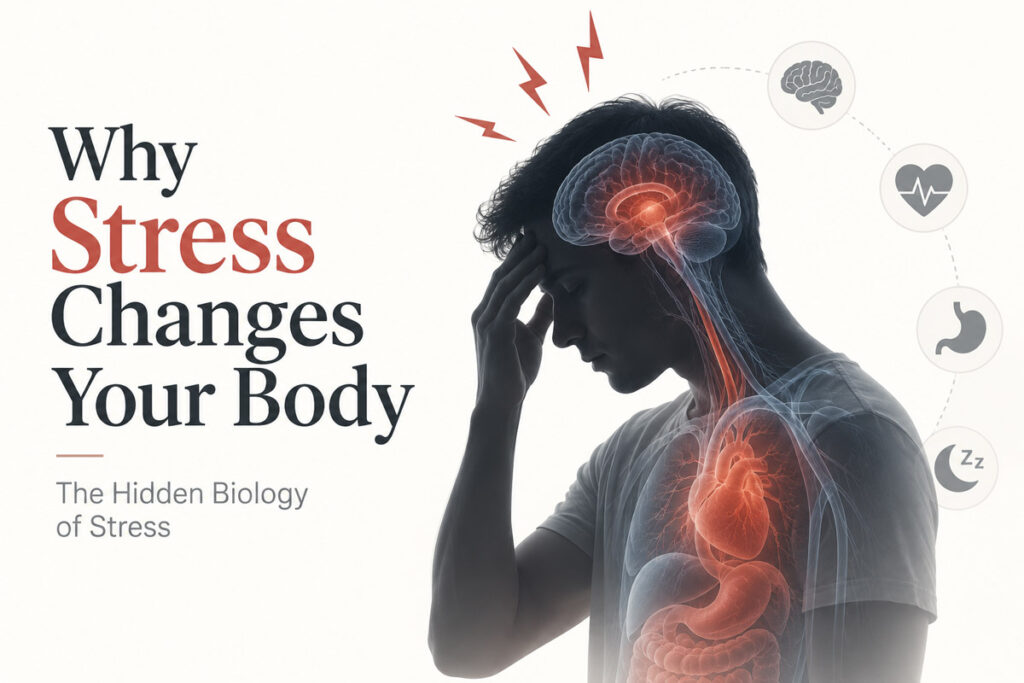
Your heart pounds before an exam result loads. Your stomach knots before a hard conversation. Here’s what your body is actually doing in those moments — and why learning to switch off matters just as much as switching on.
Stress Is More Than a Feeling
You fail an exam you were sure you would pass. You have three hours to finish work that should have taken a whole day. Your boss or teacher suddenly scolds you. There is a financial problem at home that you don’t know how to solve. Someone you care about says something that stays in your mind for the rest of the day.
We call all of these things stress. But that word hides more than it explains.
What happened in those moments wasn’t simply an emotion passing through your mind. Your stress response has already begun—your entire body responding, in seconds, to something it perceives as important, threatening or demanding.
That is what makes stress so interesting.
Why does the body react this way in the first place? Why can the same biological response sometimes help us perform, adapt and become stronger, while at other times it leaves us exhausted, restless or unable to switch off?
And perhaps the most important question of all:
What happens when the body doesn’t get the chance to return to calm?
That is where the hidden biology of stress begins.
Stress Exists for a Reason
Long before humans had calendars, deadlines or smartphones, survival often depended on how quickly the body could respond to danger—a predator nearby, a fall, a sudden flood. The body needed a way to shift from ordinary life to action almost instantly.
When it senses danger or a demanding situation, the body begins reorganising itself. The heart beats faster, breathing changes, energy becomes more readily available, and attention narrows towards what matters most. These changes are not a malfunction. They are the body’s way of preparing us to deal with a challenge.
Stress, therefore, is not inherently bad. It is a biological response that helps us meet demands. The World Health Organization’s overview of stress similarly describes stress as a natural response to challenges and threats, while noting that the way we respond to stress matters for our well-being.
But not all stress feels the same.
There is the stress of a hard workout, an intense game, a long day of physical work or even running to catch a bus. And there is the stress that comes from failing an exam, being scolded, having an argument, worrying about money, facing uncertainty, or carrying grief and emotional tension.
These experiences are very different. Yet the body doesn’t have completely separate stress systems for physical and emotional challenges. Many of the same nervous and hormonal pathways can become active in both.
After a hard workout, however, there is usually something important: an ending. You stop exercising. You rest, eat and sleep. The body gets time to repair itself and adapt to the challenge.
Mental and emotional stress may not end so neatly. An argument can be over, yet your mind may continue replaying it. A financial problem doesn’t disappear when you stop thinking about it. A failure may have happened yesterday, but you can still experience the same emotions today.
The event may be over. The stress response may not be.
And this distinction will become central to everything that follows:
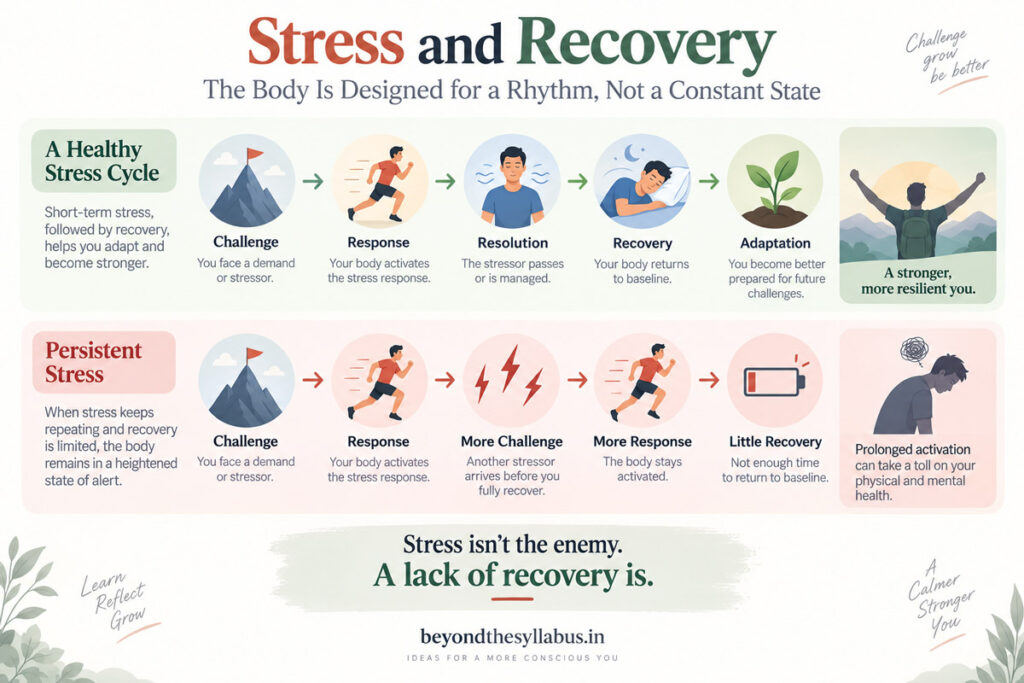
Stress → response → recovery
or
Stress → response → more stress → little recovery
Your body was built to respond to demands. It was also built to come back from them.
What Happens When Your Body Sounds the Alarm
You’re sitting at home one evening when a message arrives that you weren’t expecting. Perhaps it is worrying news about someone you love, or a message from work that immediately makes your stomach sink.
You haven’t decided what to do yet. You may not even have finished reading the message. But your body has already started responding.
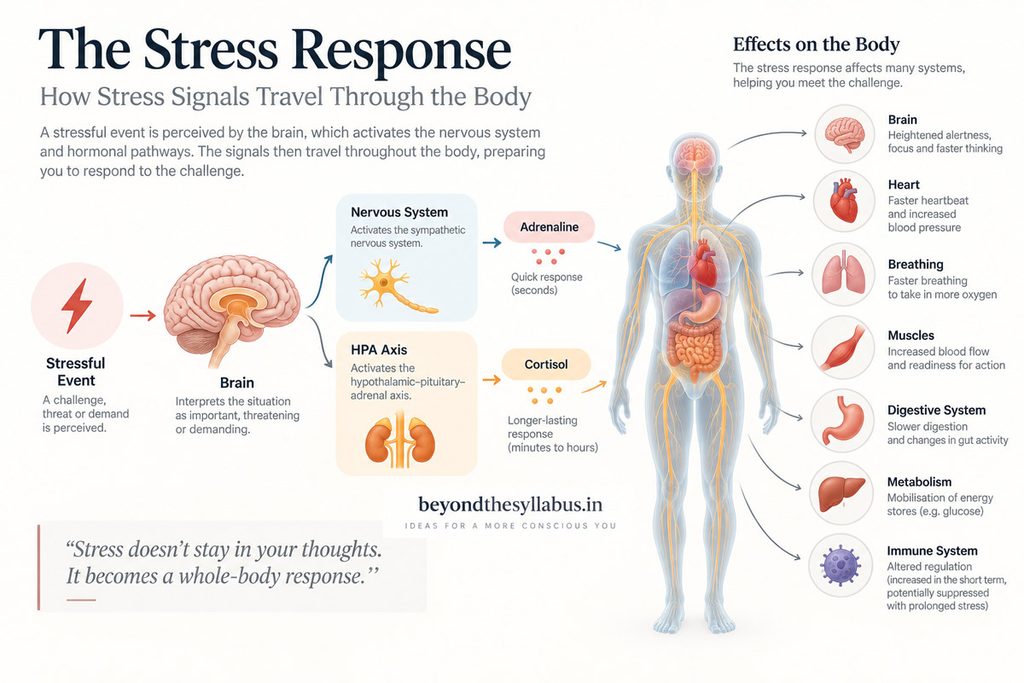
Your brain is constantly evaluating what is happening around you and inside you. When it detects something that could represent danger, pressure or a significant demand, it can trigger the body’s stress response almost immediately.
The first response comes through the nervous system. Signals travel rapidly through the body, increasing alertness and preparing you for action. Your heart rate rises. Your breathing becomes faster. Your muscles become more ready to move. Your attention narrows towards whatever your brain considers important at that moment.
Then comes adrenaline, one of the body’s fastest stress messengers. It helps increase blood flow and energy availability, allowing the body to respond quickly. This is why your heart can start pounding before you’ve even fully processed what has happened.
If the situation passes quickly, the response can settle down soon afterwards. But some problems don’t disappear in seconds. The uncertainty continues. The argument goes on in your head. The financial problem remains. The body now needs a slower system that can help maintain the response for longer.
That is where hormones such as cortisol become important.
So when we casually say fight-or-flight, we’re describing something very real. Your body is physically changing its state—through nerves, hormones, breathing, heart rate and metabolism—to prepare you to deal with a demand.
And importantly, the body can begin this process before you have consciously decided that you are stressed.
The Hidden Language of Stress
Stress doesn’t speak in words. It speaks through nerves and chemical messengers that tell different parts of the body what to do.
Some act within seconds. Others help keep the response going for longer. Five simple ideas explain most of what we need to know.
i Adrenaline — The Emergency Messenger
Adrenaline is one of the body’s fastest stress messengers. It can make your heart beat faster, your breathing change and your attention sharpen within seconds.
That sudden rush you feel when something frightening happens is part of this response. Adrenaline is built for the immediate moment. When the danger passes, its effects can settle down.
ii. Cortisol — The Longer-Range Manager
If the demand lasts longer, another hormone becomes important: cortisol.
It helps keep energy available and helps the body manage a prolonged challenge. So cortisol isn’t simply a “bad stress hormone.” Your body needs it.
The problem is not cortisol itself.
The problem is when the stress response keeps asking for it, again and again, without enough recovery.
iii. The HPA Axis — The Communication Chain
Cortisol doesn’t appear randomly. It is part of a communication chain between the brain, pituitary gland and adrenal glands, known as the HPA axis.
You don’t need to remember the name. The important idea is that stress is a coordinated conversation between different parts of the body, not a single switch being turned on.
iv. Allostatic Load — When Stress Adds Up
One stressful day is very different from months of poor sleep, financial pressure, work demands and unresolved emotional tension.
When the body has to keep adjusting to demands without enough time to recover, the physiological burden can begin to accumulate.
Scientists call this allostatic load. In simple terms, it is what happens when the body’s demands keep piling up faster than its opportunities to recover.
v. The Brain Is Part of the Story Too
The brain doesn’t just start the stress response. It also experiences repeated stress.
When stress keeps returning without enough recovery, it can affect things such as attention, memory, mood and sleep.
So stress doesn’t remain inside your thoughts.
The signals travel through the body. And that takes us to the next question: what exactly happens to the heart, metabolism, immune system, gut and sleep when stress keeps showing up?
When Stress Travels Through the Body
Stress may begin with a thought, a situation or an emotion, but the response doesn’t stay in the brain. The same signals that prepare you to deal with a challenge can affect many other parts of the body. The American Psychological Association’s overview of how stress affects health describes how prolonged activation of the stress-response system can influence processes across the body, including the cardiovascular, digestive and sleep systems.
The Heart
You already know this one from experience. Your heart pounds before an important conversation, an exam or a frightening moment.
That’s the body increasing circulation and preparing you for action. An occasional rise in heart rate is a normal part of the stress response. The concern is when the body is repeatedly pushed into this alert state without enough time to settle.
Metabolism
Stress also changes how your body handles energy.
When you need to act quickly, making more energy available makes sense. But if the stress comes from sitting at a desk worrying about money, work or an argument, you aren’t necessarily using that extra energy to run or fight.
Occasionally, this is no problem. When the pattern becomes frequent and prolonged, it can affect how the body manages energy and blood sugar.
The Immune System
Your immune system listens too.
Short-term stress can temporarily prepare the body’s defences for a possible challenge. But prolonged stress can disturb this balance and is associated with less favourable patterns of immune regulation.
Once again, duration matters.
The Gut
Then there is the gut—the place where many people have already felt stress without knowing why.
Your stomach may knot before an exam. Your appetite may disappear during grief. An argument may send you rushing to the bathroom.
These aren’t just figures of speech. The brain and gut are in constant communication, and stress can influence digestion, gut sensitivity and other aspects of gut function.
This is one reason we explored the subject more deeply in Your Gut Is Smarter Than You Think.
Sleep
And finally, sleep.
To sleep properly, the body has to move away from a state of alertness. But when worries keep circling, conversations keep replaying or tomorrow’s problems are already occupying your mind, that transition can become difficult.
You can be physically exhausted and still feel as though some part of you hasn’t received the message that the day is over.
We explored the other side of this relationship in Why We Sleep.
Stress, then, doesn’t stay where it started. A problem may begin in your thoughts, but the body’s response can reach your heart, metabolism, immune system, gut and sleep.
And that raises an important question:
Why does modern life seem so good at keeping this system switched on?
Why Modern Stress Feels Different
Think about an ordinary day.
You wake up and check your phone. There are work messages, family messages and reminders about things that need to be done. Then come traffic, deadlines, unfinished work, financial worries, social media and perhaps a difficult conversation waiting in the background of your mind.
None of these things may be dangerous in the traditional sense. Yet your body can respond to many of them as demands that require attention.
The difference is that many modern stressors don’t have a clear ending.
If you narrowly escape an accident, the danger passes. Your body can gradually recognise that you are safe again. But an unpaid bill can remain a problem tomorrow. A difficult email can sit unanswered. A disagreement can replay in your mind long after the conversation has ended. A deadline can follow you home through your phone.
The stressor may not be physically present anymore, but your mind can keep bringing it back.
And this is one of the strange mismatches of modern life.
Our surroundings have changed enormously, but the basic stress machinery inside us still works through the same fundamental biological principles: detect a demand, prepare to respond, and return towards normal when the demand is over.
Modern life gives us plenty of reasons to switch on.
It doesn’t always give us clear signals to switch off.
That doesn’t mean modern stress is imaginary, or that life in the past was somehow easier. It means that many of today’s pressures are persistent, abstract and difficult to physically resolve.
And when demands keep arriving before the body has had enough time to recover, something important begins to happen.
Stress starts to accumulate.
The Real Problem Isn’t Stress — It’s the Lack of Recovery
Think again about a hard workout.
Your heart is pounding, your muscles are working hard and your breathing is heavy. Your body is under genuine stress. But then you stop. You drink some water, eat, rest and eventually sleep.
The challenge has an ending.
Over the next few hours and days, your body repairs itself and adapts to what it experienced. This is how stress can actually make the body stronger. The challenge creates the signal; recovery allows the body to respond to it.
Mental stress can be harder to finish.
An argument may end, but you keep replaying it. A difficult workday may be over, but messages continue arriving. You may fail at something once, yet keep reliving that failure in your mind. A financial problem can remain unresolved even when you are sitting quietly at home.
The original event has ended, but your mind can keep sending reminders that something is still wrong.
This is why the goal cannot be to eliminate stress from life. Some stress is unavoidable, and some of it is useful. What matters is whether the body gets enough opportunity to come back towards its normal state afterwards.
Think of it as a rhythm:
Challenge → Response → Resolution → Recovery → Adaptation
The problem begins when the rhythm starts looking more like this:
Challenge → Response → More challenge → More response → Little recovery
That is when stress can stop being a temporary response and start becoming a persistent background state.
We often imagine a healthy life as one without pressure, difficulty or discomfort. But the body doesn’t need a life without challenges. It needs a life in which challenges are followed by recovery.
Recovery isn’t what happens after the important part is over. Recovery is part of the important part.
Can You Teach the Body to Switch Off?
If stress is a normal part of life, then trying to eliminate every source of it is neither possible nor necessary. The more useful question is whether we can give the body enough opportunities to recognise that the demand has ended.
And recovery doesn’t always begin with simply telling yourself to “calm down.” The body responds to what is actually happening around and within it. Sleep, physical activity, slower breathing, time outdoors, meaningful conversations and periods away from constant notifications can all help create a shift away from continuous alertness.
Think about what happens after a stressful day. A quiet walk, a workout, a conversation with someone you trust, or simply lying down without a screen demanding your attention can feel different from merely telling yourself that you should relax. They give the body and mind some space in which the demand is no longer constantly being renewed.
There is also a reason exercise keeps appearing in this story. A workout creates a controlled physical challenge, but it also has something many modern stressors lack: a clear beginning and an unmistakable end. You push the body, stop, and then recover.
The goal, therefore, isn’t to build a life where nothing stressful ever happens.
It is to give your body enough experiences of challenge followed by recovery that being switched on doesn’t become its permanent state.
Small Everyday Habits That Give Your Body a Chance to Recover
You don’t need to redesign your entire life to give your body more opportunities to recover. Often, the useful changes are much smaller: creating a little more space between one demand and the next.
Sleep is one of the most important places to start. A body that is repeatedly asked to stay alert needs periods of genuine rest. Protecting your sleep may mean resisting the temptation to trade another hour of scrolling or unfinished work for the time your body needs to recover.
Movement matters too. It doesn’t always have to be another hard workout. A walk, some stretching, playing a sport or simply getting up regularly can give the body a chance to move rather than carrying the physical tension of an entire day.
Then there is space from constant stimulation. Notifications, messages and endless feeds keep giving the brain something new to process. Even short periods without them can create a small but meaningful gap in the stream of demands.
Predictable pauses can help as well. A quiet cup of tea, a walk after work, eating without your phone, or simply sitting for a few minutes without trying to accomplish anything may seem insignificant. But recovery doesn’t always need to be dramatic. Sometimes the body simply needs to know that, for the next few minutes, nothing is being demanded from it.
And don’t underestimate people. A conversation with someone you trust, time with family or friends, laughter, affection and the feeling of being understood can all make a difficult day feel less like something you have to carry alone.
None of these habits can remove stress from life. Nor should that be the goal.
The goal is simpler:
Don’t let stress become the permanent background setting of your body. Give it moments when the demand ends, the alertness can settle, and recovery can begin.
Your Body Is Trying to Protect You
Go back to the situations we started with: the failed exam, the impossible deadline, the harsh words, the financial worry. The racing heart, tense muscles, restless mind and uneasy stomach can feel like your body is working against you.
But it isn’t.
Your body is responding to something it believes matters. Stress is an ancient protective system, built to help you meet challenges. Sometimes the challenge is physical. Sometimes it is emotional. Sometimes it exists mainly in your thoughts.
The problem isn’t that this system switches on. It is supposed to. The problem begins when it gets very few chances to switch back off.
A healthy stress response has a rhythm:
Challenge → Response → Recovery → Adaptation
You face something demanding. Your body responds. The demand ends. You recover. And sometimes, you come out of the experience better prepared for the next challenge.
Modern life can interrupt that rhythm. One demand follows another. A notification becomes another worry. A difficult conversation keeps replaying. Work follows you home. Even when nothing is happening, the mind can keep something going.
Your body was built to handle storms.
It was never meant to live permanently inside one.
A healthy life isn’t a life without stress. It is a life in which stress, once it has done its job, has somewhere to end.
Continue Reading
If this article made you curious about how the body responds, adapts and recovers, you may also enjoy:
→ The Science of Exercise: How Movement Changes Your Body
How physical activity acts as a biological signal, changing muscles, metabolism, mitochondria and even the brain.
→ Why We Sleep: The Hidden Science of the Hours That Heal Us
Why sleep is far more than rest—and how the body uses those quiet hours to repair, regulate and restore itself.
→ Your Gut Is Smarter Than You Think: Why Digestion Shapes More Than Your Stomach
How the gut communicates with the brain and influences far more than digestion.
Frequently Asked Questions (FAQs)
1. Is all stress harmful?
No. Stress is a normal biological response to demands and can be useful in the right circumstances. Short-term stress can help you become more alert, mobilise energy and respond to a challenge. The bigger concern is repeated or prolonged stress without enough recovery.
2. Is physical stress healthier than mental stress?
Not automatically. A hard workout is a form of physical stress, but it can be beneficial when followed by adequate recovery. Mental and emotional stress can also be temporary and manageable. What matters greatly is how intense and prolonged the stress is, and whether the body gets a chance to recover afterwards.
3. Why does stress make my heart beat faster?
When your brain detects a threat or significant demand, the stress response prepares your body for action. Adrenaline helps increase heart rate and makes more energy available. This is useful when you need to respond quickly, even though the “threat” today might simply be an exam, argument or difficult message.
4. Can stress affect digestion?
Yes. The brain and digestive system are in constant communication, so stress can influence digestion and gut sensitivity. This is why stress can sometimes feel like a knot in the stomach, change appetite or even cause an urgent need to use the bathroom.
5. What is cortisol?
Cortisol is a hormone that helps the body manage longer-lasting demands. It helps maintain energy availability and plays roles in metabolism and immune regulation. Despite being called the “stress hormone,” cortisol itself is not bad—the problem can arise when the stress response remains activated for too long.
6. What is allostatic load?
Allostatic load refers to the cumulative physiological burden that can develop when the body repeatedly has to adapt to stress without enough opportunity for recovery. It is less about one particularly stressful day and more about the effects of repeated demands that consistently outpace recovery.
7. How can I help my body recover from stress?
There is no single switch that turns stress off. Regular sleep, physical activity, periods away from constant stimulation, meaningful social connection and time to genuinely relax can all create opportunities for recovery. The goal isn’t to eliminate every source of stress, but to make sure stress has enough opportunities to end.