
Most of us think of sleep as the part of the day when everything stops.
We close our eyes, drift into unconsciousness, and wake up several hours later, hoping to feel refreshed. Because we are unaware of what happens during those hours, it’s easy to assume that sleep is simply the body’s way of taking a break.
Yet the science of sleep tells a very different story.
While we sleep, the brain strengthens memories, clears away waste, and prepares itself for another day of learning. Cells repair damaged components, hormones help regulate growth and metabolism, the immune system carries out vital maintenance, and countless biological processes quietly work through the night. Far from being a period of inactivity, sleep is one of the busiest and most carefully coordinated states the human body enters each day.
Despite spending nearly one-third of our lives asleep, scientists are still uncovering why sleep is so essential. What once seemed like empty hours are now understood as a time when the body repairs, restores, and prepares for the future in ways that waking life simply cannot replace.
Understanding sleep, therefore, doesn’t begin with asking how many hours we need. It begins by understanding the science of sleep in an entirely new way.
Why We Think Sleep Is Just Rest
From an early age, we learn that sleep is something we need to stay healthy. Parents remind children to go to bed on time, doctors recommend getting enough sleep, and nearly everyone has experienced feeling tired after a restless night. Yet despite spending almost one-third of our lives asleep, few of us truly understand the importance of sleep.
Much of what we learn about sleep is surprisingly simple. We are told that the body becomes tired after a long day, falls asleep to recover, and wakes up ready to begin again. While this explanation isn’t wrong, it leaves out almost everything that makes sleep remarkable.
Unlike eating, exercising, or working, sleep appears unproductive. We cannot think clearly, move with purpose, or respond to the world around us. From the outside, the body seems quiet and inactive, as though it has temporarily switched itself off.
Looking back, it’s understandable why so many of us think of sleep as “doing nothing.” Modern science, however, tells a very different story.
Far from shutting down, the sleeping body becomes extraordinarily active. The brain reorganises memories, cells begin important repair work, hormones are carefully regulated, and biological systems across the body work together in ways that are difficult to observe while we are awake. Some of the most essential processes that keep us healthy happen not during our busiest hours, but during the hours when we appear to be doing nothing at all.
Seeing sleep as simple rest is a little like looking at a busy city from space at night. From a distance, everything appears calm. But beneath that quiet surface, millions of lights remain on, countless people continue working, and vital systems keep the city alive until morning.
Sleep works in much the same way.
To understand why it is so essential, we first need to see what is really happening once we close our eyes.
What Really Happens While We Sleep
If sleep simply made us unconscious, it would be one of evolution’s greatest mistakes.
A sleeping animal cannot search for food, defend itself, or escape danger as effectively as one that is awake. Yet sleep is nearly universal across the animal kingdom. Birds sleep, mammals sleep, reptiles sleep, and even tiny fruit flies and worms exhibit sleep-like states. For hundreds of millions of years, evolution has preserved a behaviour that appears to make living creatures more vulnerable.
That alone suggests sleep must offer benefits so essential that life could not thrive without it. Modern research and the science of sleep confirm exactly that.
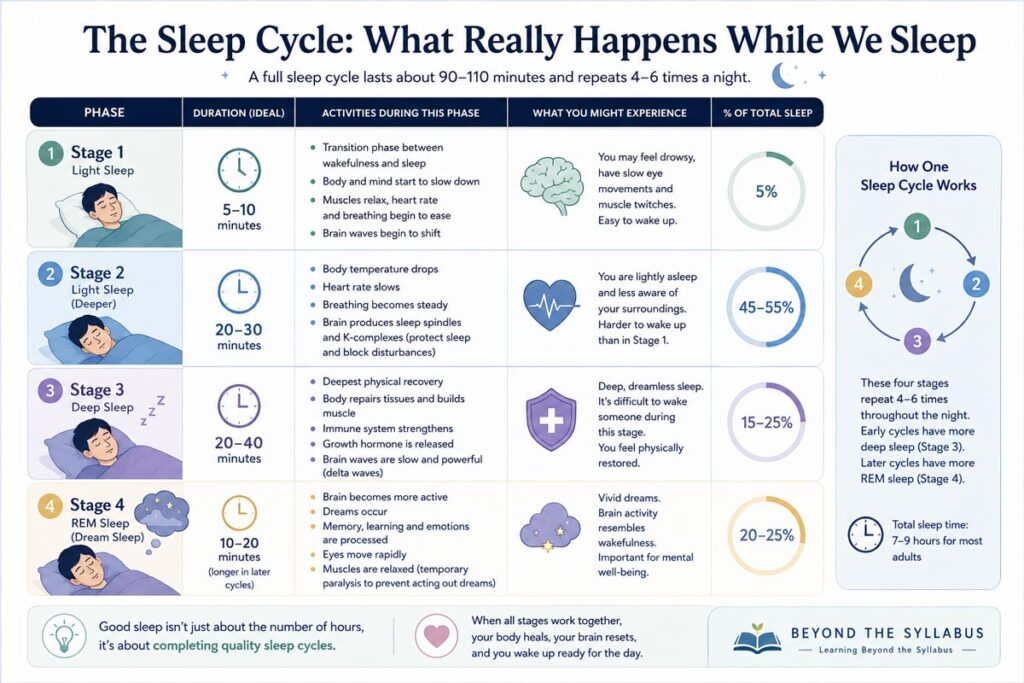
Sleep is not a single, uniform state. Instead, the sleep cycle is a carefully organised sequence that the brain repeats several times each night. As we sleep, we move through different stages, each with its own purpose. Some stages are characterised by deep, slow brain waves that allow the body to repair tissues, restore energy, and support physical recovery. Others are marked by rapid eye movements, vivid dreams, and intense brain activity associated with learning, memory, and emotional processing.
Rather than switching off, the brain remains remarkably active throughout the night. Different regions communicate with one another, important memories are strengthened, unnecessary information is filtered away, and biological systems prepare the body for the challenges of the following day. At the same time, cells repair themselves, hormones are released in carefully timed patterns, and the immune system continues its quiet work behind the scenes.
This constant cycle of restoration explains why a full night’s sleep feels so different from simply lying awake in bed. Rest alone cannot replace sleep because the body isn’t merely relaxing—it is carrying out a complex programme of maintenance that depends on passing through these natural stages in the right order.
The more scientists study sleep, the clearer it becomes that its greatest purpose is not simply to help us recover from today.
It is to prepare us for tomorrow.
Before we explore how sleep transforms the brain, it’s worth looking at some of the remarkable biological processes that quietly unfold every night—many of which have only been discovered in recent decades.
The Hidden Work of Sleep
For centuries, people judged sleep by what they could see.
A sleeping person lies still. Their breathing slows, their eyes remain closed, and the outside world grows quiet. It seems as though the body has pressed a pause button until morning.
The science of sleep has revealed something entirely different.
Beneath that calm exterior, billions of cells continue working. The brain clears away waste, memories are reorganised, hormones follow carefully timed rhythms, and countless repair processes unfold without any conscious effort. Many of these discoveries are surprisingly recent, reminding us that even something as familiar as sleep still holds remarkable mysteries.
Here are some of the extraordinary processes that make sleep one of the busiest periods of every day.
Circadian Rhythm: The Body’s Master Clock
Sleep is governed not only by tiredness but also by time.
Deep within the brain lies a tiny group of nerve cells called the suprachiasmatic nucleus (SCN), often described as the body’s master clock. Using light entering our eyes as its primary signal, this clock synchronises nearly every organ with the 24-hour cycle of day and night.
As evening approaches, the brain begins releasing melatonin, a hormone that signals the body that it is time to prepare for sleep. In the morning, exposure to natural sunlight helps reset this clock, promoting alertness and keeping the sleep–wake cycle in balance.
When this rhythm is repeatedly disrupted—by irregular schedules, late-night screen use, or shift work—the body struggles to coordinate many of its normal biological functions. Good sleep, therefore, is not only about getting enough hours; it is also about sleeping at the right time.
The Glymphatic System: The Brain’s Overnight Cleaning Crew
For many years, scientists wondered how the brain removed the waste products generated by billions of active nerve cells.
The answer turned out to be surprisingly elegant.
During sleep, a specialised network known as the glymphatic system becomes far more active. Cerebrospinal fluid flows through brain tissue, helping wash away metabolic waste that accumulates during the day. This nightly cleaning process is thought to play an important role in maintaining healthy brain function over the long term.
Just as a city depends on workers who clean its streets after everyone has gone home, the brain appears to carry out much of its housekeeping while we sleep.
Autophagy: The Body’s Cellular Housekeeping
Sleep also supports the body’s ongoing work of repair at the cellular level.
One important process involved is autophagy, a word that literally means “self-eating.” During autophagy, cells identify and break down worn-out proteins, damaged structures, and other unwanted materials, recycling many of their components for future use. Rather than being harmful, this is one of the body’s natural ways of maintaining healthy cells.
Scientists continue to study how healthy sleep supports these repair processes, alongside other factors such as fasting, regular physical activity, and the body’s natural daily rhythms. Although autophagy is only one part of a much larger picture, it offers another reminder that sleep is far more than a period of inactivity.
Memory Replay: Learning Doesn’t Stop When You Fall Asleep
Learning does not end when we close our books or leave the classroom.
Evidence suggests that during sleep, the brain revisits patterns of activity created while we were awake. Important experiences are strengthened, useful information is organised, and many new memories become more stable. At the same time, less important details may gradually fade, preventing the brain from becoming overwhelmed by everything it encounters each day.
In many ways, sleep is not simply a break from learning.
It is the final chapter of every day of learning.
Hormones and Immunity: Preparing for Tomorrow
Sleep is also a time of careful biological coordination.
Hormones involved in growth, metabolism, stress, and appetite follow natural daily rhythms that depend on healthy sleep. The immune system uses this time to strengthen its responses, repair damaged tissues, and prepare the body to face future infections. Even our sense of hunger the following day can be influenced by how well we slept the night before.
Every good night’s sleep is, in many ways, an investment in the following day.
The Brain’s Night Shift
One of the most fascinating discoveries in the science of sleep is that although every organ benefits from healthy sleep, the brain may be the busiest of them all.
Throughout the day, the brain is constantly processing information. Every conversation, decision, emotion, sound, image, and experience leaves behind tiny patterns of neural activity. By the time we go to bed, billions of nerve cells have been working continuously for hours.
Sleep gives the brain an opportunity to organise this extraordinary amount of information.
Rather than storing every experience equally, the brain appears to sort through the day’s events. Important memories are strengthened, useful skills become more stable, and emotional experiences are gradually processed. This is one reason why students often remember information better after a good night’s sleep than after staying awake to study for longer. Sleep doesn’t simply preserve learning—it helps complete it.
But the brain’s work extends beyond memory.
Sleep also helps maintain attention, decision-making, creativity, emotional balance, and problem-solving. Many people have experienced waking up with a fresh perspective on a difficult problem or finding that a solution becomes clearer after “sleeping on it.” While sleep is not a magical source of inspiration, it provides the brain with time to reorganise information in ways that are difficult to achieve during the constant demands of waking life.
The opposite is equally revealing.
Even a single night of poor sleep can reduce concentration, slow reaction times, impair judgement, and make emotions harder to regulate. Tasks that normally feel simple may require greater effort, and small frustrations can seem much larger than they really are. Over time, chronic sleep deprivation affects not only how well we think but also how we feel.
Seen from this perspective, sleep is not a pause in the brain’s activity.
It is the time when the brain prepares itself to think, learn, adapt, and function at its best.
Before we understand what happens when sleep is lost, we first need to appreciate that these changes are not limited to the brain alone. Almost every organ in the body depends on healthy sleep in ways that scientists are still uncovering.
Why Sleep Affects Almost Every Organ
Sleep is often associated with the brain, but its influence extends far beyond our thoughts and memories.
Nearly every organ in the body follows a daily rhythm that depends, in some way, on healthy sleep. From the heart and immune system to the liver, muscles, and digestive tract, countless biological processes are carefully timed to work in harmony with the body’s natural sleep–wake cycle.
The cardiovascular system, for example, uses sleep as a period of recovery. Heart rate and blood pressure typically fall during healthy sleep, giving the heart and blood vessels time to rest after the demands of the day. Night after night, this regular pattern helps maintain cardiovascular health over the long term.
The immune system is equally active. While we sleep, immune cells communicate, repair damaged tissues, and strengthen the body’s ability to recognise and respond to future infections. This is one reason why adequate sleep is associated with better resistance to illness and a more effective response to vaccination.
Sleep also plays an important role in regulating metabolism and appetite. Hormones that influence hunger and fullness are closely linked to sleep, which helps explain why even a few nights of insufficient sleep can leave people feeling hungrier, craving energy-dense foods, and finding it harder to make healthy dietary choices.
Our digestive system follows its own daily rhythm as well. The gut microbiome, digestive hormones, and the communication between the gut and the brain all depend on a stable sleep schedule. When sleep becomes irregular, this delicate balance may also be disrupted, reminding us that good digestion begins with more than just what we eat.
Even our muscles, bones, and connective tissues rely on sleep. Much of the body’s repair, growth, and recovery occurs during the night, making healthy sleep just as important for physical recovery as proper nutrition and exercise.
Seen together, these effects reveal the true importance of sleep for every organ in the body.
Sleep is not something the brain does for the body.
It is something the entire body depends upon.
When we consistently neglect sleep, we are not depriving just one organ of rest—we are disrupting a biological partnership that nearly every cell has evolved to rely on.
Before long, the consequences begin to appear.
The Cost of Modern Sleep Deprivation
For most of human history, the rising and setting of the sun largely determined when people slept.
As daylight faded, evenings became quieter. Artificial light was limited, entertainment ended naturally, and most people followed a rhythm that remained closely connected to the cycle of day and night.
Today, that rhythm has changed dramatically.
Electric lighting allows us to turn night into day. Smartphones, streaming platforms, social media, and round-the-clock work schedules make it easier than ever to stay awake long after the body is ready for sleep. In many cultures, sleeping less is even seen as a sign of ambition or productivity.
Our biology, however, has not evolved nearly as quickly as our technology.
When healthy sleep becomes the exception rather than the routine, the effects often appear gradually. We may feel more tired during the day, struggle to concentrate, become less patient, or rely increasingly on caffeine to stay alert. Because these changes develop slowly, many people begin to accept them as normal parts of modern life.
Over time, the consequences extend far beyond feeling sleepy.
Research in the science of sleep has linked long-term sleep deprivation with an increased risk of cardiovascular disease, obesity, type 2 diabetes, depression, anxiety, and reduced immune function. Poor sleep also affects reaction time, decision-making, emotional regulation, and learning, influencing everything from workplace performance to road safety and everyday relationships.
One common misconception is that the body eventually adapts to getting less sleep.
In reality, most people adapt only to the feeling of being tired. Their performance, attention, and judgement often continue to decline even as they become less aware of the impairment. In other words, we may believe we are functioning normally while our brain and body quietly pay the price.
Perhaps the greatest cost of chronic sleep deprivation is not what it does in a single night.
It is what it does after months or years of treating good sleep as something optional.
Modern life has given us the ability to postpone sleep almost indefinitely.
Unfortunately, our biology has never learned how to postpone its need for it.
Can You Catch Up on Lost Sleep?
After several nights of poor sleep, many people promise themselves the same thing:
“I’ll make up for it this weekend.”
The idea seems logical. If we lose a few hours of sleep during the week, surely we can repay that “sleep debt” by sleeping longer later.
The reality is more complicated.
Our bodies can recover from short-term sleep loss to some extent. After one or two nights of inadequate sleep, getting extra rest often improves alertness, mood, reaction time, and cognitive performance. This is one reason why a good night’s sleep after a particularly exhausting day can feel remarkably restorative.
However, sleep is not like money in a bank account that can simply be withdrawn and repaid whenever convenient.
Many of the biological processes that occur during healthy sleep depend on regular, consistent cycles. When sleep is repeatedly shortened for weeks, months, or even years, extending sleep on weekends cannot fully recreate the benefits of maintaining a healthy sleep routine every night.
This is why researchers often encourage people to think less about catching up on sleep and more about protecting it in the first place.
Another common belief is that people can train themselves to need less sleep.
For the overwhelming majority of us, this simply isn’t true.
A very small number of people carry rare genetic variations that allow them to function well with significantly less sleep. They are the exception, not the rule. Most people who regularly sleep too little do not become biologically adapted—they simply become accustomed to feeling tired, while their concentration, judgement, reaction time, and overall health continue to suffer.
The good news is that the body is remarkably resilient.
Even modest improvements in healthy sleep habits can begin to restore energy, improve mood, sharpen thinking, and support healthier biological rhythms. While years of poor sleep cannot always be erased overnight, every consistently good night’s sleep gives the body another opportunity to repair, recover, and prepare for the day ahead.
The goal, therefore, is not to achieve perfect sleep every single night.
It is to build a pattern of healthy sleep that the body can depend on.
Small Everyday Habits That Improve Sleep
Building healthy sleep habits rarely depends on one perfect habit, one expensive gadget, or one miracle solution.
Instead, it is usually the result of small, consistent choices that allow the body’s natural sleep mechanisms to work as they were designed to. The goal is not to force sleep, but to create an environment in which sleep arrives naturally.
One of the most effective habits begins shortly after waking.
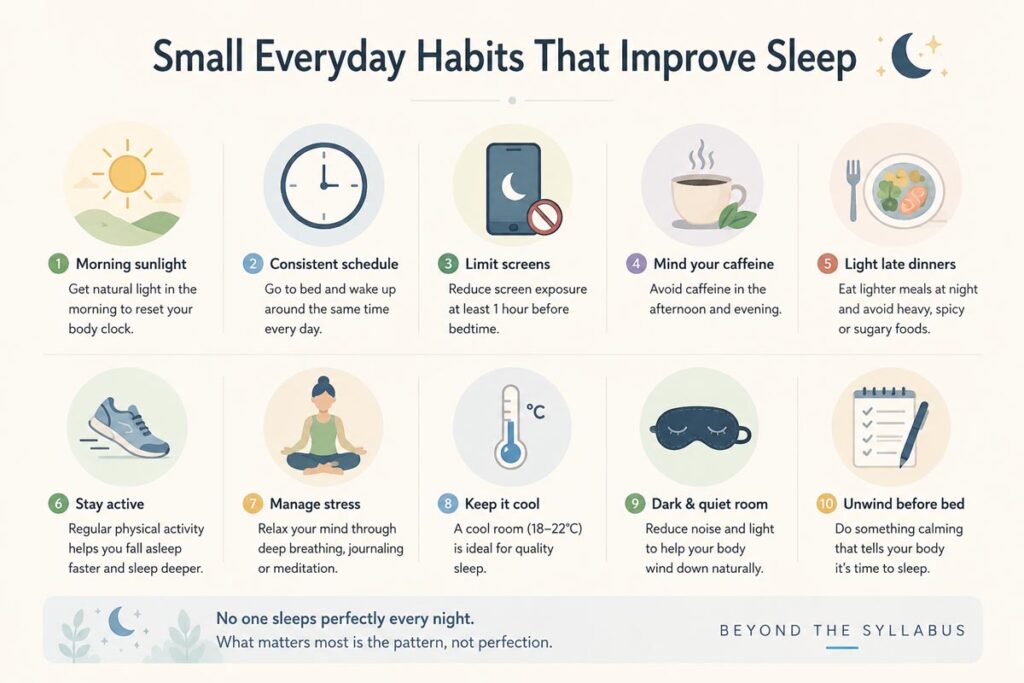
Get regular exposure to natural morning sunlight. Light is the strongest signal for the body’s circadian rhythm, helping reset the internal clock each day and making it easier to feel sleepy when night arrives. Even a short walk outdoors in the morning can make a meaningful difference.
Keeping a consistent sleep schedule is equally important. Going to bed and waking up at roughly the same time each day helps reinforce the body’s natural rhythm. While occasional late nights are part of life, an irregular schedule can make it harder for the brain and body to anticipate when it is time to sleep.
The hours before bedtime matter too.
Reducing exposure to bright screens, avoiding heavy meals late at night, and limiting caffeine in the afternoon or evening can all make it easier for the body to transition into sleep. These habits do not work because they are strict rules, but because they reduce signals that tell the brain to remain alert.
Regular physical activity also supports healthier sleep. Exercise helps regulate the body’s internal clock, improves sleep quality for many people, and contributes to overall physical and mental well-being. Like sleep itself, however, consistency is usually more important than intensity.
A calm sleeping environment can make a surprising difference. A cool, dark, and quiet bedroom helps remove unnecessary distractions, allowing the brain to move more easily through its natural sleep cycle.
Finally, it is worth remembering that no one sleeps perfectly every night.
Stress, travel, illness, work, or major life events can occasionally disrupt even the healthiest sleep routine. What matters most is not chasing perfect sleep every single night, but returning to healthy habits as consistently as possible.
Your body has spent millions of years learning how to sleep.
Sometimes, the best thing we can do is simply stop getting in its way.
Conclusion
We spend nearly one-third of our lives asleep, yet for much of history we understood surprisingly little about what those hours were truly for. What once appeared to be a period of inactivity has gradually revealed itself as one of the most biologically important parts of every day.
While we sleep, the brain organises memories, clears away waste, and prepares itself for new experiences. Cells repair and recycle damaged components, hormones follow carefully timed rhythms, the immune system strengthens its defences, and countless processes work together to keep the body healthy. Far from switching off, the body quietly performs some of its most essential work.
Perhaps the most remarkable lesson about the importance of sleep is that health is not built only by what we do while we are awake. The choices we make during the day — including healthy sleep habits — certainly matter, but so do the hours when we allow the body to repair, restore, and prepare for tomorrow.
In a world that often celebrates staying busy, working longer, and sleeping less, it is easy to think of sleep as time lost.
Science of sleep tells a very different story.
Sleep is not a pause in life.
It is one of the ways life quietly sustains itself.
The greatest discoveries do not always reveal something entirely new.
Sometimes, they simply help us see the ordinary with new eyes.
Sleep is one of those discoveries.
Continue Reading
If you enjoyed this article, you might also like:
- Health Beyond the Syllabus: What School Never Taught Us About Staying Healthy
- Your Gut Is Smarter Than You Think
- Your Body Was Designed to Move (Coming Soon)
- Food Beyond Calories: What We Eat Shapes More Than Our Weight (Coming Soon)
Beyond the Syllabus
We thought sleep was the end of the day.
Science revealed it’s where tomorrow quietly begins.
The most extraordinary work often happens unseen.
And that’s learning beyond the syllabus.
Frequently Asked Questions (FAQs):
1. How many hours of sleep do adults need?
According to the science of sleep, most healthy adults need 7 to 9 hours of sleep per night. However, sleep needs vary slightly from person to person depending on age, genetics, lifestyle, and overall health. Consistently getting enough quality sleep is generally more important than aiming for a specific number every night.
2. Why do we feel tired even after sleeping for 8 hours?
Feeling tired despite sleeping long enough may result from poor sleep quality, an irregular sleep schedule, stress, certain medical conditions, or sleep disorders such as sleep apnoea. The number of hours slept is only one part of healthy sleep; uninterrupted, restorative sleep matters just as much.
3. What happens to the brain while we sleep?
During each sleep cycle, the brain helps strengthen important memories, processes emotions, clears away metabolic waste through the glymphatic system, and prepares itself for learning and decision-making the following day. Rather than shutting down, the brain remains highly active throughout the night.
4. Can you catch up on lost sleep?
Extra sleep after a few nights of poor rest can improve alertness and reduce some effects of short-term sleep deprivation. However, regularly sleeping too little and relying on weekends to recover cannot fully replace the benefits of consistent, healthy sleep.
5. Can some people naturally sleep less than others?
Yes, but they are exceptionally rare. A small number of people have genetic variations that allow them to function well with less sleep. For most people, regularly sleeping too little leads to reduced concentration, poorer judgement, and long-term health consequences, even if they feel they have adapted.
6. Does using a phone before bed affect sleep?
It can. Bright light, particularly blue-enriched light from screens, may delay the body’s natural release of melatonin, making it harder to fall asleep. In addition, engaging content can keep the brain mentally alert when it should be winding down.
7. Does sleep affect weight and appetite?
Yes. Healthy sleep helps regulate hormones involved in hunger and fullness. Poor sleep may increase appetite, encourage cravings for energy-dense foods, and make maintaining healthy eating habits more difficult.
8. What is the best way to improve sleep naturally?
Building healthy sleep habits, such as maintaining a regular sleep schedule, getting morning sunlight, staying physically active, limiting caffeine late in the day, reducing screen exposure before bedtime, and creating a cool, dark, quiet sleeping environment helps your body complete each sleep cycle more effectively.
9. Is sleeping too much unhealthy?
Occasionally sleeping longer after illness or a period of sleep deprivation is normal. However, regularly sleeping far beyond the recommended amount may sometimes be associated with underlying health conditions. If excessive sleep is persistent and accompanied by other symptoms, it deserves medical evaluation.
10. Why is sleep important if I’m young and healthy?
The importance of sleep begins early in life. Sleep is essential at every stage of life. Even in young, healthy individuals, it supports learning, memory, emotional well-being, physical recovery, immune function, metabolism, and overall long-term health. Investing in good sleep early in life helps lay the foundation for healthier years ahead.