
When we hear the phrase Health Beyond the Syllabus, it almost sounds unusual. After all, health is something every one of us values, yet very few of us were ever taught how to care for it.
We spent years in classrooms learning mathematics, science, history, geography, grammar, and countless other subjects. We memorised formulas, prepared for examinations, and chased marks that seemed to define our future. School taught us how to solve equations, write essays, analyse problems, and eventually build careers.
But somewhere along the way, one of life’s most important subjects never found its place in the classroom.
No one taught us how to understand our own body with the same curiosity that we learnt to understand the world around us. We were rarely shown why sleep deserves as much respect as study, how our gut influences far more than digestion, why stress can quietly affect almost every system in the body, or how movement protects our health long before illness appears.
The irony is difficult to ignore.
We spend nearly fifteen years learning how to earn a living, yet remarkably little time learning how to care for the body that makes that life possible.
Perhaps that’s why many of us begin taking our health seriously only after something goes wrong. A routine blood test reveals high blood sugar. Persistent fatigue refuses to disappear. A doctor advises regular exercise after years of sitting behind a desk, or digestive discomfort becomes so common that we begin to accept it as “normal.” Sleep slowly changes from something we protect into something we sacrifice.
By then, health is no longer a chapter in a textbook. It has become deeply personal.
This isn’t a criticism of schools or teachers. Education has always evolved to prepare us for the world around us, and no curriculum can possibly teach every life skill in depth. But as our lives become increasingly fast-paced, digital, and sedentary, one question feels more relevant than ever:
If health influences almost every aspect of our lives, why do we spend so little time learning how to protect it?
That question marks the beginning of learning beyond the syllabus.
Health is about far more than avoiding illness. It is about understanding the everyday decisions that shape our future—what we eat, how we sleep, how we move, how we respond to stress, and how consistently we invest in our physical and mental well-being. These are the foundations of preventive health, yet they rarely appear in examination papers.
The irony appears once again.
We learn to calculate compound interest before we understand the value of quality sleep. We study the water cycle before anyone explains why hydration matters to our own body. We spend years preparing for careers, yet very little time preparing for the lifelong responsibility of staying healthy.
Perhaps that’s because some of life’s most important lessons were never meant to fit inside a classroom—a philosophy we explore further in What Learning Beyond the Syllabus Really Means.
They begin exactly where the syllabus ends.
What Does It Really Mean to Be Healthy?
If someone asked you to define health in a single sentence, what would your answer be?
For many of us, the answer would probably be simple: “Not being sick.” If we don’t have a fever, aren’t taking medication, and can go about our daily routine without difficulty, we naturally assume we’re healthy. It’s an understandable definition—but it’s also an incomplete one.
True health is surprisingly difficult to notice because, unlike illness, it rarely demands our attention. Health is not merely the absence of disease. In fact, the World Health Organization (WHO) defines health as “a state of complete physical, mental and social well-being and not merely the absence of disease or infirmity.” Beyond that definition, health is also the ability to wake up with energy, think clearly, move freely, enjoy time with family, recover from illness, travel without limitation, and live independently for as long as possible.
Imagine two people with no diagnosed medical condition. One sleeps only five hours a night, survives on processed food, rarely exercises, feels constantly stressed, and wakes up tired most mornings. The other also has no diagnosed illness, but sleeps well, eats nourishing meals, stays physically active, manages stress, and has the energy to enjoy everyday life.
On a medical report, both may appear equally healthy. But beneath the surface, their futures may look very different.
Perhaps that’s one of the greatest misconceptions about health. We often think of it as something we either have or don’t have, when in reality it exists on a spectrum. It isn’t simply the absence of disease; it’s the body’s ability to function, adapt, recover, and support us through the countless moments that make up a meaningful life.
Health allows us to think clearly during an important meeting, play with our children without becoming exhausted, enjoy a holiday without worrying about physical limitations, recover after a demanding week, and grow older with independence rather than dependence. It quietly supports our ambitions, relationships, and experiences long before we ever stop to appreciate its presence.
In many ways, health is like the foundation of a house. We rarely admire the foundation when everything is standing strong. We notice it only when cracks begin to appear. The same is true of our body. Most of the time, it works tirelessly in the background, asking for very little while making almost everything else possible.
That is why modern healthcare increasingly emphasises preventive health. Its purpose isn’t simply to treat disease after it appears, but to preserve health before it begins to fade. The goal isn’t perfection, nor is it about chasing every new wellness trend. It’s about understanding that our body is an investment, not a machine we can neglect until something breaks.
A healthy life isn’t measured by six-pack abs, expensive supplements, or restrictive diets. It’s measured by something far simpler: waking up refreshed, having the energy to enjoy your day, sleeping peacefully at night, recovering well after physical or mental effort, thinking clearly, moving without pain, and living without being constantly reminded by your body that something is wrong.
Perhaps that’s why health is one of life’s greatest paradoxes.
When we have it, we rarely think about it.
When we lose it, it suddenly becomes the only thing we can think about.
And maybe that’s exactly why health deserves a place among the lessons we continue learning long after school has ended.
Why School Never Taught Us How to Stay Healthy
When we look back at our school years, it’s difficult to say that education failed us.
It taught us to read, write, calculate, think logically, understand history, appreciate science, and communicate with confidence. Those lessons opened doors to universities, careers, and opportunities that many of us are grateful for today. Schools have always carried the enormous responsibility of preparing young minds for the future, and no curriculum can possibly teach every lesson life has to offer.
Perhaps that’s why some of the most important lessons are learned much later—through experience, mistakes, and sometimes, through illness itself.
Most of us can still remember studying the human digestive system before an examination. We labelled organs, memorised their functions, and reproduced diagrams that helped us score marks. Yet very few of us were taught what happens when we eat too quickly every day, sleep only five hours a night, or spend years sitting behind a desk with hardly any movement.
We learnt about the human body.
We rarely learnt how to care for it.
The same was true for many other aspects of health. We weren’t taught why chronic stress could quietly affect digestion, why poor sleep influences memory, mood, and productivity, or why something as simple as a daily walk could become one of the best investments in our future. Prevention was mentioned, but rarely explained as a lifelong mindset rather than a medical phrase.
That isn’t because schools ignored health.
It’s because the world we live in today is very different from the one in which many education systems were designed.
A few decades ago, daily life naturally taught many of these lessons. People walked more because they had to. Meals were usually cooked at home. Children spent evenings playing outside instead of sitting in front of multiple screens. Movement, sunlight, and community were woven into everyday life without anyone needing to consciously plan for them.
Modern life has changed that equation.
Today, many of us spend our mornings commuting, our afternoons in front of computers, and our evenings scrolling through phones that compete for our attention until it’s time to sleep. Convenience has made life easier, but it has also made inactivity easier. Food is available within minutes, entertainment is endless, and sleep is often the first thing sacrificed in the name of productivity.
The world changed faster than our understanding of health.
That is why health education feels more important today than ever before—not because previous generations got everything wrong, but because the challenges facing this generation are unlike anything before. Lifestyle diseases, chronic stress, digital overload, and sedentary living are no longer exceptions. For many people, they have quietly become the default.
Knowing how to build a successful career is important.
Knowing how to build a body and mind capable of enjoying that success for decades is equally important.
Maybe the purpose of education was never just to help us earn a living.
Maybe it should also inspire us to learn how to live well.
And perhaps those lessons begin exactly where the syllabus ends.
The Seven Health Lessons Missing From the Syllabus
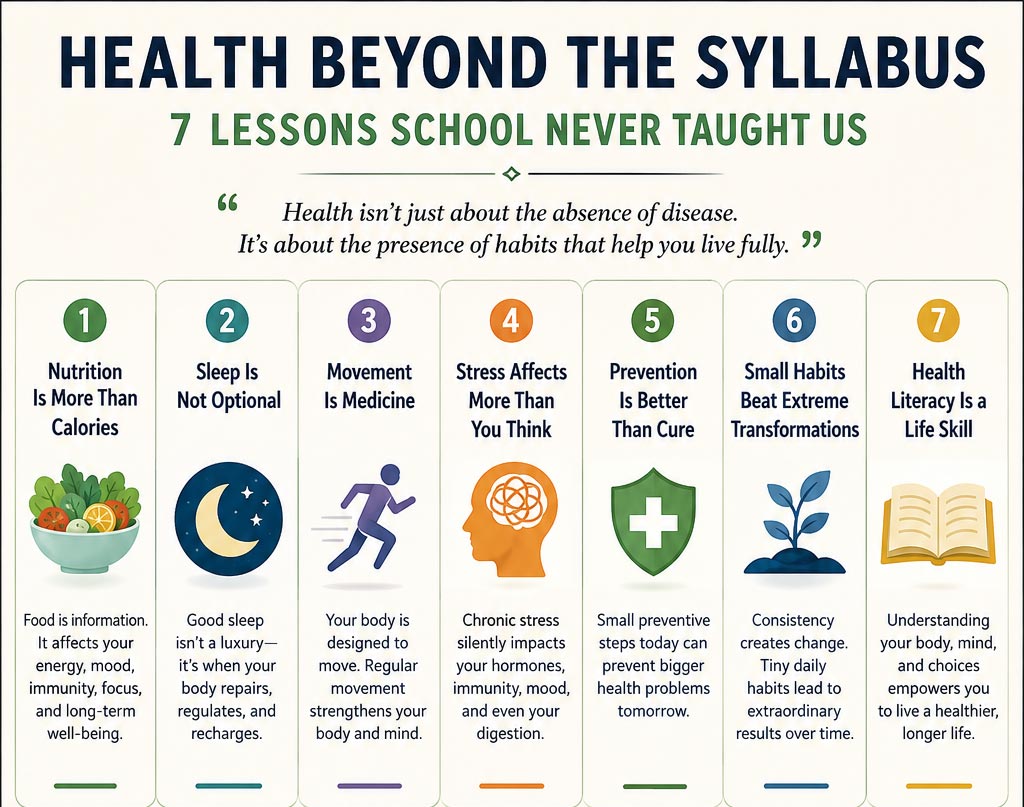
If health had been taught as a subject in school, it probably wouldn’t have been confined to a single textbook or a final examination. It would have been woven into everyday life through lessons that stayed with us long after graduation.
Imagine opening a school timetable and finding a very different set of subjects.
Not another chapter to memorise.
Not another examination to pass.
But lessons designed to prepare you for the one place you’ll live for your entire life—your own body.
Instead of asking students to remember facts for a few hours in an examination hall, these lessons would quietly prepare them for decades of everyday decisions. They wouldn’t promise perfect health or guarantee a disease-free life. Rather, they would help us understand how the body works, why it responds the way it does, and how ordinary choices influence our well-being over time.
Unlike mathematics or history, there are no report cards for these lessons.
Life becomes the examiner.
Every night’s sleep.
Every meal.
Every stressful week.
Every hour spent moving—or sitting still.
Eventually, the results appear not on paper, but in our energy, resilience, relationships, and quality of life.
Perhaps these are the lessons that deserve a permanent place in Health Beyond the Syllabus.
Lesson 1: Food Is More Than Fuel
If school taught us that food is made up of carbohydrates, proteins, fats, vitamins, and minerals, life teaches us something even more important: every meal is a conversation with the body.
Food does far more than satisfy hunger. It provides the raw materials our body uses to produce energy, repair tissues, regulate hormones, strengthen immunity, and even influence our mood. The meals we eat today become the building blocks of the body we live in tomorrow.
Healthy eating doesn’t demand perfection, expensive superfoods, or strict diets. More often, it begins with ordinary choices made consistently—choosing home-cooked meals more often than processed ones, adding more fruits and vegetables to the plate, and eating with attention rather than haste.
Perhaps the greatest lesson isn’t that food gives us energy.
It’s that food quietly shapes the quality of the life that energy allows us to live.
Lesson 2: Why Sleep Is an Investment, Not an Interruption
Many of us grew up believing that sleeping less was a sign of dedication.
Students sacrificed sleep for examinations. Adults sacrifice it for deadlines, entertainment, or endless scrolling. Somewhere along the way, sleep began to look like time lost rather than time well spent.
The body sees it differently.
Sleep is when memories are strengthened, muscles recover, hormones are regulated, and countless repair processes quietly restore what the day has demanded from us. Most adults also need 7–9 hours of quality sleep each night, as recommended by the Centers for Disease Control and Prevention (CDC). A productive tomorrow often begins with a restful night, not another late evening.
We rarely celebrate a good night’s sleep the way we celebrate hard work.
Yet one makes the other possible.
Lesson 3: The Body Was Built to Move
Our ancestors didn’t exercise because they wanted six-pack abs. They moved because movement was woven into everyday life.
Modern life has separated us from that rhythm. We sit to work, travel, study, shop, and relax. Gradually, inactivity becomes so normal that movement begins to feel like a separate task instead of a natural part of living.
Exercise certainly improves fitness, but its benefits reach much further. Walking, climbing stairs, stretching, cycling, gardening, or playing a sport all help protect the heart, strengthen muscles and bones, improve mental well-being, and reduce the risk of many lifestyle diseases.
Movement isn’t simply another item on a to-do list.
It’s one of the most natural expressions of a healthy body.
Lesson 4: Your Gut Is More Than a Digestive System
Most people think about their gut only when it starts complaining.
Acidity.
Bloating.
Constipation.
Stomach discomfort.
Yet digestion is only one part of the story.
Our gut helps absorb nutrients, supports the immune system, and communicates continuously with the brain through what scientists call the gut-brain axis. Researchers are still uncovering just how deeply this relationship influences mood, energy, immunity, and overall well-being.
Looking after the gut isn’t simply about avoiding discomfort. It’s about caring for one of the body’s most important and least appreciated systems.
Lesson 5: Stress Doesn’t Stay in the Mind
Stress is often treated as an emotional problem. The body knows otherwise.
Long before we recognise chronic stress mentally, it may begin to appear physically—through poor sleep, headaches, digestive discomfort, muscle tension, irritability, fatigue, or rising blood pressure. The body keeps a remarkably honest record of the pressures we ask it to carry.
Not all stress can be avoided.
But recovery can be practised.
Rest, meaningful relationships, movement, time in nature, and moments of genuine relaxation aren’t signs of laziness.
They’re part of how the body restores itself.
Lesson 6: Our Digital Habits Shape Our Health Too
No generation before us has carried the world’s distractions in its pocket.
Technology has transformed how we work, learn, communicate, and entertain ourselves. It has also quietly changed how we sleep, move, concentrate, and even relate to one another.
The goal isn’t to reject technology.
It’s to stop letting technology dictate every moment of our attention.
Sometimes the healthiest habit isn’t downloading another wellness app. It’s putting the phone down long enough to reconnect with the people—and the body—in front of us.
Lesson 7: Prevention Is the Lesson We Learn Too Late
Most illnesses don’t arrive without warning.
They develop gradually, shaped by years of routines, environments, and everyday decisions. High blood pressure, type 2 diabetes, obesity, heart disease, and many other lifestyle diseases rarely appear overnight.
That is why preventive health matters. Not because it guarantees perfect health, but because it gives us the best chance of protecting it.
Regular health check-ups, vaccinations, nutritious food, adequate sleep, physical activity, stress management, and avoiding harmful habits are not dramatic acts. They are quiet investments whose value often becomes visible only years later.
Perhaps prevention is one of life’s greatest paradoxes.
When it works, nothing remarkable seems to happen.
And that is exactly the point.
Health Is More Than Medicine
For many of us, health enters the conversation only when something goes wrong.
A fever sends us to the doctor. A persistent cough reminds us to slow down. A blood test reveals numbers we weren’t expecting, and suddenly health becomes our highest priority.
There’s nothing wrong with that.
Modern medicine is one of humanity’s greatest achievements. Vaccines have prevented millions of deaths, antibiotics have transformed once-fatal infections into treatable illnesses, and advances in surgery, emergency care, and medical research continue to save lives every single day.
Medicine deserves our respect.
But medicine and health are not the same thing.
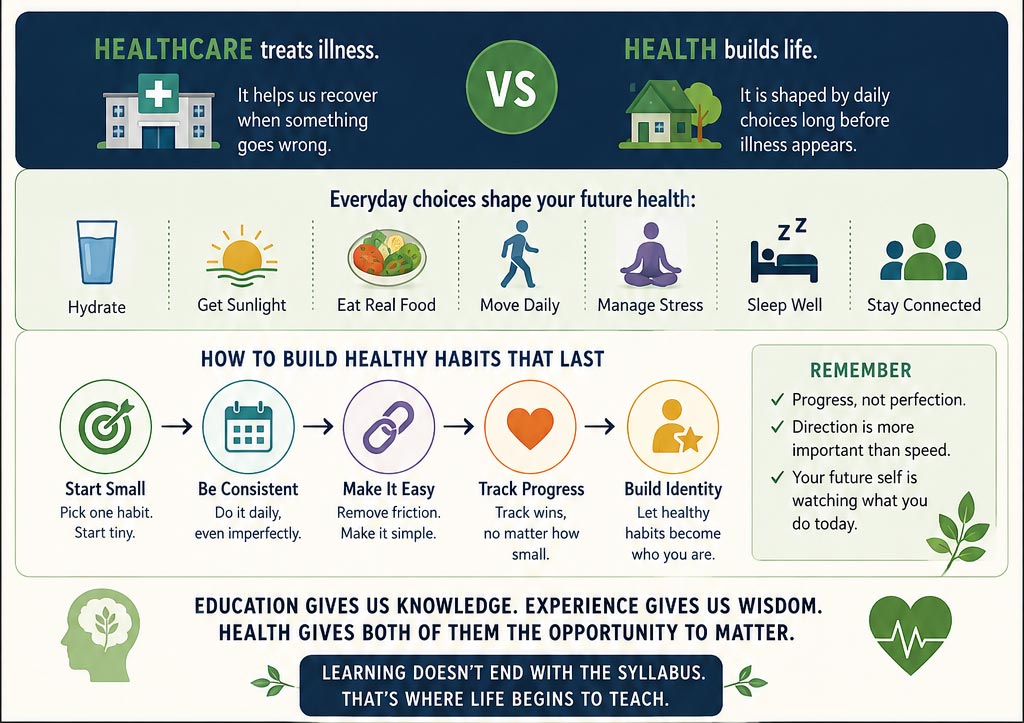
Medicine is largely designed to help us recover when illness appears. Health begins much earlier, long before we step into a clinic or hospital. It is shaped by the countless choices, environments, and routines that influence our body every day—often without us noticing.
This is where the distinction becomes important.
Healthcare helps us treat disease.
Health is about reducing the chances of disease developing in the first place.
One responds after something has gone wrong.
The other asks what we can do while everything is still going right.
That shift in perspective changes the questions we ask ourselves.
Instead of wondering,
“How do I recover after becoming unhealthy?”
We begin asking,
“How do I give my body fewer reasons to become unhealthy?”
The answers are rarely dramatic.
They are found in understanding nutrition before diabetes develops, respecting sleep before exhaustion becomes chronic, managing stress before it begins affecting the body, and recognising that movement is not simply exercise—it is one of the ways the body maintains itself.
None of these habits eliminate the need for doctors.
Nor should they.
Even the healthiest people become ill, develop medical conditions, or need professional treatment at different stages of life. Prevention is never a guarantee; it is simply the most sensible investment we can make in our future health.
Perhaps that is the most valuable shift in thinking this article hopes to encourage.
Good health is not something we receive from hospitals.
Hospitals help restore it when it has been lost.
The foundations of health are built much earlier—in our homes, our workplaces, our kitchens, our routines, and the choices we make when no one else is paying attention.
Because medicine helps us recover.
But understanding health helps us live.
Small Habits Beat Extreme Transformations
Modern culture has convinced us that change must be dramatic to be meaningful.
Lose ten kilograms in thirty days.
Wake up at five every morning.
Follow the perfect diet.
Join an intense fitness programme.
Transform your life overnight.
The message is everywhere, and although it can be motivating, it also creates an unrealistic expectation: that good health begins with extraordinary effort.
The truth is usually much less dramatic.
Our bodies don’t reward intensity nearly as much as they reward consistency.
A ten-minute walk after dinner may not feel life-changing today. Drinking another glass of water, going to bed thirty minutes earlier, eating a little more slowly, or spending a few minutes in the morning sunlight rarely feels like a breakthrough.
Yet the body has an extraordinary memory. It quietly responds to what we repeat far more than to what we do once.
That is why lasting health is rarely built through a burst of motivation. It grows through routines that become so natural we no longer think about them. Walking becomes part of the evening instead of an exercise session. Carrying a water bottle becomes automatic rather than a reminder. Choosing home-cooked food becomes a habit instead of a monthly resolution.
Perhaps the biggest misunderstanding about healthy living is that it requires perfection.
It doesn’t.
Missing a workout doesn’t ruin your health.
Eating dessert doesn’t undo months of good nutrition.
Sleeping poorly for one night doesn’t erase years of good sleep.
What matters is the direction we’re travelling, not whether every single day is perfect.
Think about how a tree grows. You never notice it changing from one day to the next. Yet return after a few years and it has become stronger, taller, and deeply rooted.
Health grows in much the same way. Its greatest changes are almost invisible while they are happening.
Consistency also makes healthy choices easier. The more often we repeat a behaviour, the less motivation it requires. What once felt like discipline gradually becomes routine, and what becomes routine eventually becomes part of who we are—a principle that also explains The Evolution of Human Thinking, where we explore how repeated behaviours become deeply wired into human nature.
Perhaps that is why the healthiest people often don’t appear to be trying very hard.
They aren’t relying on motivation every morning.
They are relying on habits that have quietly become part of their identity.
Real transformation isn’t created by intensity.
It’s created by repetition.
And maybe that’s the most reassuring lesson of all.
You don’t have to change your life today.
You only have to change today.
Tomorrow, do it again.
What Should Schools Teach?
Imagine a student graduating from school with one subject that would remain useful for the next seventy years of life.
Not because it helped them score higher marks.
Not because it increased their chances of getting a job.
But because it helped them understand the only body they would ever live in.
Perhaps that subject could simply be called Health Literacy.
It wouldn’t replace mathematics, science, history, or literature. Those subjects help us understand the world around us. Health literacy would help us understand ourselves.
Students could learn how nutrition affects not only physical growth but also concentration, mood, and long-term well-being. They could discover why sleep is essential for learning rather than an obstacle to studying, why regular movement supports both the body and the mind, and how mental health deserves the same attention and openness as physical health.
They could also learn practical skills that remain valuable throughout life: basic first aid, recognising the early warning signs of common illnesses, understanding routine health check-ups, managing stress in healthy ways, and developing a balanced relationship with technology in a world where screens increasingly shape our attention.
None of these lessons require students to become doctors. They simply help them become informed caretakers of their own health.
That, perhaps, is what education has always tried to do at its best—not merely prepare people to earn a living, but prepare them to live wisely.
This isn’t a criticism of schools or teachers. In fact, it’s a continuation of an idea explored in What the Syllabus Prepares You For—and What It Ignores: education has always evolved alongside society, adapting to the challenges of each generation.
A century ago, the greatest concerns were different. Today, young people are growing up in a world shaped by processed food, sedentary lifestyles, chronic stress, endless notifications, and rising lifestyle diseases. Preparing them for that reality requires more than academic knowledge alone.
It requires health awareness.
Not as another examination to pass.
But as a lifelong skill to carry.
Because education should prepare us not only for our first job. It should also prepare us for our first forty years of adulthood.
Perhaps one day, report cards will celebrate more than academic achievement.
Perhaps they’ll also reflect whether students understand how to care for themselves, support one another, and make informed choices about their physical and mental well-being.
If that day comes, we won’t simply produce better students.
We’ll raise healthier generations.
And maybe…
That would be one of the most valuable lessons ever taught.
Conclusion
There comes a moment in every person’s life when the lessons written in textbooks are no longer enough. It’s the moment explored in The Day the Syllabus Ends—when real education shifts from classrooms to everyday life.
No examination asks whether we’re sleeping well.
No report card measures how we manage stress.
No degree guarantees that we’ll know how to nourish our body, recognise the early signs of illness, or create habits that protect our health for decades to come.
Those lessons arrive quietly through experience.
Sometimes through curiosity.
Sometimes through mistakes.
And sometimes through challenges we never expected to face.
Perhaps that is why health is one of life’s greatest teachers.
It reminds us that our body is not simply a machine to carry us through work, responsibilities, and ambitions. It is the foundation upon which every dream, relationship, journey, and achievement ultimately depends.
The irony is that many of the choices that shape our future health rarely feel important in the moment. A little more sleep. A walk after dinner. A balanced meal. Time away from a screen. A conversation that eases stress. Individually, they seem ordinary. Together, they become the quiet architecture of a healthier life.
Maybe the greatest lesson isn’t that health is our greatest wealth.
It’s that caring for our health is one of the few investments whose returns touch every part of life.
Education gives us knowledge.
Experience gives us wisdom.
Health gives both of them the opportunity to matter.
And perhaps that’s the real lesson beyond the syllabus.
The classroom eventually ends.
Learning never does.
Continue Reading: Build Your Health Beyond the Syllabus
Health isn’t a single lesson we learn and move on from. It’s a lifelong conversation between our choices, our body, and the world we live in. If this article encouraged you to see health differently, these upcoming essays will explore some of its most important ideas in greater depth.
🟢 Your Gut Is Smarter Than You Think
Why digestion influences your energy, immunity, mood, and overall well-being.
🟢 Science of Sleep: How Sleep Shapes Your Brain and Health
The science of sleep, recovery, and why your body performs best when it’s truly rested.
🟢 Your Body Was Designed to Move (Coming Soon)
How movement supports your heart, mind, metabolism, and long-term health—far beyond weight loss.
🟢 Your Mind Can’t Heal If Your Body Never Gets a Break (Coming Soon)
Understanding stress, recovery, and the powerful connection between mental and physical well-being.
🟢 Food Beyond Calories (Coming Soon)
Why nutrition isn’t about dieting or restriction—it’s about nourishing your body for life.
More essays will be added as the Health Beyond the Syllabus series continues, exploring the science, psychology, and everyday habits that shape a healthier life.
Beyond the Syllabus
Beyond the Syllabus isn’t about learning more.
It’s about learning what matters.
Learning doesn’t end with the syllabus.
That’s where life begins to teach.
Frequently Asked Questions (FAQs)
What does “Health Beyond the Syllabus” mean?
Health Beyond the Syllabus is the idea that many of the most important lessons about staying healthy—such as nutrition, sleep, stress management, movement, and preventive care—are rarely taught in school. Instead, they are often learned through experience. This article encourages lifelong health literacy beyond traditional education.
Why is health literacy important?
Health literacy helps people understand how everyday choices affect their physical and mental well-being. It enables individuals to make informed decisions about nutrition, exercise, sleep, stress, preventive healthcare, and medical care, leading to healthier lives and better long-term outcomes.
What are the most important healthy habits for everyday life?
Some of the most effective healthy habits include:
1. Eating a balanced and nutritious diet
2. Getting 7–9 hours of quality sleep
3. Staying physically active
4. Managing stress effectively
5. Drinking enough water
6. Scheduling regular health check-ups
7. Limiting excessive screen time
Small, consistent habits often have a greater long-term impact than extreme lifestyle changes.
Why don’t schools teach more about health?
Traditional education systems have primarily focused on academic knowledge and career preparation. While subjects like science explain how the body works, practical topics such as nutrition, sleep, mental health, preventive care, and healthy lifestyle habits have historically received much less attention. As modern lifestyle diseases continue to rise, many educators believe health literacy deserves a greater place in education.
Is it ever too late to start living a healthier life?
No. Positive changes can begin at any age. While starting healthy habits earlier offers long-term benefits, improving nutrition, sleep, physical activity, stress management, and preventive healthcare can enhance health and quality of life regardless of when you begin. Progress comes from consistency, not perfection.