

Money and relationships are deeply connected, yet most couples eventually discover that earning a good life and living a good life are not always the same thing. This is a reflection on wealth, time, ambition, emotional security, and the life we choose to build together.
Every generation asks the same question in a different way.
Some ask it before marriage.
Some ask it after becoming parents.
Some ask it while chasing promotions.
And some only realise its importance much later in life.
The question is simple:
One of the most important questions in money and relationships is surprisingly difficult to answer:
How much money is enough for a happy relationship?
At first glance, the answer appears obvious.
More money means a better life.
A better house.
Better education for children.
Better healthcare.
More travel.
More comfort.
Fewer financial worries.
Most people would agree that financial security in marriage plays an important role in building healthy relationships. As constant money problems can create stress, anxiety, arguments, and uncertainty. Love may be powerful, but it cannot pay electricity bills or school fees.
Yet there is another side to the story that rarely receives equal attention. Discussions about money and relationships often focus on financial stability, lifestyle, and future security. Yet many couples eventually discover that emotional connection and shared experiences matter just as much as income.
Because while money can improve a lifestyle, it cannot automatically create closeness.
It can buy a larger dining table.
But it cannot guarantee that people will sit around it together.
It can buy a beautiful home.
But it cannot guarantee warmth inside it.
It can buy comfort.
But it cannot buy companionship.
And that is where many modern relationships find themselves standing at a crossroads.
Not between love and money.
But between different versions of a life.
One evening, three different couples sat down at three different places.
Each was living a life that many people secretly desired.
Each was making sacrifices that few people could see.
And each was unknowingly searching for the same thing.
A life that felt meaningful.
The Success Dilemma of Arjun and Meera

At 10:45 PM, Arjun finally reached home.
The city outside his apartment was still buzzing with life.
Cars moved endlessly through the illuminated streets below.
Office towers continued to glow against the night sky.
The world appeared awake.
But his home felt unusually quiet.
He loosened his tie, dropped his office bag near the sofa, and glanced around the living room.
The television was off.
The dining area was empty.
The silence felt heavier than usual.
On the dining table sat a covered plate.
Dinner.
Beside it was a folded piece of paper.
Arjun picked it up.
The note was written in Meera’s familiar handwriting.
“Aarav waited till 9 PM.
He wanted to show you the drawing he made.
He’s asleep now.”
Arjun stared at the note for several seconds.
Nothing dramatic happened.
No emotional breakdown.
No movie-like moment.
Just silence.
The kind of silence that arrives when a truth quietly finds its way into your mind.
Earlier that day, Arjun had successfully closed one of the biggest deals of his career.
His manager had congratulated him.
His colleagues had admired him.
The promotion he had worked towards for years was finally within reach.
His income had grown significantly over the past few years.
The family lived in a beautiful apartment.
Their son studied in a good school.
Financially, life looked successful. In many ways, it was.
Yet as he stood alone in that expensive apartment, holding a small note from his wife, he couldn’t help but feel that something was missing.
The next morning was Saturday.
One of the rare mornings when Arjun wasn’t rushing to the office.
He woke up later than usual.
As he entered the living room, he found Aarav sitting on the floor colouring a sketchbook.
The boy immediately looked up.
“Papa!”
His face lit up.
Children have a remarkable ability to make you feel important.
Aarav quickly ran to his room and returned with a drawing sheet.
“See! I made this.”
The drawing showed three stick figures.
One was labelled “Mumma.”
One was labelled “Me.”
And one was labelled “Papa.”
The father figure stood slightly away from the other two.
Arjun smiled.
Then froze for a moment.
He knew children rarely draw symbolism intentionally.
But sometimes they reveal truths adults spend years avoiding.
That evening, after Aarav had gone to bed, Arjun and Meera sat together on the balcony. The city lights stretched endlessly before them.
For a while, neither spoke.
Then Meera broke the silence.
“Can I ask you something?”
“Of course.”
“Are you happy?”
Arjun looked surprised.
“Why wouldn’t I be?”
She smiled.
Not sarcastically.
Not angrily.
Just thoughtfully.
“Because lately it feels like you’re always running.”
He leaned back.
“I’m doing all this for us.”
And he meant every word.
The long hours.
The late-night meetings.
The constant pressure.
The travel.
The sacrifices.
Everything.
It was all for the family.
At least that was what he believed.
Meera nodded slowly.
“I know.”
Then she paused.
The next sentence stayed with him for years.
“But sometimes it feels like you’re building a beautiful life that you don’t have time to live.”
The words hung in the air between them.
Neither spoke for a while.
Because both knew there was truth in them.
This is the hidden dilemma behind many modern relationships.
People often assume that relationship problems arise because of a lack of love. In reality, many relationships suffer despite having plenty of love.
The challenge is often something else.
Time.
Attention.
Presence.
Emotional availability.
The very things that ambitious lives frequently consume.
Arjun loved his family.
Meera knew that.
But love expressed through future plans sometimes struggles to compete with love expressed through present moments.
And somewhere between performance reviews, salary increments, and career growth, an important question had quietly disappeared.
It is a question that sits at the heart of many conversations about money and relationships:
How much money is enough?
Because beyond a certain point, the pursuit of a better lifestyle begins demanding payment in another currency.
Time.
And unlike money, time cannot be earned back.
That question would continue following Arjun long after the promotion arrived. And he was not alone.
Hundreds of kilometres away, another couple was wrestling with a very different version of the same problem.
The Distance Dilemma of Aman and Priya

If Arjun and Meera represent one of the most common struggles of modern relationships, Aman and Priya represent another.
The challenge was not a lack of love. Like many modern couples trying to balance career growth and a work life balance relationship, Aman and Priya were struggling with distance.
Nor was it a lack of financial security.
Their challenge was distance.
The kind of distance that quietly enters a relationship not because two people grow apart, but because life pulls them in different directions.
When Aman and Priya got married, they had imagined a fairly ordinary life.
Not a perfect life.
Not a luxurious life.
Just a shared one.
They imagined waking up in the same home.
Sharing morning tea before work.
Complaining about traffic together.
Arguing over what to watch on weekends.
Celebrating birthdays in the same room instead of over video calls.
The sort of simple moments that never appear on social media but eventually become the foundation of a marriage.
Life, however, had other plans.
Aman received an excellent opportunity in Pune.
Priya’s career was progressing well in Bengaluru.
Both jobs were stable. Both jobs offered growth. Both jobs had taken years of hard work to earn. Their careers had helped them achieve something many couples strive for: financial security in marriage.
Walking away from either opportunity felt unreasonable. So they made what seemed like the sensible decision.
They would stay in different cities.
Temporarily.
Just until a transfer became possible.
Just until one of them found a better opportunity.
Just until life became easier.
The first few months were manageable.
They spoke constantly.
Morning messages.
Lunch calls.
Late-night conversations.
The distance felt inconvenient, but manageable.
After all, they were only one flight away.
One train journey away.
One weekend away.
Yet something interesting happens when a temporary arrangement quietly becomes permanent.
Months become years.
And one day you realise you’ve spent a significant portion of your marriage living separate daily lives.
Every Friday evening became an event.
Every Sunday evening became a goodbye.
The routine repeated itself so many times that it almost became normal.
Almost.
One Friday, Priya arrived at Pune airport after a particularly stressful week. As she exited the terminal, she immediately spotted Aman waiting outside.
The moment their eyes met, both smiled.
Not dramatically.
Not like the movies.
Just the warm smile of two people who genuinely missed each other.
For the next two days, life felt complete.
Breakfast together.
Market visits.
Random conversations.
Laundry.
Groceries.
Tea.
Dinner.
The ordinary things.
Ironically, the things most couples take for granted had become special. Because they were rare.
Sunday arrived too quickly. It always did.
The two-hour drive to the airport felt shorter than ever. Neither spoke much. Both knew what was coming.
At the departure gate, Priya looked at him and laughed softly.
“You know what’s funny?”
Aman smiled.
“What?”
“We’re married.”
“As far as I know.”
“Sometimes it still feels like we’re dating long-distance.”
Aman laughed. Then neither said anything.
Because beneath the joke was a truth neither could ignore.
Marriage had given them commitment.
Love had given them connection.
But geography had taken away something else “Shared daily life”.
Their weekends together reminded them how valuable quality time in relationships becomes once it becomes scarce.
One evening, several months later, Priya had an unusually difficult day at work.
Nothing catastrophic.
Just one of those days when everything seems heavier than usual.
The kind of day when a person doesn’t necessarily need solutions.
They simply need someone nearby.
Someone to sit beside them.
Someone to listen.
Someone whose presence says:
“You’re not carrying this alone.”
That night Aman called as usual.
The moment she answered, he sensed something was wrong.
“Rough day?”
“Very.”
“Want to talk about it?”
There was a pause.
“Not really.”
“Then what do you want?”
Another silence. This one longer.
Then Priya answered honestly.
“I just wish you were here.”
For several seconds neither spoke.
Because there was nothing clever to say.
No motivational quote.
No practical solution.
No life advice.
Some problems are not problems at all.
They are absences.
And absence cannot be fixed through a phone screen.
People often assume that financial security automatically creates relationship security.
To some extent, that is true.
Financial stability reduces many pressures. In discussions about money and relationships, financial security is often presented as the ultimate goal. Yet Aman and Priya’s story highlights another reality: a relationship can be financially stable and still struggle with the emotional cost of distance.
It allows couples to plan confidently.
It creates opportunities.
It provides peace of mind.
Yet emotional security in relationships comes from something entirely different.
Presence.
The feeling that someone is available.
The comfort of sharing life in real time.
The ability to experience important moments together instead of describing them later.
A promotion can be celebrated over a video call.
A difficult day can be discussed over the phone.
But certain things lose something in translation.
A reassuring hug.
A quiet evening together.
The comfort of simply knowing someone is nearby.
Nearly four years into this arrangement, Priya asked a question that neither of them had been brave enough to ask directly.
It happened during one of their late-night calls. Nothing dramatic had happened.
No argument.
No crisis.
Just honesty.
“Do you think this is worth it?”
Aman immediately understood what she meant.
Not the marriage.
Never the marriage.
The distance.
The years.
The trade-off.
Everything.
He remained silent for a while. Then finally said:
“I don’t know.”
The answer surprised her. Aman was usually decisive.
Usually confident.
Usually certain.
Not tonight.
After a few moments, he continued.
“I only know that one day we’ll have to decide what we’re optimising for.”
The sentence lingered between them. Because modern life constantly encourages optimisation.
Optimise your income.
Optimise your career.
Optimise your investments.
Optimise your opportunities.
But very few people stop and ask:
What is the purpose behind all this optimisation?
A better future?
Certainly.
Greater stability?
Of course.
More opportunities for the family?
Absolutely.
But if the future arrives after years of sacrificing the present, what exactly have we built?
To be clear, there is no simple answer here.
Many long-distance marriages succeed beautifully. Many couples endure years apart and eventually create wonderful lives together.
For some, temporary separation becomes the foundation of long-term stability.
Life is rarely simple enough to fit into slogans. But there is a question every couple must eventually answer for themselves.
Not society’s question.
Not their relatives’ question.
Their own.
How much togetherness are we willing to sacrifice for a future we hope to enjoy together?
Because every relationship involves trade-offs. The goal is not avoiding them.
The goal is choosing them consciously.
And perhaps that is why Aman and Priya’s story is not really about distance.
It is about priorities.
About understanding what matters most.
About deciding which sacrifices feel meaningful and which ones eventually become too expensive.
And that brings us to a very different couple.
A couple with fewer luxuries. Fewer opportunities.
But perhaps a different kind of wealth altogether.
Dev and Sita.
The Simplicity Dilemma of Dev and Sita
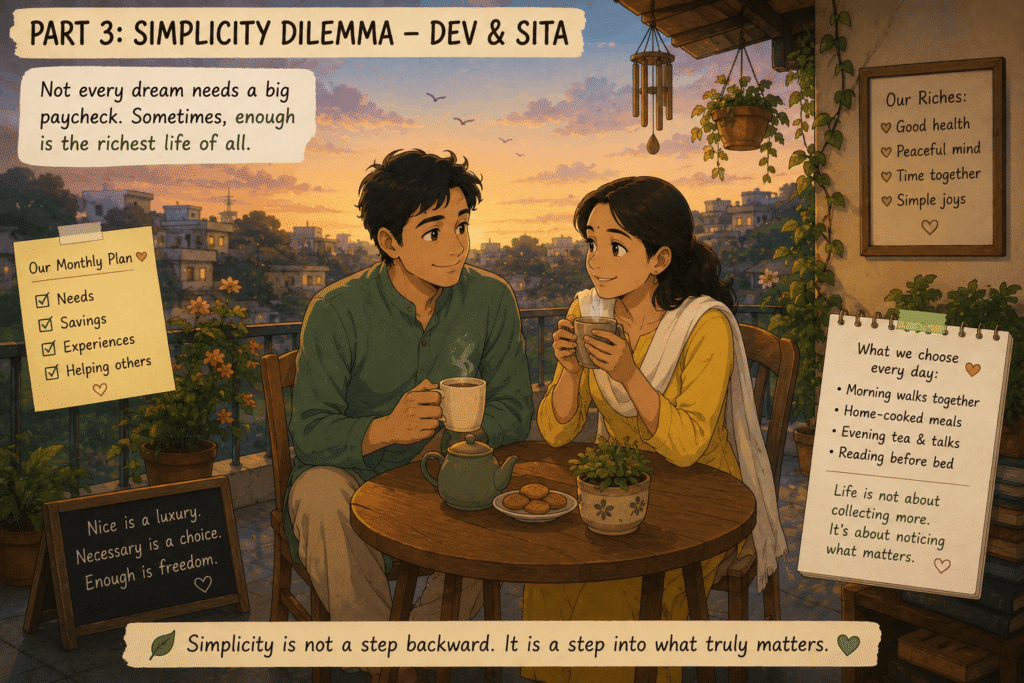
If Arjun and Meera’s life looked successful from the outside, and Aman and Priya’s life looked ambitious, Dev and Sita’s life appeared almost ordinary.
Painfully ordinary by modern standards.
No luxury apartment.
No international holidays.
No impressive LinkedIn updates.
No photographs from exotic destinations.
No discussions about stock portfolios over dinner.
Just a modest home in a quiet neighbourhood.
A life that most social media algorithms would completely ignore.
And yet, there was something about it that felt increasingly rare.
Presence.
Every evening, almost without fail, Dev and Sita invested in something many healthy relationships quietly depend on: Quality Time in Relationship.
Not because they had planned it.
Not because they had read a relationship book.
Not because some expert had advised them to.
It simply happened.
Around six-thirty, Dev would return home. Sita would bring two cups of tea.
Sometimes they sat on the veranda.
Sometimes on the balcony.
Sometimes in the living room during monsoon rains.
The location changed.
The ritual remained.
Twenty or thirty minutes.
No phones.
No television.
No urgency.
Just conversation.
Most of those conversations appeared ordinary at the time — the kind of everyday exchanges people barely notice until they become memories.
The vegetable prices had increased again.
The neighbour’s son had secured a government job.
The washing machine was making a strange noise.
Someone’s cousin was getting married.
Nothing extraordinary.
Nothing profound.
Just life.
Yet years later, when people ask what makes a healthy relationship, they often imagine grand gestures.
Anniversary surprises.
Luxury vacations.
Expensive gifts.
What they rarely imagine is a thousand ordinary conversations accumulated over decades. And yet those conversations are often where relationships are truly built.
Their story reminds us that healthy relationships are often built through consistency rather than grand gestures.
One Saturday afternoon, Sita was scrolling through social media. A former classmate had uploaded photographs from Switzerland.
Snow-covered mountains.
Luxury hotels.
Beautiful cafés.
Designer shopping bags.
The comments section was overflowing with admiration.
“Living the dream.”
“Goals.”
“What a life.”
Sita stared at the photographs for a while. Then she looked around her own living room.
The sofa was several years old.
The walls needed repainting.
The ceiling fan made a slight noise whenever it rotated.
Nothing about the room felt extraordinary.
At that moment, Dev walked in carrying vegetables from the market.
Sita smiled.
Then asked a question she had never asked before.
“Do you ever feel we’re falling behind?”
Dev put the bags down.
“Behind whom?”
“Everyone.”
He laughed.
“Everyone is a very large group of people.”
“You know what I mean.”
Dev sat beside her. He looked at the photographs on her phone. Then looked around their home.
For a few moments, neither spoke. Finally, he said:
“I think the problem is that we’re comparing our daily life to somebody else’s highlights.”
Sita looked at him.
“And?”
“Highlights are a terrible way to measure happiness.”
One of the biggest mistakes people make when thinking about money and relationships is assuming that a higher lifestyle automatically creates a happier life.
The truth, however, was more complicated than Dev admitted.
He had worries too.
Many of them.
Sometimes he worried about money.
Sometimes he worried about the future.
Sometimes he wondered whether he was providing enough.
Whether his family deserved more.
Whether he should be working harder.
Earning more.
Achieving more.
Because while social media often glorifies simple living, simplicity is not always simple.
Financial limitations create their own challenges.
And pretending otherwise would be dishonest.
One evening, after an unexpected medical expense for a family member, Dev sat quietly at the dining table.
The bills lay spread before him.
He wasn’t panicking.
But he was thinking.
Calculating.
Recalculating.
Trying to make everything fit. Sita noticed immediately.
After years together, she could recognise his worried face within seconds.
She sat opposite him.
“You’re thinking too much.”
“Maybe.”
“What’s bothering you?”
Dev hesitated.
Then answered honestly.
“Sometimes I wish I could give you more.”
Sita smiled.
“More what?”
“Everything.”
She laughed.
“That’s a dangerous answer.”
“Why?”
“Because ‘everything’ has no finish line.”
Dev looked up.
She continued.
“A bigger house would be nice.”
He nodded.
“A newer car would be nice.”
Another nod.
“Travelling more would be nice.”
He smiled.
“See? That’s exactly my point.”
Sita leaned back in her chair.
Then said something that stayed with him for years.
“Nice and necessary are not the same thing.”
The room became quiet. Neither spoke for a while.
Then Dev asked:
“Do you ever feel like something is missing?”
Sita thought carefully. A full minute passed.
Then she shook her head.
“No.”
“Nothing?”
“Nothing important.”
That answer stayed with him.
Not because it was entirely true.
Every person wants something.
Every family dreams of improvement.
Every couple imagines a better future.
The difference was that Sita had not postponed happiness until that future arrived.
She was not waiting for life to begin.
She was already living it.
And perhaps that is where many relationships quietly struggle.
Not because they lack money.
Not because they lack love.
But because they become trapped in permanent preparation. Always preparing for the next stage.
The next promotion.
The next house.
The next investment.
The next version of life.
As if happiness has signed an agreement to arrive later.
One winter evening, Dev and Sita attended the fiftieth wedding anniversary celebration of an elderly couple in their neighbourhood.
Near the end of the event, someone asked the husband the question people always ask.
“What’s the secret to fifty years of marriage?”
The room laughed.
The old man adjusted his glasses.
Thought for a moment.
Then answered:
“We had less than people have today.”
The room listened carefully.
“Less money.”
“Less comfort.”
“Less convenience.”
Then he smiled.
“But we had more evenings together.”
Everyone laughed.
His wife immediately added:
“That’s because neither of us had anywhere else to go.”
The room erupted again.
But after the laughter faded, the old man said something remarkable.
“The strange thing about growing old is that you stop remembering what things cost.”
The room became silent.
He looked at his wife.
Then around the hall.
And finally said:
“You remember who was there.”
Driving home that night, neither Dev nor Sita spoke much.
The old man’s words lingered.
Not because they rejected ambition.
Not because they rejected success.
But because they revealed something easy to forget.
Relationships are built in ordinary moments. Not extraordinary ones.
A marriage is rarely transformed by a luxury vacation. But it can be strengthened by ten thousand shared evenings.
One conversation.
One meal.
One walk.
One ordinary day at a time.
And yet, before we declare Dev and Sita’s life the ideal answer, we must be careful. Because life is rarely that simple.
Arjun and Meera are not wrong.
Aman and Priya are not wrong.
Dev and Sita are not necessarily right.
Each couple is paying a different price.
Arjun and Meera sacrifice time.
Aman and Priya sacrifice togetherness.
Dev and Sita sacrifice certain opportunities and comforts.
No life comes without trade-offs.
The question is not:
Which couple is correct?
The question is:
Which trade-off aligns with the life you truly want to build together?
Because every relationship eventually answers that question. Whether consciously or unconsciously.
Money and Relationships: The Hidden Value of Time

By now, we have met three couples.
Arjun and Meera.
Aman and Priya.
Dev and Sita.
Three different relationships.
Three different lifestyles.
Three different definitions of success.
And perhaps one uncomfortable realization. No couple gets everything.
Every relationship pays a price.
Some pay with time.
Some pay with distance.
Some pay with financial limitations.
The question is not whether sacrifices exist.
The question is whether we are consciously choosing them.
While financial security in marriage reduces many practical worries, it cannot replace companionship. Relationship happiness rarely comes from one major decision. More often, it emerges from thousands of small moments shared over time. Perhaps that is why one of the most important conversations in any relationship is rarely about money itself.
It is about priorities.
Not:
“How much do we want?”
But:
“Why do we want it?”
A bigger home may be worth pursuing.
|A better career may be worth pursuing.
A promotion may be worth pursuing.
A business may be worth building.
A transfer may be worth accepting.
None of these things are inherently wrong. The problem begins when we stop asking what all of it is for.
Because money is not the destination.
Money is a vehicle. A very useful one. But a vehicle is only valuable if it takes us somewhere worth going.
Perhaps that is the lesson at the heart of money and relationships. Money is important, but it was never meant to become the destination. It is a tool that should support a meaningful life, not replace it. Research consistently shows that quality time in relationships often contributes more to long-term relationship happiness than expensive experiences or material possessions.
Yet modern society tends to focus far more on financial success than emotional fulfilment. From a young age, many of us are taught how to compete, achieve, and earn more. Far fewer are taught how to build meaningful relationships, communicate effectively, or define success beyond wealth and status. In fact, our education system often rewards memorisation over understanding—a theme I explored in Why Rote Learning Is Killing Indian Students.
Perhaps that is why conversations about financial security in marriage often dominate discussions about relationships. And to be fair, they should not be ignored. Financial stress can damage even healthy relationships. Constant uncertainty creates anxiety. Medical emergencies require money. Children’s education requires money. Responsibilities require money. Anyone who claims otherwise is being unrealistic.
Love alone cannot solve practical problems.
Children require money.
Responsibilities require money.
Anyone who claims otherwise is being unrealistic.
But there is another kind of security that receives far less attention.
Emotional security.
The security of knowing that someone is present is one of the foundations of emotional security in relationships.
The security of being heard.
The security of being understood.
The security of knowing that when life becomes difficult, you won’t face it alone.
Money creates one form of safety. Presence creates another.
The strongest and most healthy relationships tend to combine both forms of security—financial and emotional.
Relationship researchers at The Gottman Institute have spent decades studying what makes relationships succeed or fail. Their findings consistently highlight the importance of trust, emotional connection, responsiveness, and everyday interactions—factors that cannot be replaced by financial success alone.
A few years ago, a journalist interviewed several couples who had been married for more than forty years.
The answers were fascinating.
Nobody spoke much about money.
Nobody proudly listed their investments.
Nobody discussed their promotions.
Instead, they spoke about things that seemed almost insignificant.
Shared meals.
Family trips.
Evening walks.
Difficult years survived together.
Ordinary conversations.
One elderly gentleman said something remarkable.
“When you’re young, you think happiness comes from the big events.”
The room smiled.
He continued.
“Then you grow older and realise life was mostly Tuesdays.”
Everyone laughed. But hidden inside the joke was a profound truth.
Most relationships are not built during anniversaries. They are built during ordinary Tuesdays.
Ordinary breakfasts.
Ordinary evenings.
Ordinary conversations.
The moments that seem forgettable while they are happening. Until one day you realise they were the life itself.
Interestingly, this idea is supported by real-world research as well. The Harvard Gazette article on the Harvard Study of Adult Development, one of the longest-running studies on human happiness and wellbeing, has repeatedly found that strong relationships contribute significantly to a meaningful and satisfying life. While money and success certainly matter, the quality of our relationships often plays an even greater role in long-term happiness.
Which brings us to a question worth considering.
Is time the greatest gift one person can give another?
At first glance, the idea sounds sentimental.
Almost cliché.
But think about it carefully.
Money can often be earned again.
Lost possessions can sometimes be replaced.
Opportunities occasionally return.
Time never does.
The hour you spend today can never be recovered tomorrow.
The evening you miss is gone forever.
The conversation postponed may never happen.
The child who waited to show you a drawing will eventually stop waiting.
The parent who wanted one more visit will eventually stop asking.
The partner who wanted one more walk may one day no longer be there.
This is not meant to be sad. Only honest.
Time is precious precisely because it is limited.
And perhaps that is why presence feels so meaningful.
When someone gives you their attention, they are giving you something they can never get back –
“A portion of their life”.
So, how much money does love really need?
Enough to live with dignity.
Enough to feel reasonably secure.
Enough to handle responsibilities.
Enough to build a stable foundation.
Beyond that point, the answer becomes deeply personal.
Because every additional level of success often comes attached to a hidden question:
“What will this cost me in return?”
Sometimes the cost is worth paying.
|Sometimes it is not.
Only the people living that life can decide.
The goal is not to reject ambition.
The goal is not to glorify simplicity.
“The goal is awareness”.
To understand the trade-offs before life chooses them for us.
Many years from now, imagine our three couples sitting together in old age.
Arjun and Meera.
Aman and Priya.
Dev and Sita.
Their careers are over. Their children have grown up. The ambitions that once felt urgent have become memories.
One evening, they sit together looking through old photographs. What do you think they will search for?
Salary slips?
Promotion letters?
Performance reviews?
Investment statements?
Probably not.
They will search for moments.
The family vacation.
The evening walk.
The train journey.
The birthday celebration.
The random photograph taken on an ordinary day.
Because memories are not made of money.
They are made of experiences.
And experiences require presence.
Perhaps that is the answer we have been searching for all along.
Money matters.
Love matters.
Ambition matters.
Security matters.
None of these things should be dismissed. But somewhere beyond all the calculations, all the goals, and all the plans, there remains a simple truth.
The richest relationships are rarely the ones that possess the most.
They are the ones that share the most.
The most conversations.
The most laughter.
The most struggles.
The most ordinary days.
The most life.
Because in the end, people rarely remember what you earned.
They remember whether you were there.
And perhaps that is why the greatest luxury in a relationship is not unlimited wealth.
It is having someone you love sitting beside you on an ordinary Tuesday evening, with nowhere else either of you would rather be.
The debate around money and relationships is not really about choosing between wealth and love. It is about understanding how financial ambition, emotional security, quality time, and shared experiences fit together in a life that feels meaningful. Without emotional security in relationships, even financial success can feel surprisingly empty.
And perhaps that brings us back to the question we started with.
How much money does love really need?
There is no universal answer.
For some couples, the answer may be a larger house, greater financial freedom, and years of hard work to create opportunities for the future.
For others, the answer may be simpler—a modest life with fewer luxuries but more shared evenings, conversations, and memories.
Neither choice is inherently right or wrong.
Every relationship eventually chooses its own balance.
The real question is:
What kind of life are you trying to build together?
How much importance do you place on money?
How much value do you place on time?
How much togetherness are you willing to sacrifice for greater financial security?
And how much financial comfort are you willing to sacrifice for greater togetherness?
Because every relationship is making these trade-offs, whether consciously or unconsciously.
The happiest couples are often not the ones who found a perfect answer.
They are the ones who had the courage to ask the question together.
So before you close this article, take a moment to reflect.
If you were writing the next chapter of your relationship today, what would matter more to you:
More money?
More time together?
Or a balance between the two?
Perhaps your answer says more about your definition of a meaningful life than any article ever could.
* * *
Frequently Asked Questions (FAQs)
Does money make relationships happier?
Money can improve comfort, reduce financial stress, and create opportunities for a better lifestyle. However, research and real-life experience suggest that relationship happiness depends on a combination of financial stability, emotional connection, trust, communication, and shared experiences.
How important is money in a relationship?
Money is important because it affects daily life, future planning, healthcare, education, and overall security. However, money alone cannot create intimacy, companionship, or emotional security. Healthy relationships require both practical stability and emotional connection.
Is time more important than money in a relationship?
Both are important, but they serve different purposes. Money provides security and comfort, while time helps build trust, intimacy, and shared memories. Most successful relationships find a balance between earning a living and living a life together.
What is emotional security in relationships?
Emotional security in relationships is the feeling that you are understood, valued, supported, and accepted by your partner. It comes from trust, communication, consistency, and emotional availability rather than financial success alone.
Can a long-distance marriage be successful?
Yes. Many long-distance marriages thrive through strong communication, mutual trust, shared goals, and regular efforts to stay connected. However, distance can create challenges around companionship and emotional presence, which couples need to address consciously.
What is more important: love or financial security?
Love and financial security are not opposites. Most healthy relationships need both. Love provides emotional fulfilment, while financial stability helps couples manage responsibilities and plan for the future with confidence.
How can couples balance career growth and relationships?
Couples can balance career growth and relationships by discussing priorities openly, protecting quality time, setting boundaries around work, and regularly evaluating whether their current lifestyle aligns with their long-term goals and values.
What is the biggest lesson about money and relationships?
Perhaps the biggest lesson is that every couple makes trade-offs. Some prioritise career growth, some prioritise togetherness, and many try to balance both. The key is not finding a perfect formula but consciously building a life that reflects what matters most to both partners.