
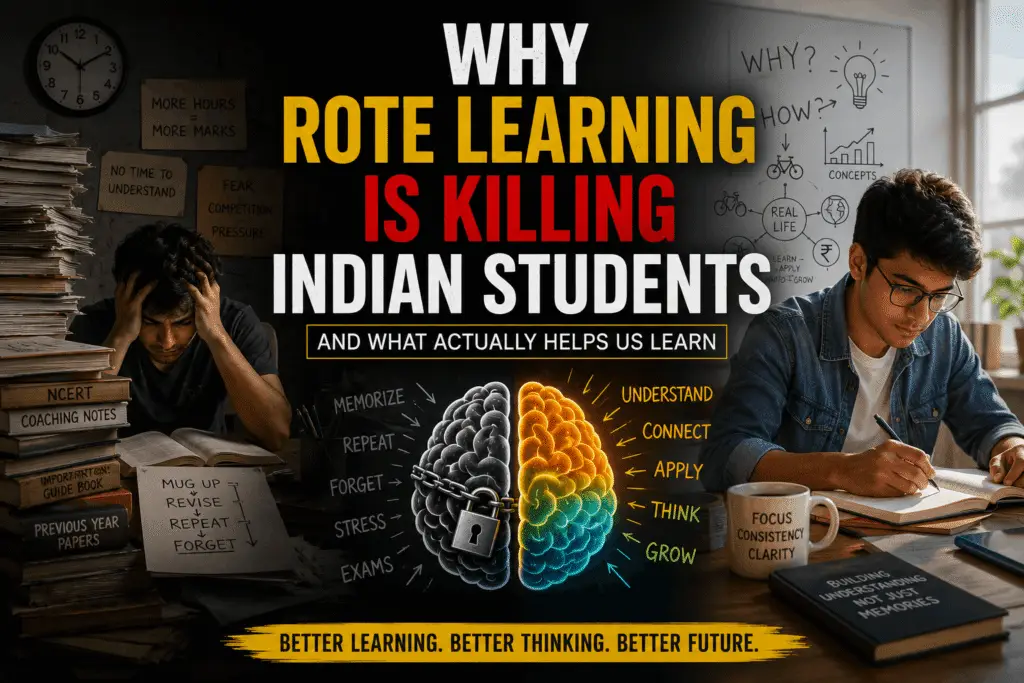
Picture this: It is 1 AM. A Class 12 student in Assam sits under a tubelight, notebook open, lips moving — not reading, not thinking, but mugging up the same paragraph for the fourth time. Tomorrow, he will reproduce it almost word-for-word in the exam. Within a week, he will have forgotten most of it. Sound familiar?
This is not a story about one student. This is the daily reality of millions of Indian students — from Guwahati to Gandhinagar, from coaching institutes in Kota to government schools in rural Odisha. We study to survive exams, not to learn. We memorise chapters, write papers, score marks — and forget everything within weeks.
An entire generation is confusing memory with intelligence. And the damage runs deeper than a few forgotten formulas.
The problem is not that students are weak. The problem is the way learning is happening.
This post explores why rote learning — the dominant study method in Indian classrooms — is quietly harming students, and what actually helps us learn better and retain knowledge for life.
What Is Rote Learning? Understanding the Problem First
Rote learning, simply put, is the practice of memorising information through repetition — without necessarily understanding what it means. Students repeat answers until they can recall them word-for-word, and this memorised content becomes the basis for their exam performance.
In Indian classrooms, rote learning shows up in very specific ways: students relying on guidebooks and refreshers instead of textbooks, coaching centres handing out “important questions” to memorise, teachers rushing to “complete the syllabus” with little room for discussion, and an entire cultural system built around scoring marks rather than developing understanding.
The suggestion culture is particularly telling. Before board exams, students and parents desperately seek out “expected questions” — not to prepare conceptually, but to memorise targeted answers. The system essentially rewards short-term performance over deep, lasting understanding.
Why the System Forces Students Into Memorisation
Before blaming students for relying on rote learning, it is important to understand why they turn to it in the first place. The Indian education system, as it currently stands, makes rote learning the most rational survival strategy.
The syllabus is enormous, the time is limited, and the evaluation is almost entirely marks-based. A student who deeply understands half the syllabus will likely score lower than one who has shallowly memorised it all. In a system where rankings determine college admissions, the rational choice is obvious: memorise more, understand less.
Teachers, too, are trapped. Many are genuinely skilled educators who want to spark curiosity in their students — but institutional pressure to “finish the portion” leaves little room for conceptual teaching. A chapter explained with real-world examples, class discussion, and questions takes three times longer than one read out from the textbook.
Add parental pressure, fear of failure, intense competition, and the psychological weight of entrance exams like JEE, NEET, and UPSC — and you have a perfect recipe for an education culture built entirely on memorisation and stress.
The Psychological Damage of Rote Learning on Students
The consequences of rote learning are not just academic — they are deeply psychological. When students spend years in a system that only rewards memorisation, something fundamental shifts in the way they relate to knowledge.
Curiosity — the most natural and powerful learning tool a child possesses — slowly dies. Students stop asking “why” and start asking only “will this come in the exam?” Questions that once felt exciting begin to feel like risks. Curiosity becomes a distraction from the real goal: marking the right answer.
Students slowly stop asking ‘why’ and start asking only ‘Will this come in the exam?’
The result is fear-based learning. Students study because they are afraid — afraid of failure, of poor marks, of disappointing their parents, of losing social standing. Fear is a terrible foundation for education. It creates anxiety, burnout, and a deep dependence on external validation.
Perhaps most tragically, rote learning suppresses creativity. When students are trained to reproduce fixed answers, they lose confidence in their own thinking. They stop trusting their own reasoning. Independent thought begins to feel dangerous — what if their answer doesn’t match the expected one?
Why Students Forget Everything After Exams
If you ask most Indian students what they studied in Class 10 Science — not just the chapter names, but the actual concepts — the honest answer is: very little. The formulas are gone. The reactions are gone. The historical dates have blurred together. Why does this happen?
The answer lies in how the brain stores information. Shallow learning — the kind produced by rote memorisation — creates weak, fragile memory traces. Information stored without connection to meaning or understanding sits in isolation. It can be recalled for a short time under the right conditions (like an exam), but it is not integrated into long-term memory.
Deep learning works differently. When we understand something — when we connect a new idea to things we already know, when we can explain it in our own words, when we can apply it to a real situation — the brain creates stronger, richer memory networks. This is why understanding builds retention in a way that repetition alone never can.
Understanding builds connections. Memorisation stores isolated information. One is architecture; the other is furniture in a room with no walls.
Memorisation vs. Understanding: The Core Difference
The distinction between rote memorisation and genuine conceptual learning can be illustrated clearly:
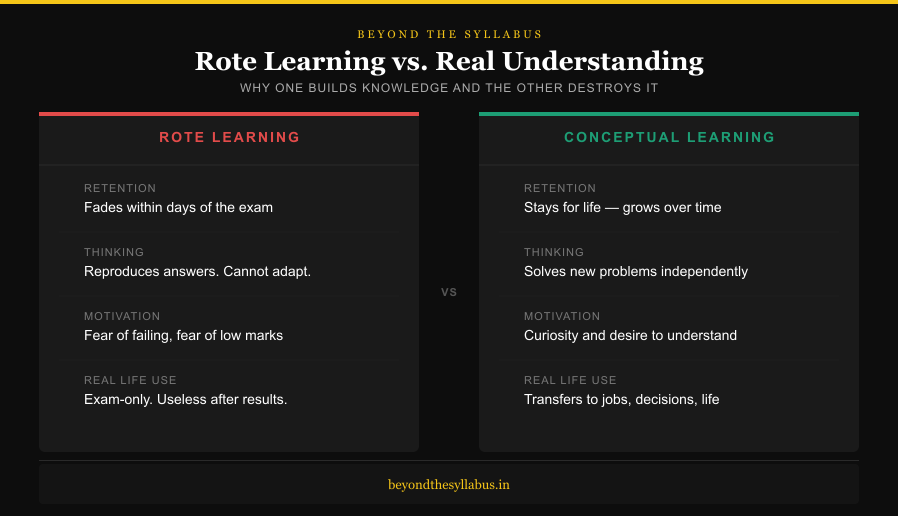
Consider physics as an example. A student who has memorised Newton’s laws can write them out correctly in an exam. But a student who understands them can explain why a motorcycle leans into a turn, why wearing a seatbelt saves lives, and why a bowling ball and a feather fall at the same speed in a vacuum. One has an answer. The other has a mental model.
What Real Toppers Often Do Differently
There is a persistent myth in Indian education culture: toppers study harder than everyone else. They study more hours, sleep less, sacrifice everything. But talk to many genuine academic achievers, and a different picture emerges.
Toppers are not always studying more. Many are studying smarter.
The habits that distinguish strong learners tend to be qualitative, not quantitative. They learn concepts before attempting to memorise them. They simplify complex topics until they can explain them in plain language — a method popularised globally as the Feynman Technique. They use active recall instead of passive re-reading, testing themselves rather than just going over their notes again.
They also revise in structured cycles with spaced repetition — returning to material at increasing intervals to strengthen memory rather than cramming everything the night before. And critically, they make connections between subjects, between textbook ideas and real-world experiences. Learning becomes a conversation with knowledge, not a transaction with a syllabus.
For a deeper understanding of how memory and learning actually work, the research compiled by cognitive scientists at institutions like Stanford’s Centre for Teaching and Learning offers evidence-based insights that go far beyond what most classrooms teach about studying.
Is Memorisation Completely Bad? A Balanced View
To be fair: memorisation is not the enemy. It is an essential part of learning. There are things that simply must be memorised — mathematical formulas, vocabulary, biological terminology, constitutional articles, chemical reactions, historical dates. These are the building blocks of thinking in a subject.
The problem is not memorisation itself — it is memorisation without understanding. When students memorise before they understand, they store information without a framework to hold it. When they understand first and memorise second, the memorised content becomes part of a larger mental structure that is far easier to retain and far more useful in practice.
Memory without understanding is fragile. Understanding strengthens memory.
The goal, then, is not to eliminate memorisation from learning — it is to make sure understanding comes first. Memorise the formula after you understand what it represents. Learn the date after you understand the event it marks. This sequence changes everything.
What Actually Helps Students Learn Better: A Practical Framework
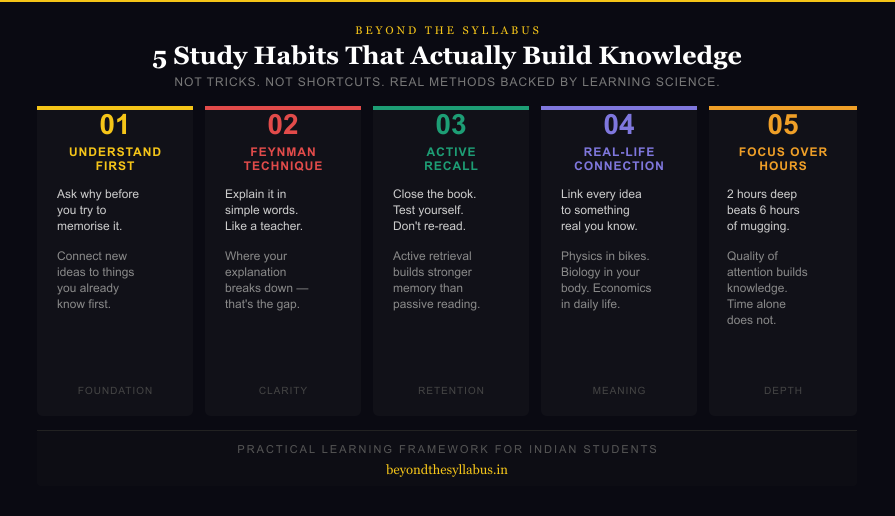
If rote learning is the problem, what is the solution? Here are five approaches grounded in how the brain actually works — approaches that help students build real, lasting knowledge.
1. Understand before memorising. Before trying to commit anything to memory, ask why it is true. Visualise the concept. Draw it. Connect it to something you already know. Understanding creates the framework; memorisation fills it in.
2. Use the Feynman Technique. Explain any topic in simple language — as if you are teaching it to a younger student. The places where your explanation breaks down are exactly the places where your understanding is weak. Go back and strengthen those gaps.
3. Practice active revision. Instead of re-reading notes, test yourself. Close the book and try to recall what you just studied. Solve problems. Take mock tests. Active recall is one of the most evidence-backed study techniques available, and most students never use it.
4. Connect learning to real life. Biology becomes vivid when you connect it to your own body. Economics becomes relevant when you connect it to household expenses. Physics comes alive when you think about how a bike brakes on a wet road. Real-world connections are not distractions from studying — they are the deepest form of it.
5. Prioritise focus over hours. Two hours of focused, conceptual study beats six hours of passive mugging. Quality of attention matters more than quantity of time. Protecting deep work — undistracted, engaged study — is a skill that most students in the era of smartphones have never developed.
For students looking to build these habits more systematically, resources like Khan Academy’s Learning Research offer accessible, evidence-based guidance on mastery learning — studying each concept until it is genuinely understood, not just temporarily memorised.
Indian Education Needs Deeper Change
These individual study strategies matter — but it would be naive to place the entire burden of change on students. The rote learning crisis in India is systemic, and systemic problems require systemic responses.
The world that Indian students are preparing to enter is not the world the current exam system was designed for. The 21st-century economy increasingly rewards adaptability, problem-solving, communication, and creativity — the very capacities that rote learning suppresses. Employers in every sector, from technology to agriculture to public administration, report that graduates lack the critical thinking skills their roles demand.
Meaningful change would require shifting evaluation away from pure recall and toward application and analysis. It would require giving teachers the time and training to teach conceptually. It would require reducing the exam-stakes culture that makes memorisation feel like the only rational choice. These are not impossible changes — many schools and educators across India are already making them, quietly and at significant personal effort.
A Personal Note
Having studied through the Assamese education system and now pursuing an M.A. in Education, I have experienced both sides of this conversation. I know what it feels like to sit before an exam having memorised content I did not truly understand — and I know the specific emptiness that comes when that content evaporates within days of the exam.
I also know what it feels like to understand something — to have a concept click, to see how one idea connects to another, to be able to pick up a topic weeks later and still have it. The difference in how that knowledge feels to carry is not subtle. One is a burden you put down when the exam ends. The other becomes part of how you think.
That distinction is why this blog exists. Beyond the Syllabus is built for learners who want to carry their education with them — not leave it in the exam hall.
Conclusion: Education Should Not End at the Exam Paper
Rote learning is not a student failure. It is a system failure that students are paying for with their curiosity, their confidence, and their capacity to think independently. The good news is that the alternative is not complicated. It begins with one simple shift: understanding before memorising.
Marks matter. Exams matter. But learning matters more — because it is learning, not marks, that stays with you when the textbooks are closed and the real world begins.
Real learning begins when curiosity becomes stronger than fear.
Students across India are more intelligent, more creative, and more capable than the system currently allows them to show. The goal is not to discard the system overnight — it is to learn smarter within it today, and push for something better tomorrow.
Also from Beyond the Syllabus:
→ Why Knowing More Doesn’t Make Decisions Easier
Frequently Asked Questions (FAQs)
Q1. Is rote learning always harmful?
Not entirely. Rote learning is harmful when it replaces understanding — but memorisation still plays a useful role in education. Formulas, definitions, vocabulary, and foundational facts often do need to be memorised. The critical difference is sequencing: understanding should come first, memorisation second. When that order is reversed — or when memorisation becomes the only method — the damage begins.
Q2. Can a student do well in Indian board exams without rote learning?
Yes — and often better. Students who build genuine conceptual understanding tend to perform more consistently across paper patterns and unexpected questions. They are also far less susceptible to exam panic, because their knowledge is not stored as fragile memorised strings that can be disrupted by stress. That said, some degree of targeted memorisation (especially for definitions and factual content) is still necessary for exams like boards and UPSC.
Q3. What is the Feynman Technique and how can Indian students use it?
The Feynman Technique involves explaining a concept in the simplest possible language — as if teaching it to someone with no prior knowledge. If you cannot do this clearly, it reveals gaps in your own understanding. Indian students can apply it practically: after studying a chapter, close the book and explain the main idea out loud or in writing in your own words. The places where you stumble or go blank are exactly the places that need more study.
Q4. How does spaced repetition differ from the usual revision students do?
Standard revision typically means going over material repeatedly in the days before an exam — a method that creates short-term recall but weak long-term retention. Spaced repetition means revisiting material at increasing intervals: once the day after learning it, then three days later, then a week, then a month. This exploits the “spacing effect” — one of the most robust findings in learning science — to build durable long-term memory with significantly less total study time.
Q5. What can parents do to move their children away from rote learning?
The most powerful thing parents can do is to change the questions they ask. Instead of “what marks did you get?”, try “what did you learn today?” or “can you explain that to me?”. This simple shift in focus signals to the child that understanding matters more than performance. Parents can also reduce the pressure around marks enough to create space for genuine curiosity — and resist the urge to enrol children in every available coaching class, which typically intensifies the rote learning cycle rather than breaking it.