
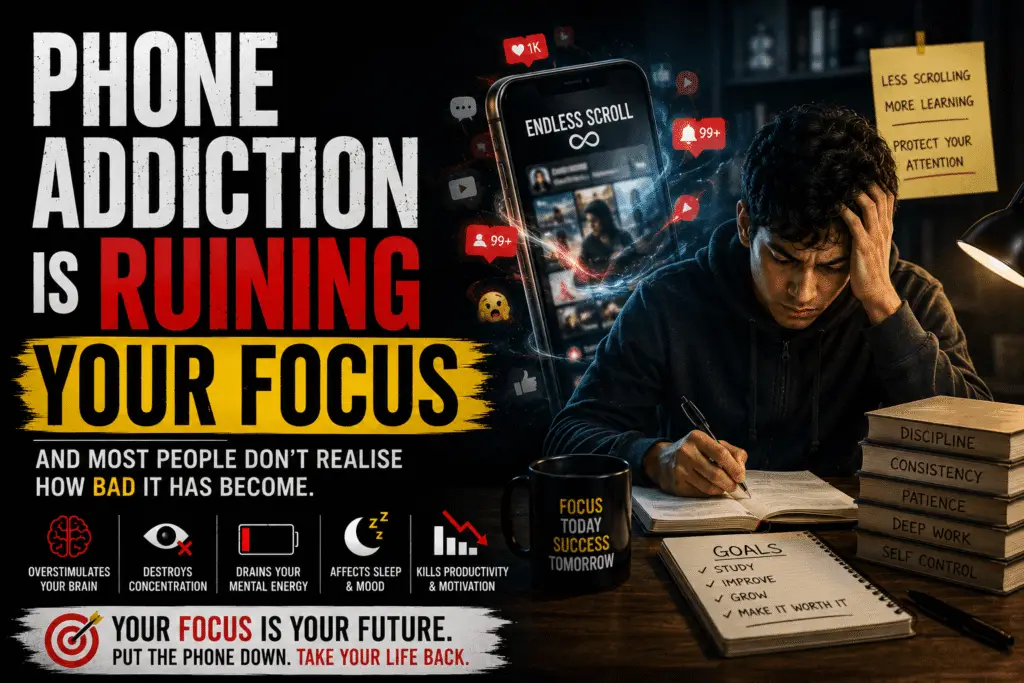
Picture this. You sit down to study. You’ve got your notebook open, the chapter’s right there, and you’re genuinely ready to focus. Then your phone buzzes. One notification. You unlock it, just to check. Five seconds becomes five minutes. Five minutes becomes a reel, then another, then somehow — forty-five minutes are gone. You look up, your chapter is still open at page one, and your brain somehow feels more tired than when you started.
Sound familiar? That is not laziness. That is not a lack of discipline. That is attention fragmentation — and it is happening to millions of students and working adults every single day. The truth is, phone addiction has quietly become one of the most serious focus problems of our time, and most people don’t even notice it happening until the damage is already done.
The Problem Is Bigger Than You Think
Let’s get one thing straight first: smartphones are extraordinary tools. They connect us, inform us, and open up access to knowledge that previous generations could only dream of. The problem is not the phone itself. The problem is uncontrolled stimulation — the way constant phone use is quietly rewiring how our brains process attention, patience, and effort.
Most people think of phone addiction as a productivity issue. You lose a few hours, you get a bit distracted, you could have studied more. But the real damage runs much deeper. Regular smartphone overuse is reshaping the brain’s ability to sustain focus, reducing tolerance for slow and difficult tasks, and actively training the mind toward distraction. It is not just stealing your time — it is changing the way your attention works at a neurological level.
Why Your Brain Feels More Restless and Unfocused Than Before
Here’s something worth sitting with: many people today cannot read two pages of a book without reaching for their phone. Many cannot sit in silence for five minutes without feeling a pull toward their screen. Many cannot watch a full movie without checking notifications halfway through. And a few years ago, the same people could do all of these things without effort. What changed? The short answer: the habits that modern phone use trains. Constant notifications condition the brain to expect interruptions. Endless app-switching teaches it to jump between tasks rather than settle into one. Infinite scrolling removes the natural stopping points that allow the mind to rest. Together, these habits train attention for distraction — the exact opposite of what focused thinking requires.
| Earlier | Now |
| Watched full movies patiently | Skip scenes every few seconds |
| Read books for hours at a stretch | Struggle to read 2 pages without distraction |
| Sat quietly without anxiety | Feel restless the moment boredom arrives |
| Focused on one task at a time | Constant multitasking, rarely finishing anything |
Attention works like a muscle. Train it for distraction, and distraction is what it gets good at.
How Phones Rewire Motivation: The Dopamine Trap
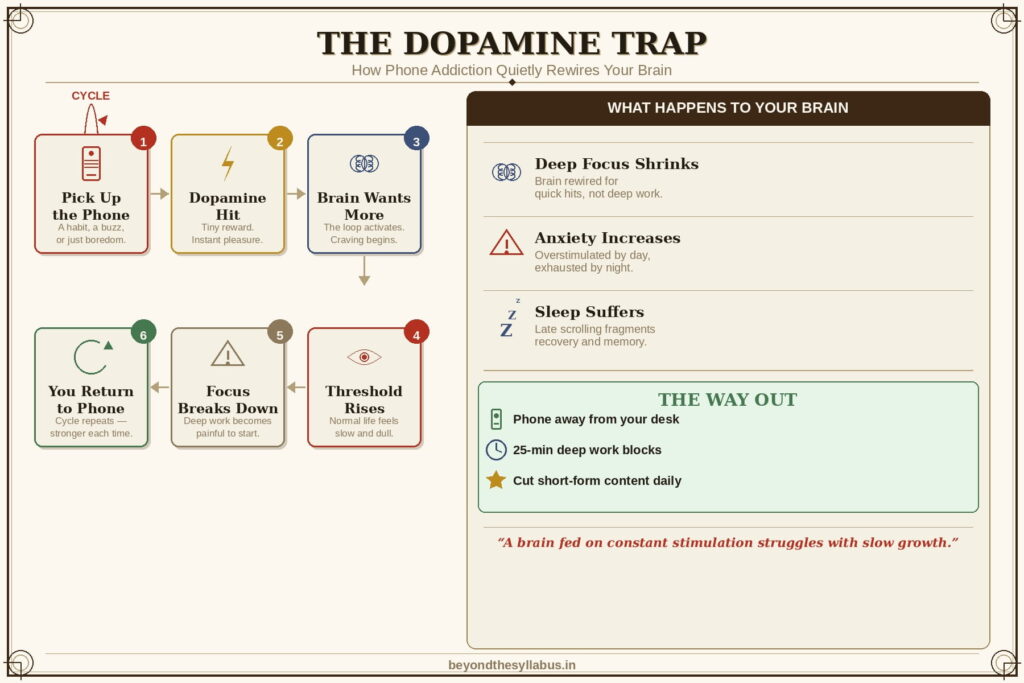
To understand why phone addiction is so hard to escape, you need to understand dopamine — the brain’s primary reward chemical. Dopamine is not just about pleasure. It is about anticipation, novelty, and the drive to seek out new experiences. And modern social media apps are engineered, down to every micro-interaction, to exploit that system.
Every notification, every new reel, every swipe up for more content triggers a tiny dopamine spike. It is a small reward, but it is immediate, effortless, and endlessly available. Over time, the brain adapts to this constant stream of stimulation. And here is where the real damage begins: once the brain is used to quick dopamine hits, anything slower starts to feel painful. Textbooks feel boring. Long lectures feel unbearable. A single task that requires thirty minutes of sustained attention starts to feel genuinely difficult — not because it is hard, but because the brain has been trained to expect something new every few seconds.
A brain addicted to constant stimulation struggles with slow growth.
This is the quiet mechanism behind why so many students find deep study increasingly difficult. It is not a willpower problem. It is a neurological adaptation to overstimulation.
Why Reels and Shorts Are Making Your Attention Span Worse
Short-form video content — reels, YouTube Shorts, TikToks — deserves its own mention here, because it is arguably the most powerful attention-training tool that most people are using every day without realising what it is training them toward.
Each clip is two to thirty seconds of high stimulation: rapid visuals, emotional music, a punchline or surprise, and then immediately, another clip. The brain gets used to a new visual stimulus every few seconds. It gets used to constant audio changes. It gets used to emotional spikes delivered on a tight schedule. The result is a mind that has been trained to expect novelty constantly — and that finds anything without that rhythm increasingly difficult to tolerate.
The consequence for students is direct: weakened concentration, reduced patience, and an almost physical discomfort when asked to sit with a single topic for an extended period. Less short-form content genuinely means a calmer, more capable brain.
Signs Your Phone Is Affecting Your Focus
Before solutions, an honest check-in. How many of these feel familiar?
- You unlock your phone without any clear reason
- You open an app and forget immediately why you did
- Study breaks quietly become thirty-minute scrolling sessions
- You cannot sit in silence without reaching for your phone
- You reread the same page or paragraph repeatedly without retaining it
- You feel mentally drained even on days when you haven’t done much
- You fall asleep watching reels or scrolling through your feed
- You check notifications the moment they appear, almost automatically
If most of these feel familiar, your attention span is already being affected.
The Psychological Effects Nobody Talks About
The focus and productivity angle gets the most attention when people discuss smartphone distraction, but the psychological costs go further than lost study hours.
Constant phone use — especially social media — exposes people to an unending stream of curated highlights: perfect lives, career wins, body standards, travel, and success. Nobody posts their ordinary Tuesday. The result is a steady, low-level comparison cycle that quietly erodes self-confidence and generates background anxiety that most people do not consciously connect to their phone use.
Many people today are overstimulated all day and emotionally drained all night. The phone that was supposed to help them connect is leaving them more isolated, more anxious, and less capable of genuine presence. This is not a minor side effect. It is a significant mental health pattern that is becoming more visible in younger populations year on year.
Research compiled by the American Psychological Association on technology use and adolescent mental health consistently points to links between high social media use, reduced wellbeing, and increased anxiety — patterns that are not limited to teenagers.
You Are Not Weak — The Apps Are Engineered This Way
If you feel like you lack the discipline to put your phone down, there is something important you need to understand: you are not competing against yourself. You are competing against billion-dollar attention systems built by some of the most skilled behavioural psychologists, engineers, and designers in the world.
Infinite scrolling was designed to remove natural stopping points. Algorithmic feeds are engineered to show you exactly what keeps you watching. Variable rewards — the same principle that makes slot machines addictive — are baked into the like and notification system. These are not accidents. They are deliberate design choices made to capture and hold attention for as long as possible.
The most important insight here is that environment matters more than motivation. Willpower alone will always struggle against a system specifically designed to defeat it. The solution is not to try harder — it is to change the environment.
How to Rebuild Your Focus: Practical Solutions That Actually Work
None of these require superhuman discipline. They are environmental and behavioural changes that work with your brain instead of against it.
Keep your phone physically away from your study space. Even a visible phone reduces cognitive capacity on tasks — research from the University of Texas found this holds true even when the phone is face-down and silent. Out of the room is better than out of sight.
Turn off all non-essential notifications. The default notification settings on most apps are designed for maximum engagement, not for your wellbeing. Switching from push notifications to intentional checking immediately reduces the interruption cycle.
Create phone-free hours. Mornings before study, during focused work blocks, and the hour before sleep are the three highest-value times to protect. Even one phone-free morning per week has a measurable effect on baseline focus levels.
Start practising deep work in short blocks. Twenty-five minutes of full, undivided attention, followed by a five-minute break. This is not a rigid system — it is a way of building focus stamina gradually, the same way you would build physical fitness. Consistency over weeks is what creates genuine change.
Relearn how to be bored. This sounds odd, but it is genuinely important. The impulse to reach for your phone the moment boredom arrives is the core habit to break. Walking without headphones, sitting quietly for a few minutes, journalling without a destination — these are ways of rebuilding the brain’s tolerance for mental stillness.
Reduce short-form content consumption deliberately. Set a specific daily limit on reels and shorts — not to punish yourself, but because the cognitive effect of reduced short-form content becomes noticeable within two to three weeks. Many people are surprised by how different their ability to concentrate becomes.
Protect your sleep from your phone. Late-night scrolling disrupts sleep quality in ways that compound directly into next-day focus problems. The phone in bed habit is among the most costly for sustained mental performance.
For a well-researched framework on how to structure focused work sessions, Cal Newport’s work on deep work and digital minimalism offers a compelling and practical approach that goes well beyond surface-level productivity advice.
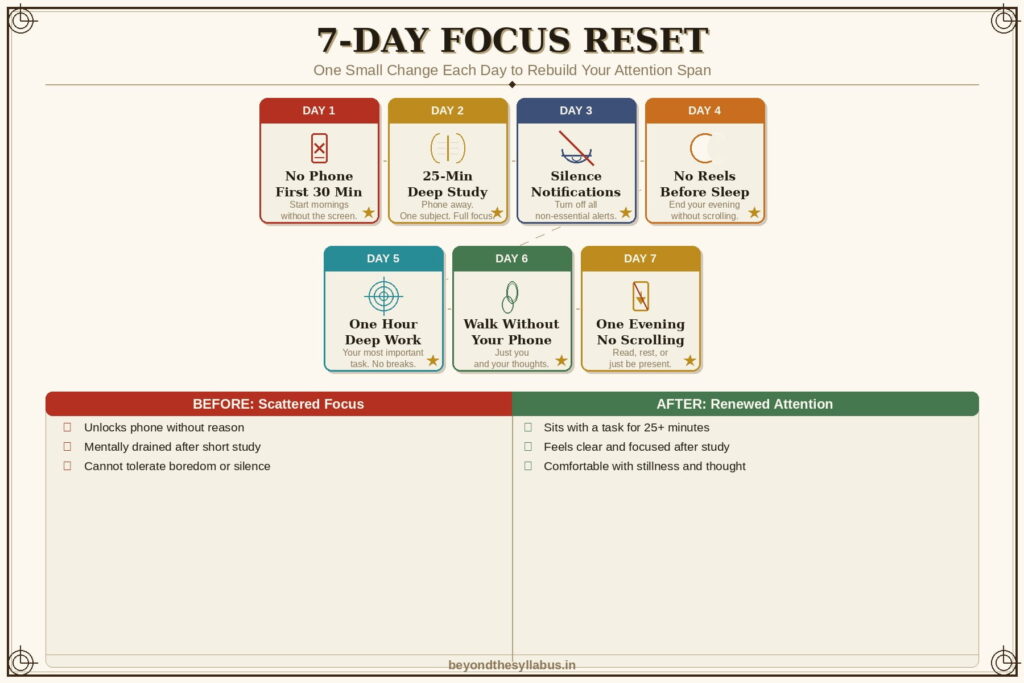
7-Day Focus Reset Challenge
One week. Seven small changes. Try it and notice what shifts.
- Day 1 — No phone for 30 minutes after waking. Start your morning without it.
- Day 2 — 25 minutes of completely uninterrupted study. Phone in another room.
- Day 3 — Turn off all unnecessary notifications. Keep only calls and essential alerts.
- Day 4 — No reels or shorts before sleep. End your evening without scrolling.
- Day 5 — One full hour of deep, focused work on your most important task.
- Day 6 — A walk without your phone. Just you and your thoughts.
- Day 7 — One evening with no scrolling at all. Read, think, rest.
Save this challenge. Share it with someone who needs it.
Attention Is the New Superpower
There is a shift happening quietly across the modern world. For centuries, the people with access to the most knowledge had the greatest advantage. Today, knowledge is nearly unlimited and almost free. What is becoming genuinely rare — and therefore genuinely powerful — is the ability to sit with difficult information long enough to actually understand it.
Most people today cannot focus deeply. They cannot sit with silence. They cannot think uninterrupted for thirty minutes. In a world where almost everyone is distracted almost all the time, the person who can choose where to direct their attention — and keep it there — has an extraordinary advantage.
In a distracted world, focus becomes rare. And rare things become valuable.
A Personal Note
Working through university assignments while managing a blog and other responsibilities means I live this tension directly. There have been stretches of weeks where I could feel my concentration getting weaker — where sitting with a single chapter for twenty minutes felt genuinely difficult in a way it had not before. It took deliberately examining my phone habits to connect what I was doing at night with how my mind was performing during the day.
The changes that helped were not dramatic. They were small, environmental, and consistent. And the effects on clarity, patience, and ability to think deeply were noticeable within days. This is not a lecture — it is a record of something that is very real and very fixable, and something I believe every student and learner in India right now is quietly dealing with.
Conclusion: Your Attention Is Worth Protecting
Phones are genuinely useful, genuinely powerful, and genuinely here to stay. This is not an argument against technology. It is an argument for being deliberate about how that technology is used — because the cost of getting it wrong is not just lost time. The cost is the slow erosion of the capacity to think deeply, learn effectively, and engage fully with the things that actually matter.
The scariest part of phone addiction is not wasted time. It is the slow destruction of your ability to think deeply.
You have not lost your ability to focus. You have allowed it to be trained in the wrong direction. That is something you can change — gradually, deliberately, and with results that are far more noticeable than most people expect. In a world that is constantly fighting for your attention, choosing where you direct it is not just a productivity strategy. It is an act of self-respect.
Also from Beyond the Syllabus:
→ Why Knowing More Doesn’t Make Decisions Easier
→ Why Rote Learning Is Killing Indian Students
Frequently Asked Questions (FAQs)
Q1. How much screen time is too much for students?
There is no single number that works for everyone, but most research suggests that more than two to three hours of recreational screen time per day — separate from studying or work — begins to show measurable effects on attention span, sleep quality, and emotional regulation. The type of screen time matters as much as the quantity. Passive short-form scrolling is far more cognitively costly than reading, video calls, or deliberate content consumption.
Q2. Can you recover your attention span after prolonged phone addiction?
Yes, and often faster than people expect. The brain is remarkably adaptive. Many people who deliberately reduce their short-form content use and create phone-free focus periods notice significant improvements in concentration and patience within two to four weeks. The key is consistency rather than intensity. Gradual, sustained environmental changes produce more durable results than dramatic short-term digital detoxes.
Q3. Why do I keep reaching for my phone even when I don’t want to?
This is a conditioned behavioural response, not a character flaw. The brain has learned to associate moments of boredom, anxiety, or even mild discomfort with the dopamine relief that phone use provides. Over time, this becomes automatic — the hand reaches for the phone before the conscious mind has made a decision. Interrupting this pattern requires both environmental change (removing the phone from reach) and a gradual rebuilding of the brain’s tolerance for discomfort and stillness.
Q4. Does the 7-Day Focus Reset challenge really work?
It works as a starting point, not as a complete solution. The value of a structured challenge like this is not that seven days transforms your habits permanently — it is that it gives you a concrete experience of what focused attention feels like, which makes it much easier to protect going forward. Think of it as a proof of concept: seven days of small changes gives you direct evidence that your attention is not permanently damaged, and that rebuilding it is genuinely possible.
Q5. Is it possible to use social media without it damaging focus?
Yes, but it requires deliberate structure rather than passive use. The most effective approach is scheduled, time-limited social media use — for example, two specific twenty-minute windows per day — rather than open-ended access throughout the day. Turning off algorithmic feeds where possible, unfollowing accounts that trigger comparison anxiety, and consuming content intentionally rather than by default all make a significant difference. The goal is not abstinence but agency: choosing when and how you use the tool, rather than letting the tool choose for you.