
Most of us don’t think about our gut very often. Until it reminds us that it’s there.
A little bloating after lunch.
Acidity that keeps returning.
Constipation before an important journey.
Or those familiar butterflies in the stomach before an examination, an interview, or a difficult conversation.
Suddenly, the organ we had ignored all day demands our attention.
Yet gut health affects far more than the moments when something feels wrong.
Perhaps that’s because we’ve always thought of the gut as something ordinary.
A place where food is digested.
A passage through which every meal quietly travels.
As long as everything works normally, we rarely give it another thought. But what if the gut is doing far more than simply digesting food?
What if it quietly influences parts of our health that seem to have nothing to do with our stomach at all?
Most of us learnt about the digestive system in school. We memorised diagrams, labelled the stomach and intestines, and explained how food travelled through the body. We knew the route well enough to score marks in an examination.
That education helped us understand digestion.
But it was only part of a much bigger story.
Today, research has revealed that our digestive system is much more than a place where food is broken down. Hidden within it is a living ecosystem that communicates, adapts, and quietly supports our health every single day.
The more we learn about the gut, the more we realise we’ve underestimated it.
And perhaps…
Understanding gut health doesn’t begin by asking how we digest our food.
It begins by seeing the gut in an entirely new way.
Why We Think the Gut Only Digests Food
Think back to your school biology classroom.
A labelled diagram of the digestive system.
Mouth.
Oesophagus.
Stomach.
Small intestine.
Large intestine.
A question worth a few marks in the examination.
We memorised the order.
We labelled the parts.
We explained how food travelled through the body. Then, like many lessons, we moved on.
There was nothing wrong with what we learnt.
It gave us a solid understanding of how digestion works.
But it was only part of a much bigger story.
We learnt the route food takes through the body.
We rarely explored what happens after that journey begins.
Very few of us were taught that our digestive system is home to trillions of microorganisms, that it has its own network of nerves, or that it is constantly communicating with the rest of the body in ways researchers are still working to understand.
Perhaps that’s because much of this knowledge is relatively new. Over the past few decades, research into the gut microbiome, the gut-brain connection, and the enteric nervous system has transformed our understanding of gut health.
The gut is no longer seen as simply a place where food is processed.
It is increasingly recognised as a living ecosystem—one that helps digest food, supports a healthy gut, and quietly influences many other aspects of our health.
Looking back, it’s surprising how much of this hidden world lay beyond the classroom.
We spent years learning the map of the digestive system. But almost no time exploring the living world hidden inside it. And perhaps that’s the best place to begin. Because before we understand how the gut communicates with the brain…
We first need to meet the tiny residents that call it home.
Your Gut Is Home to Trillions of Tiny Helpers
Imagine walking through a busy city.
People are working, communicating, repairing roads, delivering supplies, collecting waste, and protecting the places where they live. Every person has a role, and together they keep the city running smoothly.
Now imagine carrying a city like that inside your own body. It may sound surprising, but that’s exactly what happens inside your gut.
Your digestive system is home to trillions of tiny microorganisms—mostly bacteria, along with fungi, viruses, and other microbes. Together, they form what scientists call the gut microbiome.
The word bacteria often makes us think of disease. But the reality is far more interesting.
Many of these microorganisms are not our enemies. They have lived alongside humans for thousands of years, helping us digest certain foods, contributing to the production of certain vitamins, supporting our immune system, and helping keep potentially harmful microbes in check. Rather than invading our body, many of them are essential partners in maintaining our health.
Like every healthy ecosystem, balance matters.
When different kinds of microbes live in harmony, they support one another and, in turn, support us. But poor diet, lack of sleep, chronic stress, illness, or unnecessary use of antibiotics can disturb that balance, making it harder for this living community to function as it should.
Research over the past two decades has revealed just how important this hidden world really is.
We’re learning that the gut microbiome influences not only digestion, but also immunity, metabolism, and its communication with the brain. Many questions remain unanswered, yet one message has become increasingly clear.
We are never truly eating for ourselves alone.
Every meal also nourishes the microscopic world living inside us. Looking after our gut health isn’t simply about nourishing our own body. It’s also about caring for the countless tiny helpers that quietly care for us every single day.
But if this hidden community is constantly working inside us…
How does it communicate with the rest of the body?
The answer begins with a remarkable network of nerves that has earned the gut an extraordinary nickname—the Second Brain.
Why Scientists Call It the “Second Brain”
The brain is often described as the body’s control centre.
It receives information, makes decisions, and sends instructions to every organ. So when scientists began referring to the gut as the “second brain,” the phrase naturally caught people’s attention.
The name doesn’t mean that your gut can think, solve problems, or make decisions like your brain.
It can’t. Instead, the nickname comes from something equally remarkable.
Hidden within the walls of your digestive system is an extensive network of nerves called the Enteric Nervous System (ENS). It contains more than 100 million neurons—more than the spinal cord—and can coordinate many digestive functions independently.
Recent research suggests that the Enteric Nervous System may be even more remarkable than previously thought. Experimental studies indicate that it can undergo forms of learning and memory through changes in its neural connections—a property known as neural plasticity. While this doesn’t mean the gut can think or remember experiences the way our brain does, it does suggest that the gut can adapt its responses over time, reinforcing why scientists often describe it as far more than a simple digestive organ.
Every time you eat, this network helps move food through the intestines.
It regulates the release of digestive juices, monitors the environment inside the gut, and coordinates countless small processes without requiring your conscious attention.
In other words, your brain doesn’t have to supervise every bite you swallow. Your gut already knows much of what needs to be done. But the story doesn’t end there.
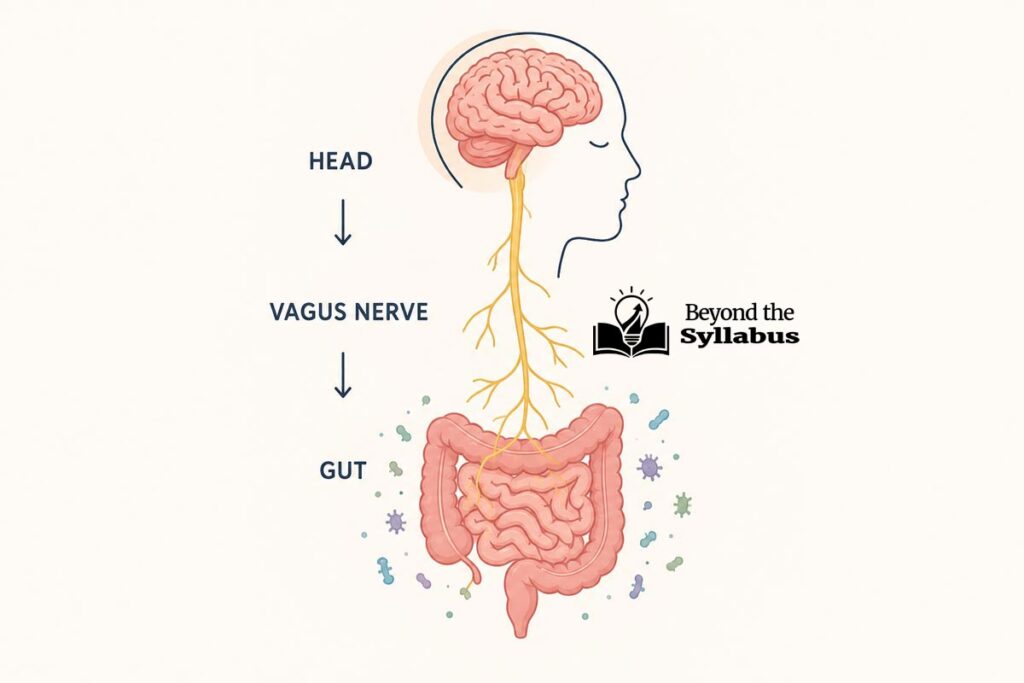
The gut and the brain are constantly exchanging information through a communication pathway known as the vagus nerve. Like a busy two-way highway, it carries signals in both directions, allowing each to respond to what the other is experiencing.
If the gut is a thriving ecosystem, the Enteric Nervous System is the communication network that keeps everything connected.
And this conversation never really stops.
Long before you become aware of hunger, your gut has already begun preparing for a meal.
Before you realise you’ve eaten enough, signals are already travelling to the brain that help create the feeling of fullness.
When harmful bacteria or irritating substances enter the digestive system, messages are exchanged almost instantly, allowing the body to respond.
Most of these conversations happen silently, without us ever noticing. Yet they influence how our digestive system functions every single day.
Although researchers are still uncovering the full extent of this relationship, one conclusion has become increasingly difficult to ignore.
The gut is far more than a passive organ waiting for instructions. It is an active partner in maintaining the body’s balance. And we experience that partnership more often than we realise.
A stressful meeting can take away our appetite.
An exciting opportunity can fill our stomach with butterflies.
A period of anxiety can upset our digestion.
These aren’t strange coincidences.
They’re everyday reminders that the brain and the gut are in constant conversation. Understanding that conversation changes the way we think about digestion. It also changes the way we think about ourselves.
Because some of the feelings we assume begin in the mind…
Have already started somewhere much lower.
When Your Gut Speaks Before Your Mind
Have you ever noticed that your stomach sometimes reacts before your thoughts do?
You’re waiting outside an interview room. Your hands are steady. Your mind tells you to stay calm. Yet your stomach feels unsettled.
Or perhaps you’re about to receive important news. Before a single word is spoken, your appetite disappears.
Many of us have experienced moments like these.
We describe them with familiar phrases:
“I had butterflies in my stomach.”
“I couldn’t eat because I was so nervous.”
“The stress upset my stomach.”
For a long time, these expressions sounded more like figures of speech than science. Today, we know they’re often rooted in real biology.
Because the gut and the brain are constantly communicating, emotional experiences don’t remain confined to the mind. Signals carried through nerves, hormones, and other chemical messengers can influence the digestive system within minutes. At the same time, the gut sends information back to the brain, shaping how we feel in return.
This is why prolonged stress can sometimes lead to bloating, diarrhoea, constipation, or abdominal discomfort, even when no infection is present.
It also helps explain why many digestive disorders become worse during periods of anxiety.
The connection works in both directions. When the brain is under stress, the gut often feels the effects. And when the gut is unhealthy, it can influence how energetic, comfortable, or emotionally balanced we feel.
Research continues to explore just how deep this relationship goes. Studies suggest that the gut microbiome may influence the production of important chemical messengers, including serotonin, a neurotransmitter involved in regulating mood. This doesn’t mean that gut bacteria control our emotions, but it does highlight how closely these two systems are connected.
This is an important distinction.
Feeling anxious doesn’t always mean there’s something wrong with your gut. And having digestive symptoms doesn’t necessarily mean the problem is “just stress.”
Both the brain and the gut influence one another, and recognising that relationship helps us avoid oversimplifying either.
For generations, we’ve separated mental health and digestive health into different conversations.
Our body never did. It has always treated them as parts of the same conversation.
The next question, then, isn’t whether the gut and the brain are connected.
It’s what happens when modern life begins to interrupt that conversation.
Your Gut Is an Ecosystem, Not a Machine
For a long time, we’ve thought of the human body as a machine.
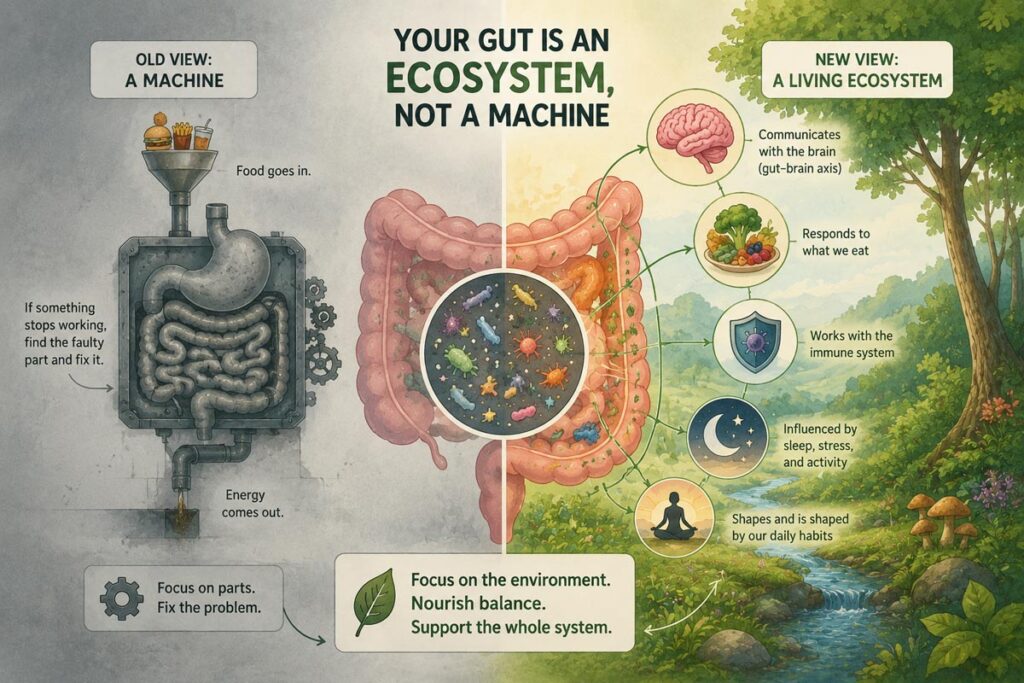
Food goes in.
Energy comes out.
If something stops working, we look for the faulty part and try to fix it. That way of thinking has helped medicine make extraordinary progress. But it doesn’t tell the whole story.
Your gut doesn’t behave like a machine with a few moving parts.
It behaves more like a living ecosystem.
Think about a healthy forest. No single tree keeps it alive.
The soil, insects, fungi, plants, animals, water, and countless invisible microorganisms all depend on one another. When the ecosystem is in balance, the forest thrives. When that balance is disturbed, the effects spread far beyond a single tree.
Your gut works in much the same way.
The trillions of microbes living inside it don’t exist in isolation. They interact with one another, compete for space, produce useful compounds, and create an environment where the entire community can thrive. At the same time, the gut exchanges constant signals with the brain, works closely with the immune system, and responds to what we eat, how well we sleep, how active we are, and even how we handle stress.
Nothing in this system works alone. Everything is connected.
That’s why improving gut health is rarely about finding one miracle food, one magical supplement, or one quick detox.
Healthy ecosystems don’t recover overnight. They recover when the conditions around them gradually improve.
A forest becomes healthy because clean water returns, the soil is nourished, and biodiversity is allowed to flourish.
The gut follows a similar principle.
Small choices, repeated consistently, slowly shape the environment in which this hidden community lives.
One nourishing meal won’t transform your gut.
One sleepless night won’t damage it.
But the patterns we repeat day after day quietly shape the balance within.
This changes the way we think about health itself.
Instead of asking,
“What can I take to fix my gut?”
a better question might be,
“What kind of environment am I creating for it every day?”
That simple shift in perspective may be one of the most important lessons modern gut science has taught us.
And once we begin seeing the gut as an ecosystem rather than a machine, another question naturally follows.
How has the modern world changed the environment that this ecosystem depends on?
What Modern Life Is Doing to Our Gut
For almost all of human history, the gut evolved in a world very different from the one we live in today.
Our ancestors ate a wide variety of seasonal foods, spent more time outdoors, moved their bodies throughout the day, and came into regular contact with the natural world around them. Their internal microbial community developed under conditions that changed gradually over thousands of years.
Our lifestyle, however, has changed dramatically within just a few generations.
Today, convenience often replaces variety. Meals are rushed, sleep is shortened, and stress lingers long after the workday ends. Many of us spend hours sitting indoors, disconnected from the natural environments our bodies once evolved alongside.
None of these changes are harmful on their own. The problem arises when they become our normal way of living.
A living ecosystem responds to its surroundings. The gut is no different.
A diet low in fibre provides less nourishment for many beneficial microbes. Chronic stress can alter the way the gut and the brain communicate. Poor sleep affects several systems involved in digestion and overall health. Even necessary medicines, such as antibiotics, may temporarily reduce the diversity of the gut microbiome while treating harmful infections.
These changes rarely happen overnight. They build quietly.
Just as a river does not dry up after a single hot day, the gut microbiome is shaped by the habits we repeat over weeks, months, and years.
The encouraging news is that the same principle works in our favour. Healthy habits also build quietly.
Adding more fibre to our meals, sleeping a little better, staying physically active, managing stress, and using antibiotics responsibly won’t produce dramatic changes by the next morning.
But together, they create the conditions in which this living community can recover, adapt, and thrive.
Modern life is not the enemy. Medical advances have saved countless lives. Technology has made life easier in many ways. Convenience itself isn’t the problem.
The challenge is remembering that our bodies are still guided by biology that evolved long before supermarkets, smartphones, and twenty-four-hour work schedules.
The more modern our lives become, the more intentionally we must care for the ancient community living within us.
And like every healthy ecosystem…
it has a way of telling us when something is out of balance. If we know how to listen.
Signs Your Gut May Be Trying to Tell You Something
The body rarely develops problems without leaving clues. More often than not, they begin with small signals that are easy to dismiss.
A little bloating after meals.
Frequent acidity.
Constipation that comes and goes.
Loose stools for no obvious reason.
Feeling unusually full after eating only a small amount.
Many of us brush these experiences aside.
“We’ll be fine tomorrow.”
“It’s probably something I ate.”
Sometimes, that’s exactly what it is.
An occasional digestive upset is a normal part of life. Everyone experiences it from time to time, and in most cases it settles on its own.
The important question isn’t whether you have symptoms once in a while.
It’s whether your gut keeps trying to tell you the same story.
Persistent discomfort, frequent digestive problems, or noticeable changes in bowel habits deserve attention—not because they always point to something serious, but because they suggest that the gut may not be functioning as comfortably as it could.
Our bodies are remarkably good at adapting. Sometimes, they adapt so well that we begin accepting discomfort as normal.
We learn to live with daily bloating.
We carry antacids wherever we go.
We assume irregular digestion is simply part of getting older or having a busy life.
But common doesn’t always mean normal.
Many everyday digestive symptoms improve when the underlying causes are understood and healthy habits become consistent. In other cases, persistent or severe symptoms may be a sign of an underlying medical condition that deserves evaluation by a healthcare professional.
Learning the difference is part of looking after our health. Listening to the gut doesn’t mean becoming anxious about every sensation.
It means paying attention to patterns.
When do the symptoms appear?
Do certain foods trigger them?
Has stress made them worse?
Have they been getting better, staying the same, or gradually becoming more frequent?
These simple observations often tell a more useful story than a single uncomfortable day ever could.
The gut doesn’t expect us to interpret every signal perfectly. It simply asks us to notice when something has changed.
And once we begin paying attention…
the next step becomes surprisingly simple.
Not a miracle cure. Not a restrictive diet. Just small, consistent habits that help this remarkable system do what it has evolved to do.
Small Everyday Habits That Help Your Gut
If there’s one lesson modern gut science continues to reinforce, it’s this:
Healthy ecosystems aren’t built overnight.
They’re shaped by small, consistent changes over time. The gut is no different.
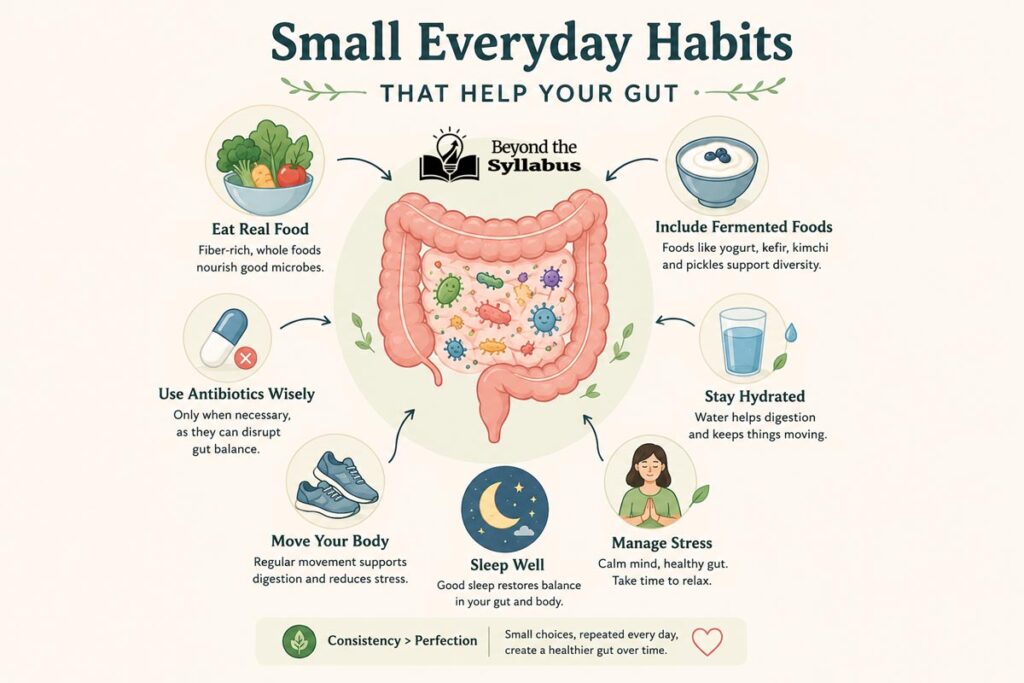
Gut health rarely depends on one superfood, one supplement, or one dramatic change. Instead, it’s often the result of simple choices repeated consistently.
Eating a variety of fibre-rich foods gives different microbes the nourishment they need to thrive. Fruits, vegetables, whole grains, legumes, nuts, and seeds each contribute something unique to the community living inside us.
Fermented foods, such as yoghurt, curd, kefir, kimchi, or fermented vegetables, may also support gut health in many people by introducing beneficial microorganisms or encouraging a healthier microbial environment. Their effects, however, can vary from person to person.
Movement matters too.
Regular physical activity doesn’t just strengthen muscles and improve heart health. Research suggests it may also support a more diverse and resilient gut microbiome.
Sleep deserves equal attention.
While we rest, the body carries out countless processes that help maintain balance, including those that influence digestion and communication between the gut and the brain.
Managing stress is just as important as managing diet.
We cannot eliminate stress from our lives.
But making time for relaxation, meaningful relationships, hobbies, meditation, or simply spending time in nature can help reduce the constant pressure that affects both the mind and the gut.
One more habit deserves special mention.
Use antibiotics wisely.
When prescribed by a healthcare professional, they are among the greatest achievements of modern medicine. But they should never be taken unnecessarily or stopped halfway through a prescribed course. Responsible use helps protect both our health and the delicate microbial communities within us.
None of these habits is extraordinary on its own.
Yet together, they create the conditions in which this remarkable community can adapt, recover, and maintain its natural balance.
That may be the most reassuring lesson of all.
Your gut doesn’t expect perfection.
It responds to consistency.
A healthy life isn’t built by making the perfect choice once.
It’s built by making better choices often enough for the body to benefit.
And that’s true not just for the gut…
but for almost every part of our health.
Conclusion
When most of us think about the gut, we think about digestion. By the end of this journey, it’s difficult to see it in quite the same way.
What once seemed like a simple digestive organ has revealed itself to be something far more remarkable—a living ecosystem, home to trillions of microorganisms, connected to the brain, shaped by our daily habits, and quietly working to keep the rest of the body in balance.
Perhaps the most fascinating discovery isn’t that science has found something new inside the gut.
It’s that the gut has been quietly doing these extraordinary things all along.
Research continues to reveal that the gut is capable of far more than simply moving food through the digestive tract. Its own nervous system can adapt, change, and respond to experience in ways that scientists are only beginning to understand.
And that change in perspective matters.
When we stop seeing the gut as a machine that simply processes food, and begin seeing it as a living ecosystem that needs care, our approach to health changes with it. We become less interested in quick fixes and more willing to build habits that create lasting balance.
In many ways, that’s the story of science itself.
The greatest discoveries don’t always change the world.
Sometimes, they change the way we see the world.
The more we learn, the more we realise that health is rarely the result of one organ working alone. It is the product of countless systems, organisms, and conversations happening inside us every moment of every day.
The gut is one of the best examples of that hidden complexity.
And perhaps that’s the lesson worth carrying beyond this article.
Some of the most extraordinary things in life are hidden inside the most ordinary ones.
The gut is one of them.
Continue Reading
If you enjoyed this article, you might also like:
- Health Beyond the Syllabus: What School Never Taught Us About Staying Healthy
- Science of Sleep: How Sleep Shapes Your Brain and Health
- Your Body Was Designed to Move (Coming Soon)
- Food Beyond Calories: What We Eat Shapes More Than Our Weight (Coming Soon)
Beyond the Syllabus
At school, we learnt where the gut is.
Science is now teaching us what the gut truly is.
Sometimes, learning isn’t about replacing what we already know.
It’s about seeing familiar things through a completely new lens.
And that’s learning beyond the syllabus.
Frequently Asked Questions (FAQs)
1. What is the gut microbiome?
The gut microbiome is the community of trillions of microorganisms—mostly bacteria, along with fungi and viruses—that live in our digestive system. Many of these microbes help digest food, produce certain vitamins, support the immune system, and maintain overall gut health.
2. Why is the gut called the “second brain”?
The gut contains the Enteric Nervous System (ENS), a network of more than 100 million nerve cells. While it doesn’t think like the brain, it can control many digestive functions independently and constantly communicates with the brain.
3. Can gut health affect mental health?
Research suggests that the gut and brain communicate continuously through the gut-brain axis. Scientists are studying how the gut microbiome may influence mood, stress responses, and overall well-being. However, mental health is complex and depends on many biological, psychological, and social factors.
4. What foods support a healthy gut?
A balanced diet rich in fruits, vegetables, whole grains, legumes, nuts, seeds, and fermented foods like curd or yoghurt can help support a healthy gut microbiome.
5. How can I improve my gut health naturally?
Simple daily habits—eating more fibre, staying physically active, getting enough sleep, managing stress, drinking adequate water, and avoiding unnecessary antibiotics—can all contribute to better gut health over time.
6. Should everyone take probiotics?
Not necessarily. Many people can support their gut microbiome through a varied, fibre-rich diet. Probiotic supplements may be useful in some situations, but they are not needed by everyone and should ideally be taken based on medical advice.
7. When should I see a doctor for digestive problems?
Occasional digestive discomfort is common. However, if you have persistent bloating, ongoing constipation or diarrhoea, blood in the stool, unexplained weight loss, severe abdominal pain, persistent vomiting, or difficulty swallowing, it’s important to seek medical evaluation.
8. Can stress cause stomach problems?
Yes. Stress can affect the way the gut and the brain communicate through the gut-brain axis. During periods of prolonged stress, some people experience bloating, constipation, diarrhoea, stomach discomfort, or changes in appetite. While stress is not the only cause of digestive problems, it can make existing symptoms worse in many individuals.
9. What are the signs of an unhealthy gut?
An unhealthy gut may show itself through persistent digestive symptoms such as bloating, frequent acidity, constipation, diarrhoea, excessive gas, or ongoing abdominal discomfort. Feeling unusually full after small meals or noticing long-term changes in bowel habits may also be signs that your gut needs attention. If symptoms are severe, persistent, or accompanied by warning signs such as blood in the stool, unexplained weight loss, persistent vomiting, or difficulty swallowing, it’s important to consult a healthcare professional.
10. How long does it take to improve gut health?
Improving gut health is usually a gradual process rather than an overnight change. Some people notice improvements in digestion within a few weeks of adopting healthier habits, such as eating more fibre, staying physically active, getting enough sleep, and managing stress. However, lasting changes to the gut microbiome and overall digestive health often depend on maintaining these habits consistently over months rather than days.