
I grew up watching people with very little — limited income, basic homes, simple routines — yet many of them laughed easily, slept peacefully, and lived without constant anxiety.
Later, I observed people with far more — money, access, choices — yet often restless, distracted, and deeply dissatisfied.
So one question hit me hard and never quite left:
If more resources don’t guarantee happiness, what actually does?
In the next 10 minutes, you’ll understand not just what happiness is—but why we keep missing it, even after centuries of progress.
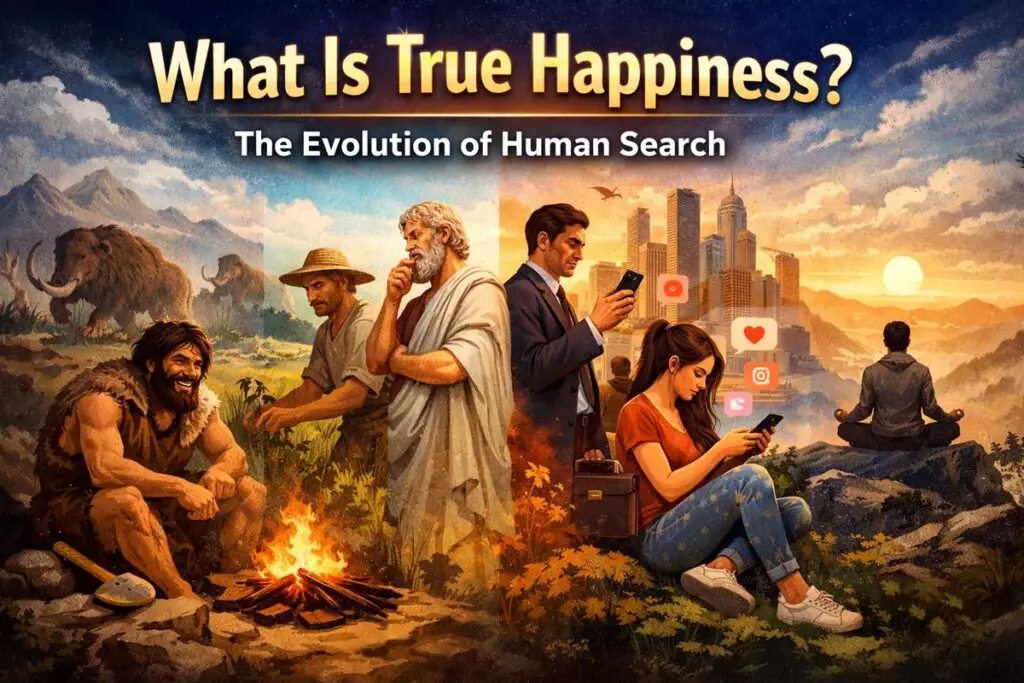
This article traces how the idea of what is true happiness has evolved across human history — from survival instincts to philosophical inquiry, from the industrial age to the digital era. More importantly, it asks what still remains unchanged at the core of that search.
1. The Prehistoric Mind: Happiness as Survival
For early humans, happiness was not a philosophy. It was a signal.
Food found meant relief. Shelter secured meant safety. Tribe together meant belonging. The brain evolved to reward actions that kept the species alive, and pleasure was simply the brain’s way of saying: you’re doing something right.
In this sense, happiness was purely functional. It pointed you toward survival, not toward meaning.
What stayed the same: we still seek safety and belonging — those needs are hardwired.
What changed: survival is now far easier, but the brain still behaves as if danger is constant. That mismatch is at the root of so much modern anxiety.
2. Agricultural Civilizations: Happiness as Stability
As communities formed and farming replaced hunting, life gained structure. Families, social roles, traditions, and seasonal rhythms all emerged together.
Happiness in this era shifted toward something steadier — stability, social harmony, and a predictable life. Community became not just a comfort but a necessity.
Identity itself became tied to social roles: the farmer, the elder, the craftsman. Fulfilling your role well was considered a form of living well.
What stayed the same: the deep need for connection and belonging remained central.
What changed: individual feelings became secondary to collective function.
3. The Philosophical Age: Happiness and Meaning
Somewhere in history, human beings stopped just surviving and started questioning. Thinkers across cultures — Greek, Indian, Chinese — began asking: What is a good life? Is pleasure enough? Does virtue matter?
Happiness evolved into something far richer: meaning, virtue, and inner peace. The idea emerged that a good life is not just about feeling good, but about living right.
The idea of happiness as meaning was not born overnight. Thinkers across cultures began asking what separates a pleasant life from a truly good one. According to the theories of happiness developed in ancient philosophy, happiness is not merely a feeling but a condition of living well — one that requires virtue, purpose, and rational engagement with life.
Aristotle called it eudaimonia — not pleasure, but flourishing. Indian traditions spoke of ananda, a deep bliss rooted in alignment with dharma and self. These weren’t abstract ideas. They were lived frameworks for how to spend a human life.
The philosophical age gave humanity its most enduring insight: happiness rooted in meaning lasts far longer than happiness rooted in pleasure.
4. The Industrial and Modern Age: The Pursuit of Happiness Through Success
Modernity reframed everything. Money, status, career achievement, and lifestyle upgrades became the dominant markers of a good life. The pursuit of happiness became inseparable from the pursuit of success.
And for a while, it seemed to work. More people escaped poverty, gained education, accessed healthcare. Life expectancy rose. Material conditions improved dramatically.
But a problem appeared quietly beneath all this progress.
The more we got, the more we wanted. Desires expanded faster than they could be satisfied. Comparison — once limited to neighbors — suddenly stretched across cities, countries, and eventually the entire world.
The mind still sought satisfaction, but could not find it in excess alone. The science of happiness would later confirm what many people were already feeling: beyond a certain threshold, more wealth adds very little to how good a life actually feels.
5. The Digital Age: Happiness Confused with Stimulation
Today, happiness is often confused with stimulation. Social media delivers a constant stream of content, comparison, validation, and novelty. Likes and attention can feel — for a brief moment — like being seen and valued.
But this model of happiness is exhausting. It produces mental overload, reduced attention spans, and a kind of chronic dissatisfaction that sits just below the surface of daily life.
We are more connected than ever, yet many people feel more disconnected internally than any previous generation.
The digital age did not create unhappiness — but it made the pursuit of happiness more confusing than ever, by flooding the mind with signals that mimic satisfaction without actually producing it.
6. The Turning Point: Rediscovering Inner Peace and Contentment
Something is shifting now, quietly but clearly. People are beginning to recognize that external success alone is not enough. That constant stimulation is not the same as being alive. That busyness is not the same as purpose.
This brings us back to fundamentals that philosophers articulated thousands of years ago: inner peace and contentment, a calm and steady mind, desires that are refined rather than inflated, and a sense of direction that makes daily actions feel worthwhile.
The turning point is not anti-modern. It doesn’t ask you to abandon ambition or reject progress. It simply asks you to look inward alongside looking outward.
7. Happiness and Desire: The Core Conflict
Here is where most people get confused: should we give up desire to be happy?
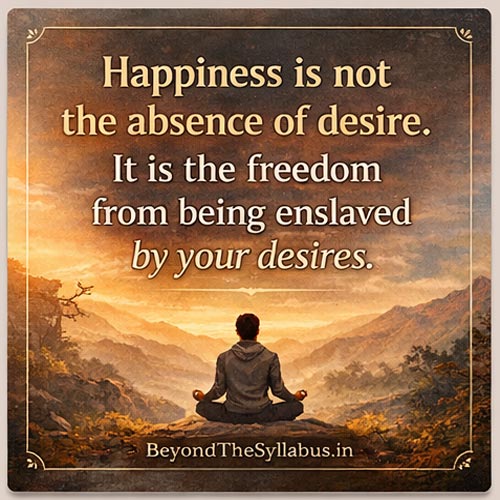
The answer is clearly no. A life without desire is dull, directionless, and incomplete. Desire is what moves us toward growth, creativity, and connection. The problem is not desire itself — it’s what happens when desire operates without awareness.
Healthy Desire vs. Toxic Desire
- Healthy desire is growth-oriented and meaning-driven. It enjoys the process, not just the outcome.
- Toxic desire is comparison-driven and outcome-obsessed. It is never satisfied, because it measures itself against others rather than against its own direction.
The real goal is not to kill desire, but to refine it. To ask, with some regularity: is this desire pulling me toward something meaningful, or is it just pulling me away from stillness?
Happiness and desire are not opposites. The question is whether your desires serve your life, or whether your life serves your desires.
8. The Village and the City: A Living Comparison
A simple observation explains a great deal about why some people with fewer resources still experience more day-to-day happiness.
Village life tends to involve simpler desires, stronger relationships, lower comparison, and a closer connection to natural rhythms. There is less noise between a person and their experience of living.
City life, by contrast, expands desires rapidly, makes comparison constant, and introduces a level of mental overload that the mind was not designed to carry indefinitely.
Neither is simply better. Simplicity without growth can limit a life. Ambition without roots can hollow it out.
The ideal is not to choose between them — it is to carry the inner simplicity of a villager while building the outer capability of a modern individual.
9. Is Happiness Just a Mindset? The Science of Happiness Weighs In
You can sit quietly, breathe deeply, and deliberately shift your attention toward something good — and feel a real, measurable change in your inner state. That is not a myth. It works.
But happiness is not fully independent of circumstance either. Environment shapes you. Health shapes you. The quality of your relationships shapes you deeply. Poverty, chronic illness, and isolation all make the cultivation of happiness significantly harder.
A more accurate view, supported by both modern science of happiness research and ancient wisdom traditions, looks something like this:
Happiness = Inner State × External Conditions × Life Alignment
All three variables matter. You can influence all three. But inner work — the quality of your relationship with your own mind — is the variable that has the most leverage, because it shapes how you interpret and respond to everything else.
Modern neuroscience has also begun to map what happiness actually looks like inside the brain. Research into the relationship between hedonia and eudaimonia — pleasure and meaning — shows that while both are real and measurable, they engage different systems. Pleasure is immediate and reactive; meaning is slower, deeper, and far more durable.
10. The Ethical Dimension of Happiness
Most people feel uneasy after doing something they know is wrong — even when no one is watching. This is not weakness. It is conscience, empathy, and social wiring all working together.
But some people find pleasure in domination, manipulation, or causing harm. This reveals an important truth that is often overlooked in popular happiness discourse:
Not everything that feels good is happiness.
Pleasure and happiness are not the same thing.
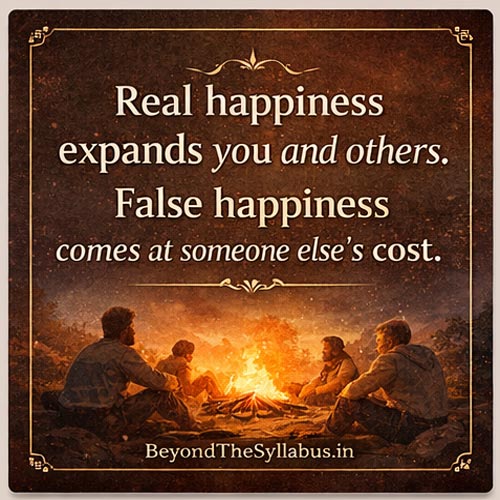
- Conscience-based happiness is calm, stable, and expanding. It grows over time.
- Ego-based pleasure is intense and short-lived. It often contracts your world over time, narrowing your relationships and your sense of meaning.
What is true happiness, then, also has an ethical dimension. A life that creates harm — even if it generates short-term pleasure — cannot sustain genuine well-being.
This distinction has been studied carefully in modern psychology. Research on psychological well-being identifies six core dimensions of a genuinely flourishing life — including purpose, personal growth, and autonomy — none of which can be reduced to simply feeling good in the moment. Happiness that aligns with these dimensions tends to be calm, stable, and self-reinforcing over time.
11. What We Still Haven’t Learned
Despite centuries of philosophical insight and decades of modern research, we still struggle with happiness in remarkably consistent ways.
We chase outcomes rather than alignment. We expand desires without any limits. We compare constantly, and globally. We ignore inner stability in favor of outer achievement.
In short: we upgraded our lifestyle, but not our relationship with our own mind. The meaning of happiness hasn’t changed — but our attention has drifted further and further from it.
The good news is that none of this is fixed. Attention can be redirected. Habits of mind can be cultivated. The research on this is clear, and so is the lived experience of every person who has made the turn inward.
12. Final Synthesis: What Is True Happiness?
Happiness is not just pleasure. It is not just peace. It is not just success. It is not found only inside you, and it is not waiting for you in some future external condition.
It is a balance — a dynamic, ongoing equilibrium — where several things are true at once:
- You have desires, but they do not control you.
- You pursue goals, but you are not entirely dependent on outcomes.
- Your actions align with your values, so there is less friction in your inner life.
- Your mind remains relatively at peace, even when circumstances are not perfect.
Happiness is a stable state of inner well-being that arises when your mind is at peace, your desires are refined, your actions align with your values, and your life is moving in a meaningful direction.
13. Closing: Jeena Bhi Hai, Aur Sukoon Bhi Chahiye
There is a phrase that captures the whole argument beautifully:
Jeena bhi hai, aur jeene ka sukoon bhi chahiye.
जीना भी है, और जीने का सुकून भी चाहिए।(We have to live, and we also need the solace of living)
Not just a life of chasing. Not just a life of escaping. But a life of balance, awareness, and depth. A life where you are ambitious enough to grow, and grounded enough to rest.
That balance — between desire and contentment, between pursuit and peace — is what every tradition, every thinker, and every honest human life has been pointing toward.
That is what true happiness looks like.
14. Evolution of Human Thinking Series
This article is part of the Evolution of Human Thinking series, exploring how human thought, learning, and behaviour continue to evolve in the modern world.
👉 Start here: Evolution of Human Thinking: From Survival to AI (pillar post)
👉 Continue exploring:
→ Evolution of Knowledge: How Information Changed from Books to AI
→ Evolution of Education: From Life’s Greatest Teacher to the World’s Most Expensive Checkbox
→ The Evolution of Decision Making: Why Choosing Feels Harder Than Ever
→ Evolution of Careers: From Lifetime Jobs to the Gig Economy
→ Evolution of Success: From Survival of the Fittest to Fulfilment of the Self
→ Evolution of Relationships: From Tribe to Screen
→ Evolution of Attention: How We Lost Focus and How to Get It Back
Also from Beyond the Syllabus:
→ Why Knowing More Doesn’t Make Decisions Easier
15. Frequently Asked Questions (FAQs)
1. What is true happiness in simple words?
True happiness is a stable state of inner well-being where your mind is at peace, your desires are balanced, and your life feels meaningful—not just momentary pleasure or success.
2. Is happiness a mindset or dependent on external factors?
Happiness is both. You can influence it internally through mindset and awareness, but external factors like health, environment, and relationships also play an important role. The best results come from aligning both.
3. Why are some poor people happier than rich people?
Happiness is less about wealth and more about:
i. Lower comparison
ii. Simpler desires
iii. Stronger relationships
Many wealthy individuals experience stress, competition, and endless desires, which can reduce day-to-day happiness.
4. Should we reduce desires to be happy?
Not exactly. The goal is not to eliminate desires but to refine them. Healthy desires that are meaningful and growth-oriented support happiness, while comparison-driven desires often create dissatisfaction.
5. What is the difference between pleasure and happiness?
Pleasure is temporary and comes from external stimulation (food, entertainment, success). Happiness is deeper, more stable, and comes from inner peace, alignment with values, and a meaningful life.