
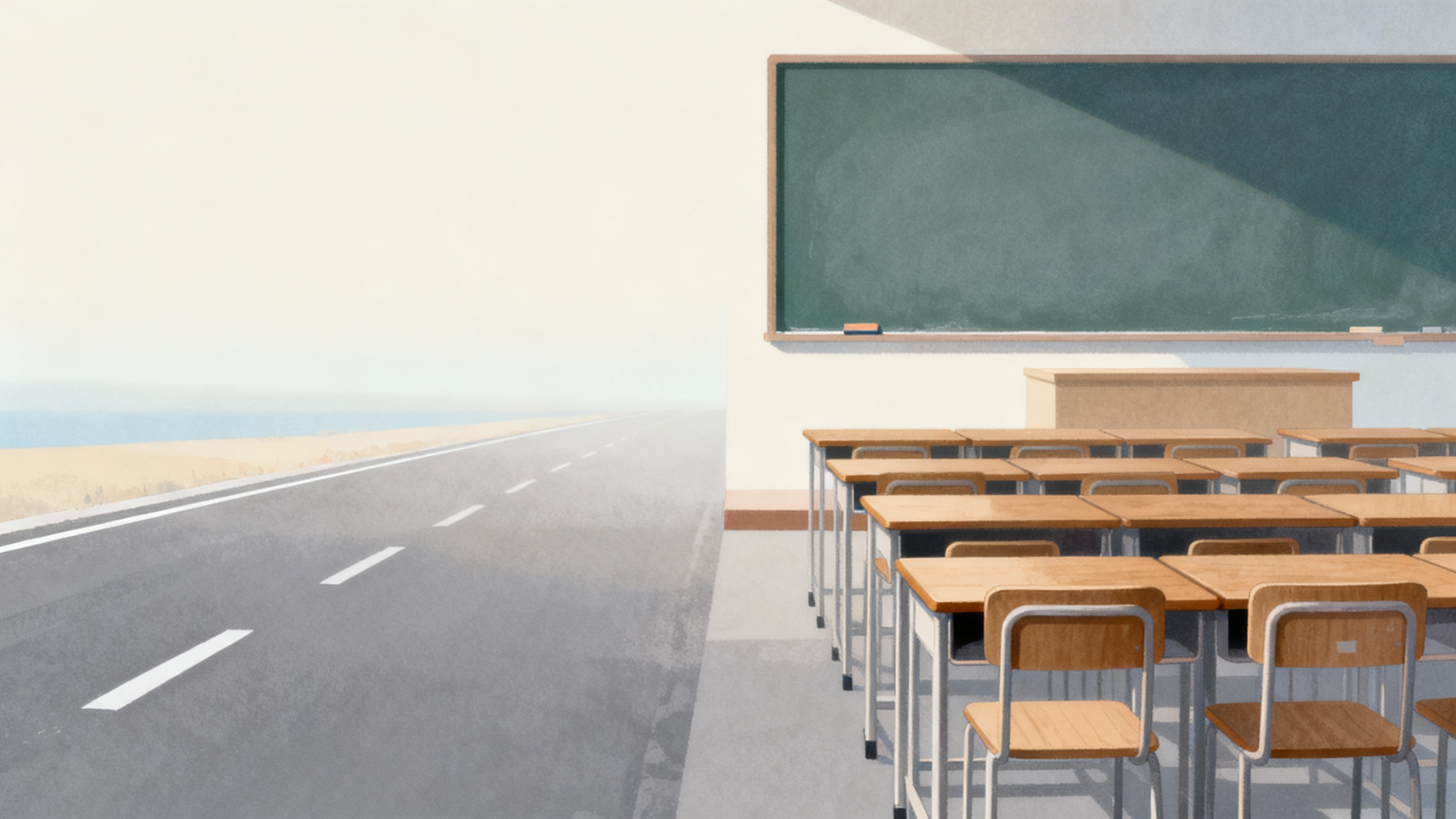
Life after the syllabus begins quietly.
There is no announcement, no ceremony, no warning.
The last exam is written. The final semester ends. A degree is collected, a result is downloaded, a chapter closes. For years, life had moved according to a visible structure—chapters to finish, marks to earn, timelines to follow. Then one day, without much drama, that structure dissolves.
Nothing feels wrong immediately. In fact, there is often relief. The pressure eases. The routine loosens. People congratulate you. You are told you are ready.
But beneath that calm, a subtle shift begins.
The familiar question—What will be asked?—is quietly replaced by a more unsettling one:
What should I do now?
For many, life after the syllabus begins not with freedom, but with uncertainty.
This transition becomes clearer when we understand what the syllabus prepares us for — and what it overlooks, explored in the companion article [What the Syllabus Prepares You For — and What It Ignores].
The Comfort of Structure
The syllabus is rarely questioned while we are inside it.
Not because it is perfect, but because it is clear.
It defines success in advance, breaks complexity into manageable units, and reassures us that effort will be rewarded in predictable ways. If you follow the sequence — attend classes, complete assignments, prepare for exams — progress is measurable and visible.
This structure is especially comforting early in life. From childhood through adolescence, the mind is still forming—curious and imaginative, but not yet fully equipped to navigate ambiguity on its own. External frameworks provide direction when internal ones are still developing.
Within this system, thinking is rarely questioned as long as performance is acceptable. You learn what to study, when to study, and how it will be evaluated. That clarity feels like safety.
And for a long time, it works.
Life After the Syllabus: When the Structure Disappears
The shift begins when the rules stop being explicit.
Outside the syllabus, there are no chapters to complete in order. No marking scheme to reassure you that you are on the right path. No authority to confirm whether your choices are correct or merely convenient.
Questions change shape.
Instead of What will be asked in the exam?
You begin to ask: What is worth learning?
Instead of What is the correct answer?
You wonder: What decision makes sense here?
There is no immediate crisis. Just a growing sense of uncertainty. A feeling that effort no longer guarantees clarity. That outcomes are no longer neatly tied to preparation.
For many, this is often the first real encounter with life after the syllabus.
A Familiar Story
Take Aarav.
Aarav did well in school. Not exceptionally, not poorly—consistently. He followed instructions, met deadlines, and understood what was expected of him. By the time he graduated, he had done everything “right.”
Then came the months after.
Applications were sent. Interviews were attended. Advice arrived from every direction—some confident, some contradictory.
Without a syllabus to organize his next steps, Aarav began hesitating over small decisions. Like many graduates navigating life after the syllabus, Aarav found uncertainty more challenging than exams.
Should he specialize or stay general?
Take the safe option or explore something unfamiliar?
Wait for clarity — or act without it?
None of these questions had clear answers. And without realizing it, he started doubting not his choices—but himself.
He wasn’t failing. He was simply navigating without a map.
The Pull of Familiar Paths
When the syllabus ends, many people do not immediately look inward.
They look sideways.
In the absence of clear direction, familiar paths begin to exert a quiet pull. Civil services. Banking exams. Corporate roles in sales or management. Not because they are inherently right or wrong, but because they resemble something recognizable.
These paths come with timelines, preparation strategies, rankings, and outcomes that can be explained to others. They feel structured. Measurable. Defensible.
In many ways, they function like a new syllabus.
Family expectations often reinforce this pull—not always through pressure, but through concern. The desire for stability, respectability, and predictability is understandable. So is the instinct to follow what has worked for others.
The difficulty arises when choices are made before self-understanding has had a chance to develop.
Over time, this can lead to a quieter problem than unemployment: underemployment. People remain busy, credentialed, and outwardly functional—yet internally disconnected from their work. Not because they lack ability, but because their abilities were never explored.
Without a framework for self-assessment, many mistake movement for direction. They keep going, hoping clarity will arrive later.
Often, it does not.
What Suddenly Matters
It is usually here that something becomes clear.
The challenge was never the absence of intelligence or effort.
It was the absence of preparation for life without a framework.
In this space beyond the syllabus, different abilities begin to matter:
- deciding without complete information
- learning without external pressure
- thinking independently rather than correctly
- adapting when outcomes are uncertain
Educational research increasingly emphasizes deeper learning and critical thinking as essential for real-world problem solving, as noted by Harvard Graduate School of Education.
Formal education prepares students to perform within defined boundaries. Real life rarely announces its boundaries in advance.
This is why learning beyond the syllabus becomes essential — a theme explored in [What Learning Beyond the Syllabus Really Means].
The Quiet Weight of Self-Blame
When confusion persists, many people turn inward.
They assume they are unprepared because they are lacking—insufficiently talented, insufficiently motivated, insufficiently capable. The discomfort feels personal.
But often, it is structural.
They were trained for clarity, not uncertainty.
For evaluation, not exploration.
For answering questions, not framing them.
The struggle is not a failure of intelligence.
It is a mismatch between preparation and reality.
This mismatch becomes even more visible when decisions must be made without clear answers — explored further in [Why Knowing More Doesn’t Make Decisions Easier].
Life After the Syllabus: A Transition Few Anticipate
The syllabus does not end with a dramatic collapse.
It ends quietly, almost politely.
Life continues. Expectations remain. But the scaffolding is gone.
Life after the syllabus is not a crisis — it is the beginning of a different kind of learning.
Some adapt quickly. Others take time. Almost everyone feels the shift.
The syllabus ends.
Learning, if it continues, does so differently.
And in that difference, a new kind of education begins.
***
Frequently Asked Questions (FAQs)
What is life after the syllabus?
Life after the syllabus refers to the transition period after formal education ends, when structured guidance disappears and individuals must make independent decisions.
Why does life after the syllabus feel confusing?
Life after the syllabus feels confusing because structured guidance disappears. Instead of clear instructions and evaluation criteria, individuals must make independent decisions amid uncertainty and competing options.
Is it normal to feel lost after finishing education?
Yes. Feeling uncertain after graduation is common. The transition from structured learning to open-ended life requires adjustment, self-discovery, and time to build independent decision-making skills.
What challenges do graduates face after formal education ends?
Common challenges include career uncertainty, decision fatigue, lack of direction, self-doubt, and adapting to environments without clear rules or evaluation systems.
How long does it take to adjust to life after the syllabus?
Adjustment varies for each person. Some adapt quickly, while others take months or years. The transition becomes easier as individuals gain experience, clarity, and confidence in decision-making.
