

Ask a student why they are studying a topic, and the most common answer is simple: “It will come in the exam.”
Education today is often measured through visible outcomes — marks, ranks, certificates, and degrees. From an early stage, many learners are trained to focus on what will be asked rather than what is worth understanding. Over time, learning becomes tightly bound to syllabi, exams, and deadlines.
While structured syllabi play an essential role in organizing education, they can create an unintended side effect: many learners begin to treat the syllabus as the limit of learning rather than its starting point. Once exams end, subjects are forgotten. When chapters close, curiosity often closes with them.
This is where the idea of learning beyond the syllabus becomes important.
Global education bodies such as UNESCO emphasize lifelong learning as essential for personal and societal development, highlighting that learning must continue beyond formal schooling.
To understand this clearly, we must first separate common misconceptions from its true meaning.
You may also find it helpful to explore how modern education shapes thinking in [What the Syllabus Prepares You For — and What It Ignores].
What “Beyond the Syllabus” Does Not Mean
Before exploring what learning beyond the syllabus truly is, it is useful to clarify what it is not.
Learning beyond the syllabus does not mean rejecting formal education. It does not encourage ignoring exams, assessments, or institutional frameworks. Syllabi exist for good reasons — they provide structure, shared standards, and a foundational body of knowledge.
It also does not promote shortcuts, exam avoidance, or the idea that effort is unnecessary. Nor does it suggest that textbooks and teachers are irrelevant.
Instead, it begins from a simple observation:
A syllabus cannot contain everything worth knowing about a subject.
What Learning Beyond the Syllabus Actually Means
Learning beyond the syllabus means developing understanding that goes deeper than prescribed content. It involves asking questions that may not appear in exams but are essential for real comprehension.
Rather than focusing only on definitions and expected answers, this approach emphasizes:
- why concepts exist
- how ideas connect across subjects
- where knowledge applies in real life
- how to think through unfamiliar situations
Educational research highlighted by Harvard Graduate School of Education describes this as deeper learning — the ability to understand concepts, apply knowledge, and think critically.
Over time, learning shifts from passive memorisation to active engagement. Subjects are no longer isolated chapters to complete, but tools to interpret situations, make decisions, and solve problems.
Most importantly, learning beyond the syllabus cultivates independent thinking rather than dependence on predefined questions and answers.
This deeper learning — often called learning outside the classroom — builds understanding that lasts far beyond exams.
To see how deeper understanding connects with the way humans have processed knowledge over time, read [Evolution of Knowledge].
Why This Matters in the Long Term
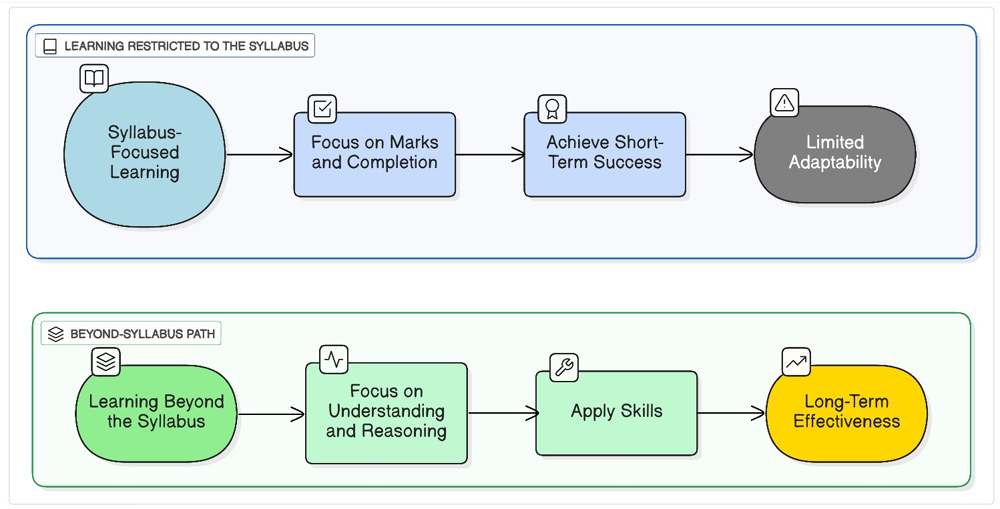
The difference between syllabus‑bound learning and learning beyond the syllabus becomes clearer when we look at how each approach unfolds over time.
| Syllabus-Focused Learning | Beyond-the-Syllabus Learning |
|---|---|
| Focus on exams | Focus on understanding |
| Short-term retention | Long-term application |
| Defined problems | Real-world ambiguity |
| Memorisation | Critical thinking |
| Predictable answers | Adaptive thinking |
Think about this:
How much of what you studied five years ago do you still understand deeply — and how much did you memorise just to pass?
Research from the OECD highlights that modern education must prioritize adaptability, critical thinking, and problem-solving skills to prepare individuals for an unpredictable world.
As people move from academic settings into professional and social environments, the nature of evaluation changes significantly.
Academic performance alone does not always translate into effectiveness beyond formal education. Individuals who excel in structured systems sometimes struggle when problems are undefined and solutions are not provided in advance.
This does not diminish academic achievement. Instead, it highlights a limitation: syllabus-bound learning often rewards recall more than adaptability, judgment, and contextual thinking.
When real-world situations demand decisions without clear instructions, those who have never learned beyond the syllabus may struggle initially — regardless of past academic success.
This challenge becomes even more evident when individuals must make decisions with incomplete information — a topic explored in [Why Knowing More Doesn’t Make Decisions Easier (And Often Makes It Worse)].
Skills That Matter Outside the Classroom
In professional life, performance is rarely evaluated through written answers alone.
Interviews, workplace responsibilities, and daily interactions assess qualities that marksheets cannot fully capture, such as:
- Ability to communicate easily
- Situational awareness and quick thinking
- Practical judgment and pragmatic actions
- Emotional intelligence
- Adaptability
Academic knowledge provides an important foundation. However, long-term effectiveness depends on how that knowledge is applied in unpredictable and human contexts.
Learning beyond the syllabus helps bridge this gap. It encourages observation, reasoning, and common sense — skills developed gradually through exposure, reflection, and thoughtful learning rather than rote preparation.
These abilities form the foundation of what modern thinkers describe as the evolution of careers, where adaptability matters more than static knowledge.
Learning as a Lifelong Process
Formal education occupies only a limited phase of life. Learning itself does not end with graduation, certification, or employment.
Some of the most meaningful learning happens later — through experience, reading, mistakes, conversations, and self-directed exploration.
Learning beyond the syllabus prepares individuals for this phase by building:
- Curiosity
- Intellectual humility
- Adaptability
- Confidence to engage with unfamiliar ideas
The real test of education begins when structure disappears and life must be navigated without a prescribed syllabus.
This approach does not require exceptional intelligence or elite institutions. It begins with a simple mindset:
A willingness to understand, not just to complete.
To explore how continuous learning shapes modern happiness and attention in a distraction-driven world, watch for upcoming posts in the Evolution series.
What You Can Expect From Beyond the Syllabus
This blog exists to explore learning in this broader sense.
Here, the focus will remain on:
✔ clarity rather than complexity
✔ understanding rather than memorisation
✔ thoughtful explanation rather than quick conclusions
The aim is not to replace formal education or examinations, but to complement them by addressing gaps that fixed syllabi often leave behind.
Content on this platform will remain calm, balanced, and grounded — free from hype, shortcuts, or exaggerated claims.
If you believe learning should continue even after the syllabus ends, you are in the right place.
In short:
Learning beyond the syllabus shifts education from completion to comprehension.
When education encourages thinking, application, and curiosity, it prepares learners not only to pass exams — but to understand the world, adapt to change, and think independently throughout life.
***
Frequently Asked Questions
What does learning beyond the syllabus mean?
Learning beyond the syllabus means going deeper than prescribed academic content. It focuses on understanding concepts, asking questions, and applying knowledge in real-world situations rather than memorising information only for exams.
Is learning beyond the syllabus necessary for academic success?
Yes. While exams require syllabus knowledge, deeper understanding improves retention, clarity, and problem-solving ability — which ultimately enhances academic performance.
How can students start learning beyond the syllabus?
Students can begin by asking “why” and “how” questions, exploring real-world applications, reading additional resources, and connecting concepts across subjects.
Does learning outside the syllabus help in careers?
Absolutely. Employers value critical thinking, adaptability, communication, and decision-making skills — abilities developed through learning beyond textbooks and classroom boundaries.
Can learning beyond the syllabus be done without extra coaching?
Yes. It requires curiosity, observation, and self-directed learning. Books, discussions, online courses, and real-life experiences are powerful tools.
What is the difference between memorisation and deeper learning?
Memorisation focuses on recalling information for exams, while deeper learning builds understanding, application ability, and long-term retention.
Why do students forget subjects after exams?
Students often forget subjects because learning is focused on memorisation rather than understanding. Without real comprehension and application, information fades quickly after exams.

Pingback: What the Syllabus Prepares You For — and What It Ignores
Pingback: Life After the Syllabus: What Happens When Structure Disappears