
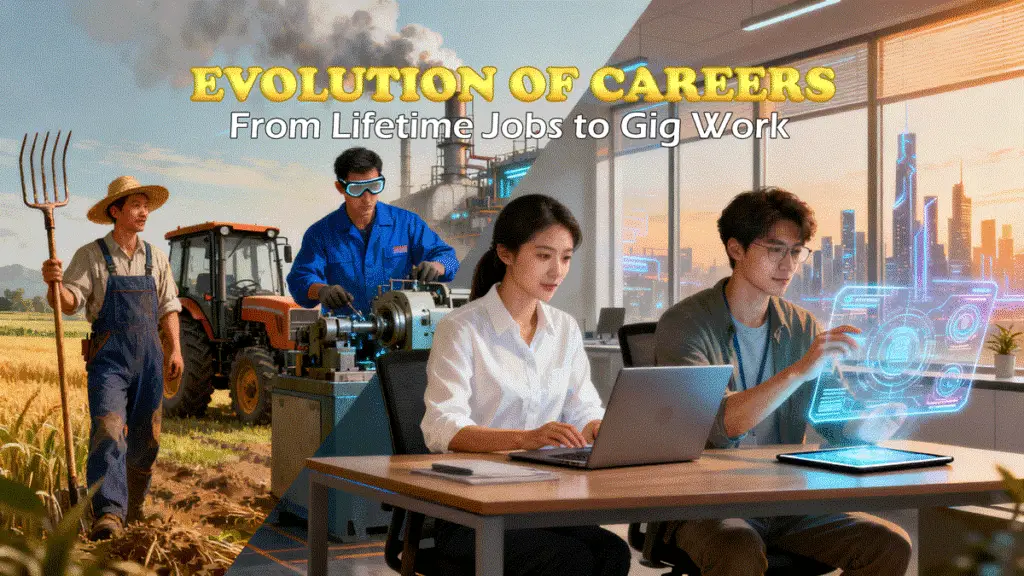
The Evolution of Careers has changed more in the past 50 years than in the previous 500.
There was a time when one job defined an entire life.
Today, people change careers multiple times. Some juggle freelance work, remote roles, and side hustles simultaneously.
Opportunities have multiplied.
Security has decreased.
Freedom has increased.
Uncertainty has increased even more.
If career options are expanding, why do people feel more insecure than ever?
Because careers have evolved — and our expectations have not.
Understanding the evolution of careers helps us adapt to the future of work instead of fearing it.
1. The Survival Era: Work Was About Staying Alive
For early humans, careers did not exist.
Work meant survival.
Hunting.
Gathering.
Building shelter.
Protecting family.
Everyone contributed. There were no job titles — only responsibilities.
Work was meaningful because it was necessary.
Effort meant survival. Contribution meant belonging.
2. The Agrarian Era: Work Became Community and Tradition
With agriculture, work became stable and predictable.
Families farmed land.
Skills passed through generations.
Occupations were inherited.
A blacksmith’s son became a blacksmith.
A farmer’s daughter became a farmer.
Benefits
✔ stability
✔ mastery of skills
✔ strong community identity
Limitation
❌ limited personal choice
❌ little mobility
Work was not chosen. It was inherited.
3. The Industrial Era: Jobs Replaced Occupations
Industrialization transformed work forever.
Factories replaced farms.
Machines increased productivity.
Cities expanded.
For the first time, people worked for employers instead of families.
The modern job was born.
Work Became Structured
Fixed hours.
Defined roles.
Monthly wages.
Hierarchy.
Job security became a life goal.
People stayed in one company for decades.
This created the idea of the lifetime job.
Security became success.
4. The Corporate Era: Careers Became Identity
In the 20th century, careers became central to identity.
People asked:
“What do you do?”
not
“Who are you?”
Job titles defined status.
Engineer.
Doctor.
Manager.
Officer.
Career growth meant promotions, designations, and salary increases…
The Hidden Cost
Work became more than survival.
It became identity.
This also created:
Stress
Competition
Burnout
Work-life imbalance
Then vs Now: Two Generations, Two Career Realities
Our parents sought stability.
We seek flexibility.
They stayed in one job for decades.
We may change careers multiple times.
They valued security.
We value meaning and freedom.
Neither approach is wrong.
They reflect different economic realities.
5. The Digital Era: Careers Became Flexible
The internet removed geographical barriers.
People could now –
Work remotely
Learn online
Build digital businesses
Freelance globally
New careers emerged –
Digital marketing
Content creation
Remote consulting
App development
Work was no longer tied to location. Freedom increased.
But so did uncertainty.
6. The Gig Economy: Work Became Project-Based
Today, the gig economy is reshaping the future of work. The International Labour Organization notes that non-standard and flexible employment models are growing worldwide.
Instead of permanent jobs, many people work on:
short-term projects
freelance assignments
contract roles
platform-based work
Millions now earn through gigs and flexible work.
Why the Gig Economy Is Growing
Companies prefer flexibility.
Technology enables remote work.
Workers seek independence.
Freedom replaces certainty.
Benefits :
✔ flexibility
✔ multiple income sources
✔ independence
✔ global opportunities
Challenges :
❌ income unpredictability
❌ lack of job security
❌ no traditional benefits
Beyond the statistics and trends, real lives are being reshaped by this new way of working. This shift is not theoretical — it is unfolding in the everyday journeys of people around us. One such story is Ramesh’s.
7. A Real Story: One Career, Three Lives
Ramesh still remembers the sound of the factory siren that marked the start of his shift each morning. For years, that sound meant security — a steady income and a predictable life.
When the factory shut down, silence replaced certainty.
Unsure of what to do next, he began fixing electrical items in nearby homes. At first, customers were few. But with patience and persistence, he built trust in his community.
Years later, his son introduced him to a mobile app that connects technicians with customers.
Now his phone rings with work requests from across the city.
The man who once depended on a factory now depends on his skills.
Three careers. One lifetime.
His story mirrors the transformation of work in our time
8. Why Career Anxiety Is Rising Today
Despite more opportunities, career anxiety is increasing.
People worry about:
- Job security
- AI replacing jobs
- Skill relevance
- Income stability
- Future uncertainty
The old promise of “one job for life” is fading.
And the new model is still evolving.
The Fear Behind Career Uncertainty
When career paths become uncertain, fear naturally increases.
Fear of instability.
Fear of failure.
Fear of falling behind.
But uncertainty does not always signal danger.
Often, it signals transition.
9. AI and Automation: The Next Career Shift
Artificial intelligence is transforming careers rapidly.
AI can automate:
routine tasks
data processing
basic analysis
customer support
But it cannot replace:
creativity
empathy
strategic thinking
complex problem solving
According to Forbes research on how AI is changing work, professionals who adapt to intelligent technologies gain long-term advantages.
10. The Future of Careers: From Job Security to Skill Security
The future does not belong to people with fixed careers. It belongs to people with adaptable skills.
Reports from the World Economic Forum highlight that adaptability and continuous learning will be essential for future careers.
Instead of:
job security → focus on skill security
single income → build multiple income streams
static careers → build dynamic capabilities
Skills That Will Matter Most
✔ adaptability
✔ continuous learning
✔ creativity
✔ communication
✔ digital literacy
✔ problem solving
Your skills will protect you more than your job title.
11. How to Stay Relevant in the Modern Career Landscape
Here are practical strategies to thrive:
1. Learn Continuously
Skills expire faster than ever.
2. Build Multiple Skills
Versatility increases opportunity.
3. Develop Digital Competence
Digital literacy is essential.
4. Focus on Value Creation
People are paid for solving problems.
5. Build a Personal Brand
Your reputation creates opportunities.
6. Embrace Change Instead of Resisting It
Change is not a threat. It is direction.
12. Beyond Income: What Work Really Gives Us
Work is not only a source of income.
It provides:
purpose
identity
growth
contribution
self-respect
A fulfilling career is not defined only by salary.
It is defined by meaning.
Ask yourself:
Is my career only paying my bills — or is it also building my life?
13. How Careers Reflect the Evolution of Human Thinking
The evolution of careers mirrors the evolution of human thinking:
Survival → Stability → Identity → Flexibility → Independence → Adaptability
Understanding this shift reduces fear and increases preparedness.
(Also read: The Evolution of Human Thinking: From Survival to AI)
14. Conclusion: From Job Security to Life Design
Careers are no longer fixed paths.
They are evolving journeys.
We moved from survival work…
to inherited occupations…
to lifetime jobs…
to corporate identities…
to flexible careers…
to gig-based work.
The future will not reward rigidity.
It will reward adaptability.
Jobs will change. Industries will evolve. Technology will advance.
But the ability to learn, adapt, and grow will always remain your greatest career security.
Your career is not a ladder to climb.
It is a landscape to navigate.
And those who evolve with change will not fear the future.
They will shape it.
15. Evolution of Human Thinking Series
This article is part of the Evolution of Human Thinking series exploring how human thought, learning, and behavior continue to evolve in the modern world.
👉 Start here:
Evolution of Human Thinking: From Survival to AI (pillar post)
👉 Continue exploring:
- Evolution of Knowledge
- Evolution of Decision Making
- Evolution of Education
16. Frequently Asked Questions (FAQs):
1. What is the evolution of careers?
The evolution of careers refers to how work has changed over time — from survival-based labor and inherited occupations to corporate jobs, flexible careers, and the modern gig economy. Today, careers are more dynamic and skill-based than ever before.
2. Why are lifetime jobs becoming rare?
Lifetime jobs are declining because technology, automation, and global competition require companies to stay flexible. Modern economies value adaptability and skills more than long-term employment in a single organization.
3. What is the gig economy and why is it growing?
The gig economy is a work model where people earn through short-term projects, freelance work, or contract roles instead of permanent jobs. It is growing due to digital platforms, remote work opportunities, and workers seeking flexibility and independence.
4. How is artificial intelligence changing careers?
Artificial intelligence is automating repetitive tasks while increasing demand for creativity, problem-solving, and strategic thinking. Professionals who learn to work with AI tools gain a competitive advantage in the modern workforce.
5. What is skill security and why is it important?
Skill security means having adaptable, in-demand skills that remain valuable even when industries change. In today’s rapidly evolving job market, skills offer more protection than job titles.
6. How can I stay relevant in the future job market?
To stay relevant, focus on continuous learning, digital literacy, adaptability, and problem-solving skills. Building a personal brand and developing multiple income streams can also improve career resilience.
7. Is the gig economy suitable for everyone?
The gig economy offers flexibility and independence, but it also involves income variability and fewer traditional benefits. It works best for individuals who value freedom, adaptability, and self-management.
8. What skills will be most valuable in the future of work?
Future careers will value adaptability, communication, digital skills, creativity, emotional intelligence, and the ability to solve complex problems.
