
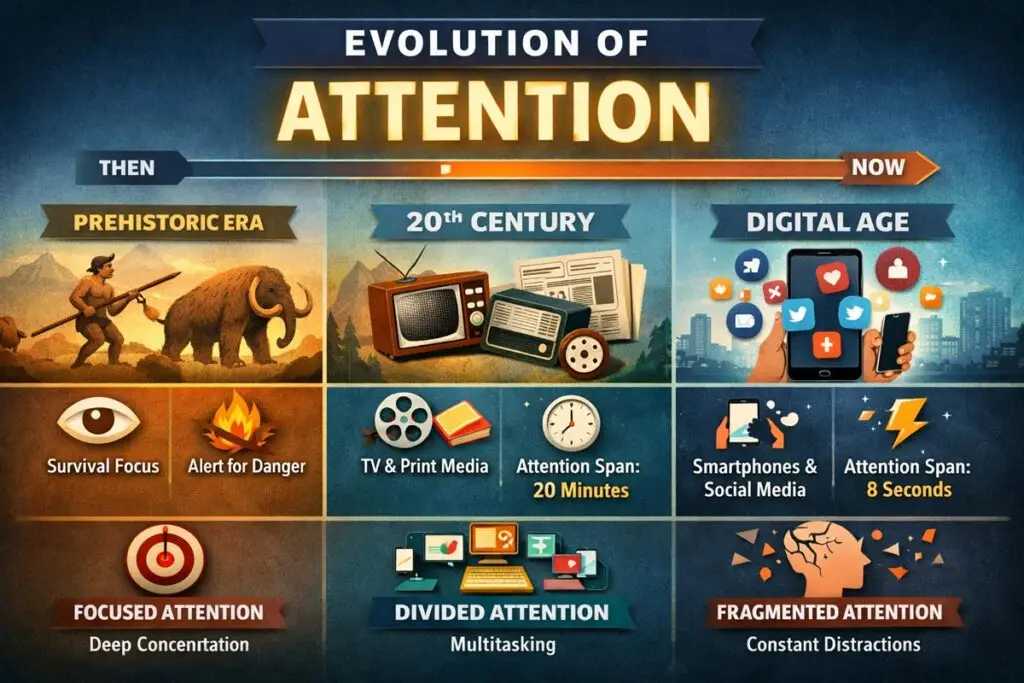
Attention span in the digital age is shrinking faster than ever.
You opened this article to read.
But chances are, your attention has already drifted.
This isn’t a lack of discipline. It’s not because you’re incapable of focus.
It’s because you are living in the digital age — where your attention span is constantly under attack.
Social media, notifications, and algorithm-driven content are not random distractions. They are engineered systems designed to capture and hold your attention for as long as possible.
Today, attention is no longer just a mental ability.
It is a resource being competed for, manipulated, and monetised.
And the real question is:
Are you in control of your attention — or is something else controlling it?
1. The Ancient Era: Attention as Survival
For most of human history, attention was not something to “manage.”
It was something to depend on.
A hunter tracking prey, a farmer reading the sky, or an elder passing knowledge — all required sustained, undivided attention. The cost of distraction wasn’t productivity. It was survival.
Human attention evolved in an environment where focus meant life.
2. The Oral Tradition Era: Attention as Memory
Before writing, attention was the only storage system available.
Entire cultures depended on deep listening. Stories, laws, and knowledge were preserved through memory — and memory required sustained attention.
This era trained the human brain to:
- Listen deeply
- Retain information
- Engage fully
Attention wasn’t optional. It was trained from childhood.
3. The Print Era: Attention Deepened
The invention of the printing press didn’t fragment attention — it strengthened it.
Books created a new cognitive habit:
long-form thinking
Reading required:
- Holding ideas across pages
- Following arguments
- Sitting with complexity
This era produced deep thinkers, not because people were different — but because their environment supported sustained focus.
4. The Industrial Era: Attention Scheduled
The Industrial Revolution introduced something new:
the clock
Attention became structured into:
- Work hours
- Shifts
- Breaks
But here’s the problem:
Human attention doesn’t naturally work in rigid schedules.
This mismatch still exists today — especially for knowledge workers trying to do deep thinking inside systems designed for repetitive labor.
5. The Broadcast Era: Attention Purchased
With radio, television, and newspapers, attention became a market.
Media companies realised something powerful:
👉 The more attention they capture, the more they can sell.
And what captures attention best?
- Conflict
- Fear
- Drama
- Novelty
This wasn’t accidental. It became the blueprint.
6. The Digital Era: Attention Span in the Digital Age and Social Media Impact
The biggest shift in attention span in the digital age comes from social media and algorithm-driven platforms.
Today:
- Every scroll is tracked
- Every click is analysed
- Every pause is measured
Algorithms learn what keeps you engaged — and feed you more of it.
This leads to:
- Shorter attention spans
- Constant distraction
- Reduced ability to focus deeply
Your attention is no longer just influenced.
It is engineered.
7. The Attention Economy Explained
To understand the decline of attention span in the digital age, we need to understand how the attention economy works. The term “Attention Economy” was first framed by Nobel Laureate Herbert Simon in 1971, in a paper that proved prophetic.
“A wealth of information creates a poverty of attention.” — Herbert Simon, 1971
(For a clear introduction to Herbert Simon’s original framework, see: The Attention Economy — Berkeley Economic Review)
Simon’s insight was simple but devastating: information is not free. It costs attention. And because attention is finite — you have only so many hours, so many focused minutes per day — an overabundance of information creates a scarcity of something far more valuable.
How Platforms Capture Your Attention
- Variable reward loops — unpredictable rewards (likes, comments, new content) trigger dopamine in the same way slot machines do
- Infinite scroll — removes the natural stopping cues that books and newspapers provided
- Social validation mechanics — likes, shares, and follower counts activate social anxiety and the desire for status
- Algorithmic personalisation — content is continuously refined to match your specific psychological profile
- Notification systems — trained responses that make your phone feel like it demands immediate compliance
What Platforms Are Optimising For
Every major platform optimises for one metric above all others: time on platform. Not your wellbeing. Not your learning. Not your relationships. Simply: how long can we keep you here.
And the content that keeps you longest is almost never the content that makes you better. It is the content that activates the most primal emotional responses — outrage, fear, envy, desire — and holds you in a state of low-grade stimulation that feels like engagement but produces nothing.
8. The Real Cost of the Attention Crisis
The decline in attention span in the digital age is not just a productivity issue — it affects learning, relationships, and mental health.
At Work
Frequent task switching reduces efficiency. See research from UC Irvine.
It takes time to regain focus — and most people never reach deep focus at all.
In Learning
Shallow attention leads to shallow understanding.
You may consume more information, but retain less meaning.
In Relationships
Presence requires attention.
And attention is increasingly fragmented.
In Creativity
Boredom is essential for creativity.
But constant stimulation has removed boredom completely.
In Mental Health
A constantly stimulated mind never fully rests.
This leads to:
- Anxiety
- Restlessness
- Lack of clarity
9. Deep Work — The Most Valuable Skill of This Era
In 2016, Georgetown professor Cal Newport gave this crisis a name and a solution.
“Deep work: Professional activities performed in a state of distraction-free concentration that push your cognitive capabilities to their limit. These efforts create new value, improve your skill, and are hard to replicate.” — Cal Newport
(Newport’s full framework is available at: Deep Work — Cal Newport)
Newport’s argument is both simple and radical: as distraction becomes the norm, the ability to focus deeply is becoming simultaneously rarer and more valuable. The people who can hold sustained attention on a hard problem — who can resist the pull of the shallow and go deep — will produce disproportionate value in almost every field.
Deep Work vs. Shallow Work
✔ Deep work: Writing, designing, coding, analysing, creating — anything that requires your full cognitive capacity
■ Shallow work: Emails, notifications, administrative tasks, social media — logistical-style work that can be done while distracted
Newport estimates that most knowledge workers spend the majority of their working hours in shallow work — not because it matters more, but because it is easier, more immediately rewarding, and socially expected. The inbox is always there. The algorithm is always waiting. And the discomfort of beginning something deep and difficult is easily avoided by the temporary comfort of something shallow and easy.
The Concept of Attention Residue
One of Newport’s most important contributions is the concept of attention residue. When you switch from Task A to Task B, part of your attention stays stuck on Task A — even after you have physically moved to Task B. This residue degrades your performance on whatever you are supposed to be working on. Every switch costs you something. And a day of constant switching means a day of severely compromised thinking.
10. How to Improve Focus and Concentration in the Digital Age
Improving focus is not about willpower. It’s about environment design.
1. Remove distractions
- Keep your phone away
- Turn off unnecessary notifications
2. Schedule deep work
Block 60–90 minutes daily for focused work.
3. Practice boredom
Don’t fill every idle moment.
Let your mind wander.
4. Read long-form content
Books train sustained attention better than anything else.
5. Use mindfulness
Even 10 minutes of quiet sitting can improve attention.
11. What You Can Do Right Now
You do not need to delete every app and move to a monastery. You need a few deliberate changes, consistently applied.
1. Do a notification audit today
Go through every app on your phone. Turn off every notification that does not require immediate response. Most notifications are not emergencies. They are interruptions dressed as urgency. Remove the ones you have been tolerating, not choosing.
2. Book one hour of deep work tomorrow morning
One hour. Phone out of reach. One task. No switching. No checking. Just you and the hardest thing on your list. Notice what your mind does in the first ten minutes — the itch to check something, the discomfort of difficulty. Notice it. Stay.
3. Read for 30 minutes without stopping — today
Not an article. Not a thread. A book, or something equally long-form. If your mind drifts, bring it back without judgment. That returning — that act of noticing distraction and redirecting — is the exercise. The content is secondary.
4. Spend 10 minutes being bored
No phone. No podcast. No scroll. Just sit, or walk, or stare out of a window. Let the mind go where it wants. Most people have not done this in years. It will feel strange. That strangeness is the beginning of reclaiming something important.
The quality of your attention is the quality of your life. Not your productivity. Not your output. Your life — how fully you inhabit it, how clearly you see it, how deeply you experience it. That quality is not determined by what happens to you. It is determined by what you attend to.
These are not productivity hacks.
They are attention resets.
12. Conclusion: Your Attention Is Your Life
Your attention shapes:
- What you experience
- What you learn
- What you become
The digital world will continue to compete for it.
That will not change.
But one thing can: 👉 Who controls it
You don’t need to escape the modern world.
You need to become conscious within it.
Because in the end:
The quality of your attention determines the quality of your life.
13. Evolution of Human Thinking Series
This article is part of the Evolution of Human Thinking series, exploring how human thought, learning, and behaviour continue to evolve in the modern world.
👉 Start here: Evolution of Human Thinking: From Survival to AI (pillar post)
👉 Continue exploring:
→ Evolution of Knowledge: How Information Changed from Books to AI
→ Evolution of Education: From Life’s Greatest Teacher to the World’s Most Expensive Checkbox
→ The Evolution of Decision Making: Why Choosing Feels Harder Than Ever
→ Evolution of Careers: From Lifetime Jobs to the Gig Economy
→ Evolution of Success: From Survival of the Fittest to Fulfilment of the Self
→ Evolution of Relationships: From Tribe to Screen
Also from Beyond the Syllabus:
→ Why Knowing More Doesn’t Make Decisions Easier
14. Frequently Asked Questions (FAQs)
Q1. What is the evolution of attention?
The evolution of attention refers to how human focus has transformed across history — from the sustained, consequence-driven attention of ancient survival contexts, through the deep reading habits of the print era, to the fractured, algorithmically exploited attention of the digital age. Each era has shaped not only what people pay attention to, but the underlying capacity of the mind to focus at all.
Q2. What is the attention economy?
The attention economy is an economic system in which human attention — rather than money — is the primary scarce resource. The concept was first articulated by Nobel Laureate Herbert Simon in 1971, who observed that an abundance of information creates a scarcity of attention. Today, social media platforms, news organisations, and digital services compete intensely for your attention, which they then sell to advertisers.
Q3. How do social media platforms exploit attention?
Platforms exploit attention through several well-documented mechanisms: variable reward loops (unpredictable rewards that trigger dopamine responses, similar to slot machines), infinite scroll (removing natural stopping cues), social validation mechanics (likes and follower counts that activate social anxiety), algorithmic personalisation (content refined to your psychological profile), and notification systems (trained responses that create a sense of urgency and obligation). Each of these is deliberately designed to maximise time on platform.
Q4. What is deep work and why does it matter?
Deep work, a concept developed by Georgetown professor Cal Newport, refers to professional activity performed in a state of distraction-free concentration that pushes your cognitive capabilities to their limit. Newport argues that as distraction becomes the norm, the ability to focus deeply is simultaneously becoming rarer and more valuable. The people who cultivate this capacity will produce disproportionate value — in knowledge work, in creative fields, and in learning.
Q5. What is attention residue?
Attention residue is the phenomenon, identified in research on task-switching, where part of your attention remains stuck on a previous task even after you have physically moved to a new one. Every switch between tasks carries a cost — a residue of the previous task that degrades your performance on the current one. A day of constant switching therefore means a day of severely compromised cognitive output, even if you feel busy.
Q6. Why is boredom important for attention?
Boredom activates the brain’s default mode network — a state of undirected mental activity associated with integration, creativity, and the formation of unexpected connections between ideas. When we immediately fill every moment of boredom with stimulation (usually through our phones), we deprive the brain of this essential processing mode. Tolerating boredom — allowing the mind to wander without direction — is one of the most important things you can do for creative thinking and long-term attentional health.
Q7. Can attention span be trained again?
Yes. With consistent habits like reading, deep work, and reduced screen exposure, attention can improve significantly.