
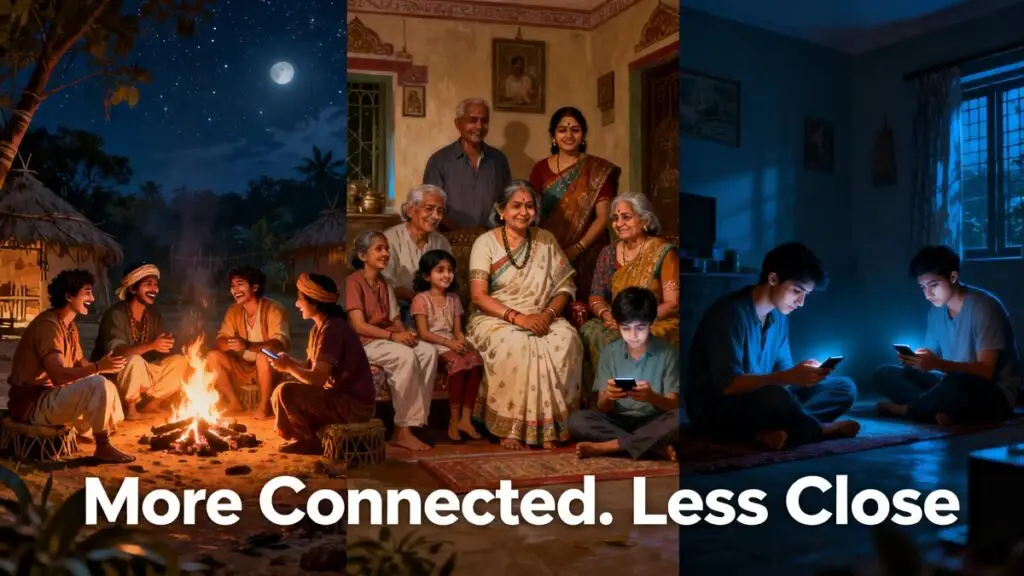
We have never been more connected. And never felt more alone.
You can message someone on the other side of the planet in seconds. You can maintain hundreds of friendships on a single app. You can find a romantic partner, a mentor, a business collaborator, or a community of people who share your most obscure interest — all before breakfast.
And yet.
Marriages are strained.
Friendships are shallow.
Family bonds are fraying.
Workplace relationships feel transactional.
And loneliness — according to the WHO — now affects one in six people worldwide.
This is the central paradox of modern relationships. More tools for connection than any civilisation in history. Less genuine connection than most.
In the Evolution of Success, we saw how chasing the wrong definition of success quietly hollows out a life. Relationships are where that hollowness is felt most acutely — and where it is also most fully healed.
How did human relationships evolve across history?
What has the modern world broken — and why?
And what does it look like to build relationships that actually last?
Let us explore.
1. The Tribal Era: Relationships as Survival
For the first hundred thousand years of human existence, relationships were not a matter of preference.
They were a matter of life and death.
In hunter-gatherer societies, belonging to a group was the most fundamental condition of survival. You did not survive alone. You survived because people knew your name, trusted your word, and would help carry you when you could not walk.
Relationships in this era were not chosen — they were inherited. The tribe you were born into, the family you belonged to, the community you were embedded in. These were not social choices. They were your entire world.
But embedded in that constraint was something precious.
Deep familiarity. Shared purpose. The kind of knowing that comes from spending your whole life with the same people, through every season, crisis, and celebration. Relationships were not curated. They were lived.
The evolution of relationships begins here — not with romance or connection as a feeling, but with belonging as a necessity.
2. The Agricultural Era: Relationships as Structure
When humanity settled into agricultural societies, relationships changed in a fundamental way.
They became organised.
Land required ownership. Ownership required inheritance. Inheritance required clear family lineages. And so the institution of marriage — in its earliest structured form — was born.
Marriage in agrarian societies was rarely about love. It was about property, alliance, and continuity. Families merged through their children’s unions. Villages maintained peace through intermarriage. Social hierarchies were reinforced through who could marry whom.
The Joint Family System — India’s Relational Architecture
In India, the joint family system became one of the most sophisticated relational structures in human history. Multiple generations lived under one roof — grandparents, parents, children, aunts, uncles, cousins — sharing resources, responsibilities, and the daily texture of life.
It was not always comfortable. Privacy was scarce. Individual desires were frequently subordinated to collective needs. Hierarchies were rigid.
But it produced something that is increasingly rare today.
A child grew up surrounded by elders who knew their temperament, their history, their smallest fears. A person facing a crisis did not face it alone — there was always a grandmother who had seen worse, an uncle who knew the right person, a cousin who would stay up through the night.
Relationships were not perfect in the agricultural era. But they were present. Constantly, unavoidably present.
3. The Classical Era: Relationships as Duty and Devotion
As civilisations matured, relationships gained an ethical and spiritual dimension.
Ancient India: The Relational Self
Indian philosophy — across traditions from the Vedas to Buddhism to Jainism — understood the self as fundamentally relational. You were never just an individual. You were a child, a spouse, a parent, a teacher, a student, a member of a community. Each relationship came with specific duties: dharma as it applied to how you treated others.
The concept of seva — selfless service — elevated relationships beyond transaction. You gave not because you expected return, but because the act of giving was itself a form of self-cultivation.
Ancient Greece: Philia — The Love Between Equals
Aristotle identified three types of relationship: those based on utility, those based on pleasure, and those based on virtue — philia. The highest form of friendship, he argued, was between people of equal character who admired and challenged each other toward their best selves.
“In poverty and other misfortunes of life, true friends are a sure refuge.” — Aristotle
Both traditions converged on something essential: relationships are not just about what you receive. They are about who you become through them.
4. The Industrial Era: Relationships Privatised
Then came the Industrial Revolution — and with it, one of the most significant transformations in the history of human relationships.
People moved.
From villages to cities. From extended families to nuclear ones. From communities built over generations to neighbourhoods of strangers. The factory required labour. Labour required mobility. Mobility severed the roots that relationships had always grown in.
The nuclear family — two parents, a small number of children, a self-contained household — became the new relational unit. In many ways, this was liberating. It freed individuals from suffocating community surveillance and rigid hierarchies. It allowed love to become a legitimate reason for marriage.
But it also created a new burden.
Two people — a couple — were now expected to be to each other what an entire village had previously provided. Best friend. Lover. Co-parent. Financial partner. Emotional support system. Source of meaning. All in one.
What the Industrial Era Changed About Relationships
✔ Freed individuals from rigid, arranged, property-based marriages
✔ Elevated love and personal compatibility as legitimate grounds for partnership
✘ Collapsed the extended support network into a single household
✘ Made couples responsible for emotional needs that communities once shared
✘ Uprooted people from the long-term social fabric where deep relationships grow
This was the moment when relationships began to feel like a personal project — something to be managed, maintained, and occasionally fixed — rather than a natural condition of being human.
5. The Modern Era: Relationships Optimised
The 20th century brought a new idea to relationships.
They could be improved.
Self-help books. Marriage counselling. Attachment theory. Love languages. Therapy. Psychology brought the language of health and dysfunction into our most intimate bonds.
This was genuinely valuable. Understanding how childhood shapes attachment patterns, how communication styles create distance, how emotional needs can go unmet even in loving relationships — these were real advances.
But optimisation has a shadow side.
When relationships become projects to be optimised, we begin evaluating them the way we evaluate products. What am I getting out of this? Is this relationship serving my growth? Am I settling?
The language of self-improvement, applied to human bonds, can quietly turn people into assessments. The spouse who is mostly wonderful but occasionally frustrating becomes a ‘below-average relationship’. The friendship that requires effort becomes a ‘drain on your energy.’
Every relationship worth having will sometimes be inconvenient. That is not a flaw in the relationship. It is the nature of genuine closeness.
6. The Digital Era: Relationships Performed
And then came the internet — and social media — and everything changed again.
Relationships became visible.
And visible things can be curated.
The couple who posts matching travel photos. The friend group whose birthdays are always celebrated with elaborate captions. The professional network of 500+ connections. The family reunion that makes it to Instagram but not to honest conversation.
Social media did not invent performative relationships. But it gave them a stage, an audience, and a metric. Likes became a form of social approval. Follower counts became a measure of relational worth.
Four Ways the Digital Era Has Changed Relationships
1. Breadth Over Depth
Technology makes it easy to maintain hundreds of weak connections. It makes depth — the kind that requires time, presence, and vulnerability — harder to prioritise. We have more contacts than any generation in history. We have fewer people we can call at 2am.
2. Comparison Corrodes Satisfaction
When other people’s relationships are visible — carefully edited, highlight-reel versions — your own messy, complicated, entirely normal relationship looks inadequate by comparison. This is not a small thing. Research consistently links social media use with lower relationship satisfaction, not because the relationships are worse, but because the comparison is unfair.
3. Presence Has Become Rare
In a world where every moment competes with a notification, being fully present with another person has become an act of discipline — not a default. We are physically together and mentally elsewhere. Families sit at dinner while each person is somewhere else entirely, in a pocket-sized screen.
4. Conflict Avoidance Is Easier Than Ever
When a difficult conversation can be replaced with a message, when distance can be managed with a mute button, when ghosting is a recognised social behaviour — we are losing the capacity to work through conflict. But working through conflict is precisely how relationships deepen. Avoidance does not protect relationships. It slowly empties them.
7. What Modern Life Is Doing to Our Relationships
The cumulative effect of all these shifts — industrialisation, mobility, optimisation culture, digital performance — is a relationship crisis that is hiding in plain sight.
The Loneliness Paradox
According to the WHO Commission on Social Connection, roughly one in six people worldwide currently experiences loneliness — and the numbers are highest among young people, the most digitally connected generation in history.
(See the full WHO report on social isolation: WHO Commission on Social Connection)
This is the loneliness paradox: the generation with more tools for connection than any before them reporting the least sense of genuine connection.
The Shallow Friendship Problem
Sociologists have tracked a significant decline in the number of close confidants people report — those they can speak to honestly about what matters. In 1985, the average American had three such people. By 2004, that number had dropped to two. Many people today report having none.
Acquaintances are abundant. Genuine friends — people who know your full story — are increasingly rare.
The Marriage Under Pressure Problem
The nuclear couple — already bearing a weight that whole villages once shared — is now also navigating career pressures, digital distraction, parenting without community support, and the constant ambient comparison that social media provides. It is not that people stopped caring about their marriages. It is that the conditions for sustaining them have become extraordinarily difficult.
The Professional Relationship Vacuum
Remote and hybrid work has stripped away the informal, ambient social contact that offices once provided. The casual conversation at the water cooler. The colleague who noticed you seemed off today. The mentor relationship that developed naturally over shared lunches. These were not luxuries. They were the connective tissue of professional life — and they are now largely gone for millions of workers.
8. What the Science Actually Says
For all the complexity of modern relationships, the research is remarkably clear.
After 85 years of tracking the same individuals, the Harvard Study of Adult Development reached a single, consistent conclusion: good relationships keep us happier, healthier, and help us live longer. Full stop.
(The Harvard Study of Adult Development — now in its ninth decade — is the longest running scientific study of adult life ever conducted. Read more: Harvard Study of Adult Development)
Specifically, the study found that relationship satisfaction at age 50 was a stronger predictor of physical health at age 80 than cholesterol levels. That loneliness is as damaging to health as smoking fifteen cigarettes a day. That what protects people from life’s difficulties — illness, loss, failure — is not wealth or status or intelligence. It is the quality of their close relationships.
What the Research Tells Us Matters
- Quality of relationships — not quantity
- The ability to lean on others and be leaned on in return
- Feeling truly known by at least one other person
- The presence of people with whom you can be honest
- Relationships that have survived difficulty together
What the Research Says Does Not Matter (As Much As We Think)
✘ How many connections you have on any platform
✘ Whether your relationship looks happy to others
✘ Never arguing — conflict in safe relationships is normal and healthy
✘ Constant excitement — long-term bonds are sustained by quiet consistency
9. What Healthy Relationships Require Now
The fundamentals of human connection have not changed. What has changed is how difficult the modern environment makes those fundamentals.
Here is what sustaining relationships in the modern world actually requires.
Presence — Chosen, Not Assumed
Being fully present with another person now requires a deliberate choice. It means putting the phone face down. It means having conversations where you are not also half-monitoring something else. Presence used to be the default. Today it is a gift you give.
Vulnerability — The Only Route to Depth
No relationship deepens without vulnerability. And vulnerability requires safety — the knowledge that what you share will be held with care. Creating that safety is the work of every meaningful relationship. It is not something you wait for. It is something you build.
Repair — Not Perfection
The research on long-term relationships is clear: what distinguishes them is not the absence of conflict, but the capacity to repair after it. The couples and friendships that survive decades are not those that never argue. They are those that reliably come back toward each other.
Maintenance — Because Relationships Are Not Self-Sustaining
Relationships require time and attention — not grand gestures, but consistent small ones. The check-in text. The remembered birthday. The ‘I thought of you’ message. The invitation extended even when you are not sure it will be accepted. In the absence of the natural proximity that communities once provided, maintenance has to be intentional.
The Courage to Go Deeper
The easiest thing in the modern world is to stay at the surface of every relationship. To keep things light, non-committal, low-stakes. But surface relationships cannot carry you through life’s actual weight. At some point, depth requires courage — the courage to be fully seen.
10. What You Can Do Right Now
You cannot rebuild the village. But you can rebuild the practices that made villages work.
1. Do a relationship audit — not to evaluate, but to tend
Think of the five people who matter most to you. When did you last give each of them your full, undivided attention — not a message, but genuine presence? That gap, for most people, is larger than they realise. Start there.
2. Have one difficult conversation you have been avoiding
The relationship that has quietly frayed because something was never said. The friend you lost touch with after a misunderstanding. The family member you interact with at the surface but never deeper. One honest conversation, offered with care, can do more for a relationship than months of polite distance.
3. Create one regular ritual of connection
A weekly call. A monthly dinner. A standing walk with a friend. Relationships survive not through intensity but through regularity. Shared rituals — however small — create the kind of accumulated time that deep bonds are made of.
4. Put the phone away for one hour each day — with someone you love
Not to be dramatic. Just to remember what undivided attention feels like. For the person across from you. And for yourself.
The most radical thing you can do for your relationships in the modern world is also the simplest: be fully here, for the person in front of you, without any part of your attention elsewhere.
11. Conclusion: The Most Human Thing We Do
Across every era, through every transformation — tribal, agricultural, classical, industrial, digital — one thing has remained constant.
Human beings need each other.
Not in the abstract. Not through a screen. Not through the performance of connection. But in the deep, unglamorous, requiring-actual-effort way that makes a life feel inhabited rather than just lived through.
The evolution of relationships has brought us more tools than ever.
It has not yet brought us more wisdom about how to use them.
That wisdom is ancient. It was in the tribe that stayed together through the cold. In the Gurukul where student and teacher ate at the same table for years. In the joint family where no one faced a crisis without company. In Aristotle’s philia — the friendship between people who brought out each other’s best.
The modern world has not made that wisdom obsolete. It has made it more necessary than ever.
Relationships are not a feature of a good life.
They are the structure of it.
The evolution of relationships is ultimately a story about what we are willing to prioritise. About whether we choose depth over breadth, presence over performance, and genuine knowing over curated visibility.
That choice is available to you right now.
It costs nothing.
And it changes everything.
REFERENCED SOURCES
🔗 Harvard Study of Adult Development— The world’s longest running scientific study of adult life, tracking relationships and wellbeing since 1938
🔗 WHO Commission on Social Connection — Social Isolation and Loneliness— WHO’s global report on the loneliness crisis and its impact on health
12. Evolution of Human Thinking Series
This article is part of the Evolution of Human Thinking series, exploring how human thought, learning, and behaviour continue to evolve in the modern world.
👉 Start here: Evolution of Human Thinking: From Survival to AI (pillar post)
👉 Continue exploring:
→ Evolution of Knowledge: How Information Changed from Books to AI
→ Evolution of Education: From Life’s Greatest Teacher to the World’s Most Expensive Checkbox
→ The Evolution of Decision Making: Why Choosing Feels Harder Than Ever
→ Evolution of Careers: From Lifetime Jobs to the Gig Economy
→ Evolution of Success: From Survival of the Fittest to Fulfilment of the Self
Also from Beyond the Syllabus:
→ Why Knowing More Doesn’t Make Decisions Easier
Frequently Asked Questions (FAQs)
Q1. What is the evolution of relationships?
The evolution of relationships refers to how human bonds — romantic, familial, social, and professional — have transformed across history. From tribal survival bonds and agricultural family structures, to the industrial-era nuclear family, to the modern crisis of digital connection without depth, each era has reshaped what relationships look like, what they demand, and what they provide.
Q2. Why do modern relationships feel harder than ever?
Because the conditions that once sustained relationships naturally — proximity, shared purpose, community embeddedness, limited mobility — have been systematically removed by modern life. We now must consciously choose and maintain what previous generations inherited by default. Add digital distraction, social comparison, and the pressure of the nuclear couple to replace an entire village, and you have a near-perfect environment for relational strain.
Q3. What does science say about relationships and health?
The research is remarkably consistent. The Harvard Study of Adult Development — the world’s longest running study of adult life, now over 85 years old — found that the quality of our relationships is the single strongest predictor of long-term health and happiness. Relationship satisfaction at age 50 predicted physical health at age 80 more accurately than cholesterol levels. Loneliness, the study found, is as damaging to health as smoking.
Q4. What happened to family relationships in India with modernisation?
India’s joint family system — one of history’s most sophisticated relational structures — provided deep support networks, intergenerational wisdom, shared childcare, and communal resilience. Modernisation, urbanisation, and economic migration have steadily eroded this structure, replacing it with nuclear families that carry far greater individual burden. Many of the relational challenges Indian families face today trace directly to this shift — not because families stopped caring, but because the infrastructure of care was quietly dismantled.
Q5. What is the loneliness paradox?
The loneliness paradox is the observation that the most digitally connected generation in history — with unprecedented tools for communication and community — reports the highest levels of loneliness. The WHO found that approximately one in six people worldwide experiences loneliness, with rates highest among younger people. More connection tools does not automatically produce more genuine connection.
Q6. What makes friendships last long-term?
Research points to three consistent factors: regular contact over time, mutual vulnerability — the willingness to be honest and be received honestly — and the capacity to navigate conflict and repair. Long-term friendships are not those where nothing goes wrong. They are those where the people involved have practiced coming back toward each other, over and over.
Q7. How has social media affected relationships?
Social media has increased the breadth of social contact while often reducing its depth. It has made relationship performance more prominent than relationship substance. It has expanded comparison groups to a global scale, making normal relationships feel inadequate against curated highlights. And it has made distraction during in-person time the default, reducing genuine presence. None of these effects are inevitable — but they require conscious resistance.
Q8. How can I improve my relationships today?
Start with presence — give the people who matter your undivided attention, even for short periods. Have the conversation you have been avoiding. Create one regular ritual of connection: a weekly call, a monthly dinner, a standing walk. And resist the urge to evaluate relationships the way you evaluate products. The best relationships in your life will sometimes be inconvenient, imperfect, and requiring of effort. That is not a problem to solve. That is what genuine closeness actually looks like.