
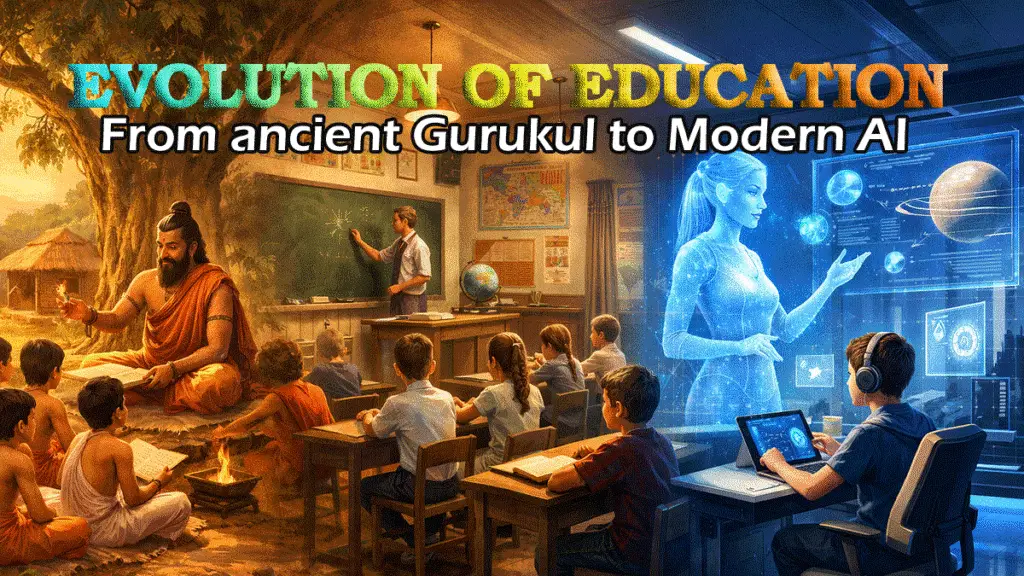
Education has shaped every civilization in human history. It influences how we think, how we work, and how we understand the world. But education has not always looked the way it does today.
In ancient societies, learning was part of everyday life. Children learned by observing elders, participating in work, and solving real problems.
Later, systems like the Gurukul in India and Paideia in Greece treated education as a path to wisdom and character.
Then came the Industrial Revolution, which transformed education into a structured system designed to produce disciplined workers for factories.
Today, we live in a completely different world.
The internet has broken the monopoly of institutions over knowledge, and artificial intelligence is reshaping how humans learn.
Information has never been more accessible.
Yet clarity has never been rarer.
Understanding the evolution of education helps us see why modern learning feels both powerful and confusing at the same time.
To fully understand this transformation, we must also explore the Evolution of Human Thinking (pillar post) — which explains how human minds adapted alongside changing knowledge systems.
Let us explore how education evolved — and what it must become next.
1. What is the Evolution of Education?
The evolution of education refers to how learning systems have changed across history — from experiential learning in ancient societies, to structured Gurukul and classical traditions, to industrial-era mass schooling, and finally to today’s digital and AI-powered learning environments.
2. The Ancient Era: Education as Life Itself
For most of human history, education was not a place you went.
It was something that happened while you lived.
In hunter-gatherer societies, children learned by doing. They hunted alongside adults. They gathered through observation. They understood social rules through participation.
There were no subjects. No curriculum. No exams.
There was only reality — and the constant, honest feedback it provided.
A child who misread the wind paid the price immediately. A child who learned to read it ate well.
Learning was inseparable from living.
This is how the evolution of education began — not in a classroom, but in the world itself.
3. The Gurukul and Paideia Era: Education as Wisdom
As civilisations grew, more structured forms of education emerged.
But they were still deeply tied to life.
The Gurukul System — Ancient India
Students lived with their teachers for years. They studied mathematics, ethics, philosophy, and the arts — not in isolated subjects, but woven together into how they lived each day.
The goal was not a certificate.
It was character.
A student left the Gurukul not just knowing things — but knowing how to live.
Paideia — Ancient Greece
Greek education — paideia — was similarly holistic. Music, gymnastics, philosophy, rhetoric.
The aim was to produce a complete human being, capable of participating in civic life and thinking independently.
In both traditions, the purpose of education was clear:
Make you more human. Not more employable.
This matters when we look at what came next.
4. The Industrial Era: Education as Compliance
Then came the Industrial Revolution.
And education was never the same again.
Factories needed workers who could show up on time, follow instructions, perform repetitive tasks, and not ask too many questions.
The modern school system was — quite literally — designed to produce them.
Prussia developed one of the first compulsory mass education systems in the 1800s. The model spread across Europe and then the world.
Bells divided the day into periods.
Students sat in rows.
Teachers delivered the same content to the same age group at the same pace.
Everywhere.
This was not a conspiracy. It was a rational response to an industrial economy. And for a while, it worked.
Literacy rates rose. Basic numeracy spread. Entire populations gained foundational skills.
What the Factory Model Traded Away
✔ Structure and basic literacy
✔ Scalable access to foundational knowledge
✘ Curiosity
✘ Context
✘ Individual pace and purpose
Education became a production line.
The student became raw material.
The diploma became a quality stamp.
This shift in how knowledge was transferred is deeply connected to what we explored in the Evolution of Knowledge — where information moved from wisdom held by elders to content stored in systems.
5. The Credential Era: Education as a Filter
By the 20th century, the factory model had evolved — but not in the way most people assume.
Post-World War II economic growth created a new belief:
Get the right degree. Get the right job. Get the right life.
Education became the great equaliser — in theory.
In practice, it became a filtering system.
Degrees stopped being about what you could do.
They became about which doors you were allowed to knock on.
The certificate became more important than the competence it was supposed to represent.
The Credential Trap
Most people are living in the credential trap without realising it.
We go to school not to learn how to think — but to earn the right to be considered by employers who themselves went through the same process.
The result?
A generation of highly educated people who are deeply uncertain about almost everything that matters:
- How to make decisions under pressure
- How to handle failure without losing identity
- How to find meaning outside of a job title
- How to keep learning when no one is grading them
This uncertainty is exactly what we traced in The Evolution of Decision Making — where more information did not lead to better choices. The education system trained people to absorb answers, not navigate real questions.
The syllabus taught them what to think. Nobody taught them how.
6. The Digital Era: Education Without Walls
The internet did not just change how we access information.
It shattered the monopoly that institutions had on learning.
For the first time in history, a curious person in a small town has access to the same knowledge as a student at a top university.
YouTube. Podcasts. Online courses. Open-source communities. Blogs.
For many people, these are not supplements to education.
They are education.
Self-directed learners are building skills, starting companies, and developing real expertise — entirely outside formal systems.
The New Problem
But the digital era also created a new challenge.
When everything is available, knowing what to learn — and in what order, and for what purpose — becomes the real skill.
Watching a lecture is not learning.
Reading an article is not understanding.
Saving a course is not completing it.
The evolution of education in the digital era gave us infinite access.
It did not give us the map.
7. The AI Era: Learning at the Speed of a Prompt
We now live in an era where AI can explain concepts, summarise books, generate study notes, and answer questions within seconds. Researchers studying AI and the future of learning suggest that artificial intelligence will transform how people access knowledge and develop skills.
What once required years of study can now be accessed in minutes.
This changes the most important question in education.
Earlier: What do you know?
Today: What can you do with what you know?
AI can provide information. It cannot provide judgment.
It cannot tell you what is right for your life. It cannot help you sit with discomfort, learn from failure, or make a decision that requires courage.
These remain deeply human responsibilities.
The Risk
If we outsource our thinking to AI — completely, passively — we do not become smarter.
We become dependent.
The evolution of education in the AI era will be defined by one question:
Are we using AI to think better — or to avoid thinking altogether?
8. A Real Story: Two Students, One System
Priya and Arjun graduated from the same college in the same year with nearly identical grades.
Priya had spent her four years doing exactly what the system asked. Attended lectures. Completed assignments. Memorised for exams. Got good marks.
Arjun had done the same — but alongside it, he had spent evenings reading books nobody assigned, writing a blog nobody graded, and building small projects nobody asked for.
When both entered the job market, Priya had better marks.
Arjun had better skills.
Priya struggled in interviews when asked open questions. She had always been given the question and shown where the answer was.
Arjun was uncomfortable too — but he had practised being uncomfortable.
The system had taught both the same content.
Only one of them had also learned how to learn.
The difference was not intelligence. It was what each of them had chosen to do beyond the syllabus.
9. What Modern Education Is Getting Wrong
To be fair, modern education is not entirely broken.
Schools provide structure, community, and foundational knowledge. Good teachers change lives. The problem is not that schools exist.
It is what they have quietly stopped doing.
Teaching Answers Instead of Questions
The most valuable skill in a changing world is knowing how to frame the right question.
Schools, by and large, test whether you can produce the right answer.
These are opposite skills.
Optimising for Performance, Not Understanding
A student who scores 90 on a test and forgets everything by next month has not learned.
They have performed.
Education systems are extraordinarily good at producing performers. They are far worse at producing people who genuinely understand things.
Separating Knowledge from Wisdom
We teach economics — but not how to think about money.
We teach history — but not how to learn from it.
We teach biology — but not how to listen to your own body.
The information is present. The wisdom of application is absent.
Treating Learning as a Phase, Not a Practice
Perhaps the deepest flaw: education is designed as something you do for 15 to 20 years and then stop.
But the people who navigate life best are those who never stop. As we explored in the Evolution of Careers, the future does not belong to those with fixed knowledge — it belongs to those with adaptable skills. That kind of adaptability comes from treating learning as a lifelong practice, not a childhood phase.
10. What the Future of Education Must Recover
The future of education will not be saved by better apps or smarter AI — though both will play a role. Reports on the future of education and skills suggest that adaptability and lifelong learning will become more important than traditional credentials.
It will be saved by recovering what was always true about learning:
Learning Must Be Tied to Real Problems
Not hypothetical exam questions. Actual challenges a person is trying to solve. When learning has a purpose the learner can feel, it sticks.
Failure Must Be Part of the Process
The ancient apprentice who ruined a pot learned more from that than from any lecture.
Schools need to stop treating mistakes as deficits — and start treating them as data.
Wisdom Must Be Explicitly Taught
Critical thinking. Emotional intelligence. Ethical reasoning. The ability to sit with uncertainty.
These are not soft skills.
They are the skills that determine how well everything else works.
Learning Must Never End
The most important thing a formal education can do is produce someone who continues to educate themselves long after the last exam.
Not because they have to.
Because they want to.
11. What You Can Do Right Now
You do not need to wait for the system to fix itself.
The evolution of education is also happening inside individuals who choose to engage with learning beyond what was assigned.
Here are three things you can do this week:
1. Follow One Thread of Genuine Curiosity
Identify something you are genuinely curious about — not because it is useful, but because it pulls you. Spend 20 minutes on it. Notice what happens when learning is self-directed rather than assigned.
2. Ask the Application Question
The next time you learn something — from a book, a video, or a conversation — ask: What would I do differently because of this?
That one question is the bridge between information and wisdom.
3. Find a Learning Community
A mentor, a community, a podcast, a discussion group — a place where people talk about ideas in a way that sparks new questions.
That conversation is education in its oldest and most effective form.
The classroom was never the only place you could learn. It was just the most convenient one. The evolution of education is asking you to remember that — and act on it.
12. Conclusion: The Real Purpose of Education
Humanity has never lacked the desire to learn.
From life-based wisdom in ancient communities, to the holistic Gurukul, to the factory-model classroom, to the infinite digital library, to the AI-powered tutor — education has always reflected what society valued most at that moment.
Today, we are at an inflection point.
The tools have never been more powerful.
The confusion has never been greater.
The future will not belong to those who collected the most credentials.
It will belong to those who learned how to keep learning.
Not because a syllabus told them to.
But because they understood why it mattered.
That is the evolution of education.
And it begins — as it always has — with a single curious question.
13. Evolution of Human Thinking Series
This article is part of the Evolution of Human Thinking series, exploring how human thought, learning, and behaviour continue to evolve in the modern world.
👉 Start here: Evolution of Human Thinking: From Survival to AI (pillar post)
👉 Continue exploring:
→ Evolution of Knowledge: How Information Changed from Books to AI
→ The Evolution of Decision Making: Why Choosing Feels Harder Than Ever
→ Evolution of Careers: From Lifetime Jobs to the Gig Economy
Also from Beyond the Syllabus:
→ Why Knowing More Doesn’t Make Decisions Easier
→ The Day the Syllabus Ends
14. Frequently Asked Questions (FAQs)
Q1. What is the evolution of education?
The evolution of education refers to how learning has transformed over time — from life-based wisdom in ancient societies, to structured Gurukul and Socratic traditions, to industrial-era mass schooling, to the digital and AI-powered learning environments of today.
Q2. When did education stop being about wisdom?
The shift began during the Industrial Revolution, when schools were redesigned to produce reliable workers rather than independent thinkers. The credential era of the 20th century deepened this — replacing wisdom with certificates as the primary goal of education.
Q3. What is the credential trap?
The credential trap is the cycle where people pursue degrees and certifications primarily to gain access to opportunities — rather than to build genuine understanding or capability. The certificate becomes more important than the competence it was meant to represent.
Q4. How has the internet changed education?
The internet broke the institutional monopoly on learning. Anyone with curiosity and connectivity can now access world-class knowledge. But it also introduced a new challenge: infinite content without direction. Access is no longer the barrier — knowing what to learn and why has become the real skill.
Q5. What is the biggest flaw in modern education?
Perhaps the most significant flaw is treating education as a phase rather than a practice. Modern systems are designed for a fixed period of schooling, after which learning is expected to stop. But the people who thrive in a rapidly changing world are those who never stop learning.
Q6. What does the future of education look like?
The future of education will combine the depth of ancient wisdom traditions with the access of digital tools and the efficiency of AI — guided by a return to genuine curiosity, real-world application, and lifelong learning as a personal practice.
Q7. How can I learn better outside the formal system?
Start with genuine curiosity rather than utility. Ask what you would do differently after learning something new. Seek communities and conversations that spark real questions. And treat learning as something you do every day — not something that ended with your last exam.