
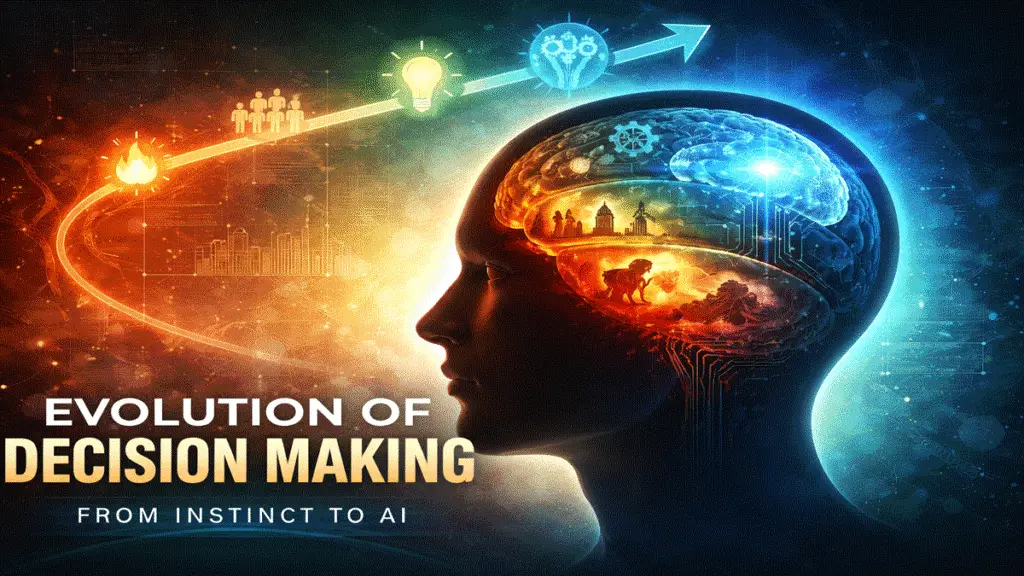
The evolution of decision making has quietly transformed how we live, work, and think.
Never before have humans had so much freedom to choose.
We can choose our careers, lifestyles, beliefs, relationships, and even where we want to live. We can learn any skill online, change professions, and reinvent ourselves multiple times.
Yet despite this freedom, people feel more confused than ever.
They delay decisions.
They second-guess themselves.
They fear making the wrong choice.
They regret decisions even after making them.
If we live in an age of opportunity, why is decision making difficult today?
The answer lies in understanding how decision making has evolved across history.
Human decision-making has evolved alongside society itself. Understanding this evolution helps us navigate modern confusion with clarity.
To make better choices in the digital age, we must understand the evolution of decision making — from instinct to artificial intelligence.
Let’s explore this journey.
1. Evolution of Decision Making in the Instinct Era
Research on human evolution shows that survival instincts shaped early decision responses.
Run from danger.
Find food.
Protect family.
Seek shelter.
Decisions were:
✔ fast
✔ instinctive
✔ emotional
✔ survival-focused
There was no time for analysis. Hesitation could mean death.
Why Instict Still Influences Us
Our brains still carry this survival system.
That is why we:
- panic before interviews
- avoid unfamiliar situations
- react emotionally under stress
Even today, instinct guides many decisions before logic steps in.
2. Evolution of Decision Making in the Tradition Era
As communities formed, decisions became guided by customs, elders, and cultural values.
People asked:
What do elders advise?
What is acceptable in society?
What is our tradition?
Decisions were shaped by collective wisdom rather than personal preference.
Why This Worked
✔ reduced uncertainty
✔ shared responsibility
✔ social stability
✔ predictable life paths
Marriage, careers, and duties were clear.
Less confusion.
Less overthinking.
Even today, family expectations and cultural values influence major life choices.
3. Evolution of Decision Making in the Reason Era
With the rise of science and formal education, decision making shifted toward logic and rational thinking.
People began asking:
What is logical?
What gives better results?
What is practical?
Decisions became based on:
- evidence
- analysis
- comparison
- measurable outcomes
Education trained people to evaluate options logically.
But it also introduced a hidden pressure: Every decision must be PERFECT.
(Also read: Why Knowing More Doesn’t Make Decisions Easier (And Often Makes It Worse))
4. Evolution of Decision Making in the Industrial Era
Industrialization made decision making future-focused and career-driven.
People prioritized:
job stability
steady income
long-term security
Success meant choosing the safe and stable path.
This mindset still shapes career choices today, especially in societies where stability is highly valued.
Security became success.
Risk became danger.
5. Evolution of Decision Making in the Information Era
The internet transformed decision making in the digital age.
Earlier, options were limited.
Today, options are endless.
Career paths.
Courses.
Business opportunities.
Lifestyle choices.
Information sources.
More options created freedom — but also confusion.
The Paradox of Choice
When choices increase:
decision time increases
doubt increases
satisfaction decreases
Too many options create mental overload and decision fatigue in modern life.
Real-Life Example
A student exploring careers sees:
engineering
medicine
design
data science
digital marketing
civil services
entrepreneurship
Instead of clarity, he feels overwhelmed.
6. Evolution of Decision Making in the AI Era
Artificial intelligence is now influencing decision making more than ever before.
AI recommends:
what to watch
what to buy
what to learn
where to invest
This shows how AI and decision making are becoming interconnected.
According to MIT Sloan research on how AI is changing work, professionals who adapt to intelligent technologies gain long-term advantages.
What AI Changes
AI improves speed and analysis.
AI reduces effort.
AI enhances recommendations.
But AI cannot replace human judgment.
AI gives answers.
Humans give meaning.
7. Why Decision Making Is Difficult Today
Despite better tools and more information, decision making in the digital age has become harder.
People struggle with:
- overthinking
- comparison
- fear of missing out
- decision fatigue
- fear of regret
We analyze too much and trust ourselves too little.
Why Choosing Feels Hard
Unlimited options
constant comparison
information overload
fear of judgment
pressure to succeed
Our ancestors had fewer choices.
We have infinite choices.
And infinite choices create hesitation.
8. The Emotional Brain: Why Logic Alone Cannot Decide
Even though modern decision making appears logical, most choices are still influenced by emotions.
We like to believe we make rational decisions. In reality, feelings guide many of our choices.
We choose comfort over risk.
We choose familiarity over uncertainty.
We choose approval over authenticity.
Psychologists call these patterns cognitive biases — mental shortcuts that simplify decisions but sometimes lead to poor outcomes.
Common Emotional Biases That Affect Decisions
Fear of Loss
We avoid risks even when potential gains are greater.
Social Approval Bias
We choose what others accept rather than what we truly want.
Status Quo Bias
We prefer staying the same instead of trying something new.
Confirmation Bias
We look for information that supports what we already believe.
Why This Matters Today
In the information age, decisions are not difficult because we lack data.
They are difficult because emotions and biases influence how we interpret that data.
Two people can see the same information and choose completely different paths.
Understanding your emotional patterns improves decision clarity more than gathering more information.
Logic Informs. Emotion Decides.
Data provides options.
Logic compares them.
But emotions often make the final choice.
Recognizing this is not weakness.
It is awareness.
And awareness leads to better decisions.
9. The Integrated Era: The Future of Decision Making
Once we understand that instincts, traditions, logic, information, and emotions all influence our choices, decision making becomes clearer.
Modern life does not demand perfect decisions.
It demands aware decisions.
The future belongs to people who integrate multiple ways of thinking instead of relying on only one.
From Reaction to Conscious Choice
Integrated decision makers understand:
Instinct warns them.
Tradition informs them.
Logic analyzes options.
Data provides evidence.
Emotions reveal inner truth.
But awareness guides the final choice.
They do not react impulsively.
They respond consciously.
How Integrated Decision Makers Think
Instead of asking:
“What is the safest choice?”
“What will people say?”
“What is trending?”
They ask:
What aligns with my values?
What supports my long-term growth?
What can I learn from this choice?
This shift transforms confusion into clarity.
They Don’t Chase Perfect Decisions
Integrated thinkers understand:
No decision guarantees success.
Every decision creates learning.
Clarity grows through action.
So they choose, act, and adapt.
Not freeze.
Why Integration Matters in the Modern World
In today’s complex world:
Logic alone is insufficient.
Emotion alone is unreliable.
Data alone is incomplete.
Balanced thinking creates wise decisions.
Integrated decision makers can:
Stay calm under pressure
Adapt to changing situations
Avoid paralysis by analysis
Make confident life choices
From Overthinking to Inner Clarity
When awareness increases, overthinking decreases.
Instead of chasing certainty, integrated thinkers build trust in their ability to navigate uncertainty.
They understand:
Clarity does not come before action.
It emerges through action.
The Future of Decision Making
The next evolution of decision making is not technological.
It is psychological.
It is the ability to combine instinct, logic, data, and emotional awareness into clear, aligned choices.
This is not perfection.
This is maturity.
10. How to Improve Decision Making Skills Today
If you want to improve decision making skills, start with these practical steps:
i. Reduce the Number of Options
Too many choices overwhelm the brain and create decision fatigue.
Limit your options to a manageable few.
Clarity grows when noise reduces.
ii. Clarify Your Core Values
When values are clear, decisions become simpler.
Ask yourself:
What truly matters to me?
What kind of life do I want to build?
Aligned decisions reduce regret.
iii. Separate Fear from Intuition
Fear says: avoid risk.
Intuition says: this feels right.
Learn to pause and ask:
Am I avoiding this out of fear, or choosing it with awareness?
This builds inner trust.
iv. Set a Decision Deadline
Overthinking expands with time.
Give yourself a reasonable deadline and commit to deciding.
Action creates clarity. Delay creates anxiety.
v. Accept That No Decision Is Perfect
Every path includes uncertainty.
Waiting for perfect certainty leads to paralysis.
Progress matters more than perfection.
vi. Reflect Instead of Regret
After making a decision, ask:
What did I learn?
What would I improve next time?
Reflection builds wisdom. Regret drains energy.
vii. Trust Your Ability to Adapt
Good decisions are not about predicting the future.
They are about trusting your ability to adjust when the future unfolds.
Confidence grows from adaptability, not certainty.
From Pressure to Clarity
When you reduce noise, understand your emotions, and align decisions with your values, decision making becomes lighter.
Not easier — but clearer.
Clarity does not eliminate uncertainty.
It helps you move forward despite it.
11. How Decision Making Shapes Modern Thinking
The evolution of decision making mirrors the evolution of human thinking:
Instinct → Tradition → Reason → Stability → Information → AI → Integration
Understanding this journey helps us navigate modern life with clarity.
12. Conclusion: From Overthinking to Clarity
Choosing has never been easy.
But it has never been this complex.
We moved from instinct to tradition…
from tradition to logic…
from logic to security…
from security to endless choice…
from choice to overload.
Now the next step is clarity.
In a world full of options, wisdom lies in choosing what aligns with who you are.
Because the hardest decision is not choosing between options.
It is choosing the life you truly want.
And that is the true evolution of decision making.
13. Evolution of Human Thinking Series
This article is part of the Evolution of Human Thinking series exploring how human thought, learning, and behavior continue to evolve in the modern world.
👉 Start here:
Evolution of Human Thinking: From Survival to AI (pillar post)
👉 Continue exploring:
- Evolution of Knowledge
- Evolution of Career
- Evolution of Education
***
14. Frequently Asked Questions (FAQs)
1. What is the evolution of decision making?
The evolution of decision making describes how human choices have changed over time — from instinct-based survival decisions to tradition-guided choices, logical reasoning, data-driven analysis, and AI-assisted decision making today.
2. Why is decision making more difficult today than in the past?
Decision making is harder today because we face unlimited options, constant information overload, social comparison, and fear of making the wrong choice. Too many choices often lead to decision fatigue and overthinking.
3. How does information overload affect decision making?
Information overload makes it difficult to filter relevant facts, leading to confusion, analysis paralysis, and delayed decisions. When the brain processes too much input, clarity decreases instead of improving.
4. What is decision fatigue and how does it affect daily life?
Decision fatigue occurs when the brain becomes mentally exhausted after making many choices. This reduces willpower, increases stress, and leads to poor decisions or avoidance of decisions altogether.
5. What is the difference between intuition and fear in decision making?
Intuition is a calm inner guidance based on experience and awareness, while fear is a stress response aimed at avoiding risk. Learning to distinguish between the two improves decision clarity.
6. Why do emotions influence our decisions even when we try to be logical?
Emotions guide many decisions because the human brain processes feelings faster than logic. Cognitive biases such as fear of loss, social approval, and familiarity influence how we interpret information and choose.
7. What is the best way to make better decisions in modern life?
Better decisions come from reducing options, clarifying personal values, setting deadlines, and balancing logic with self-awareness. Clear thinking improves when we focus on alignment rather than perfection.
8. Can decision making skills be improved over time?
Yes. Decision making is a skill that improves with self-awareness, reflection, experience, and practice. Learning from past decisions helps build confidence and clarity.