
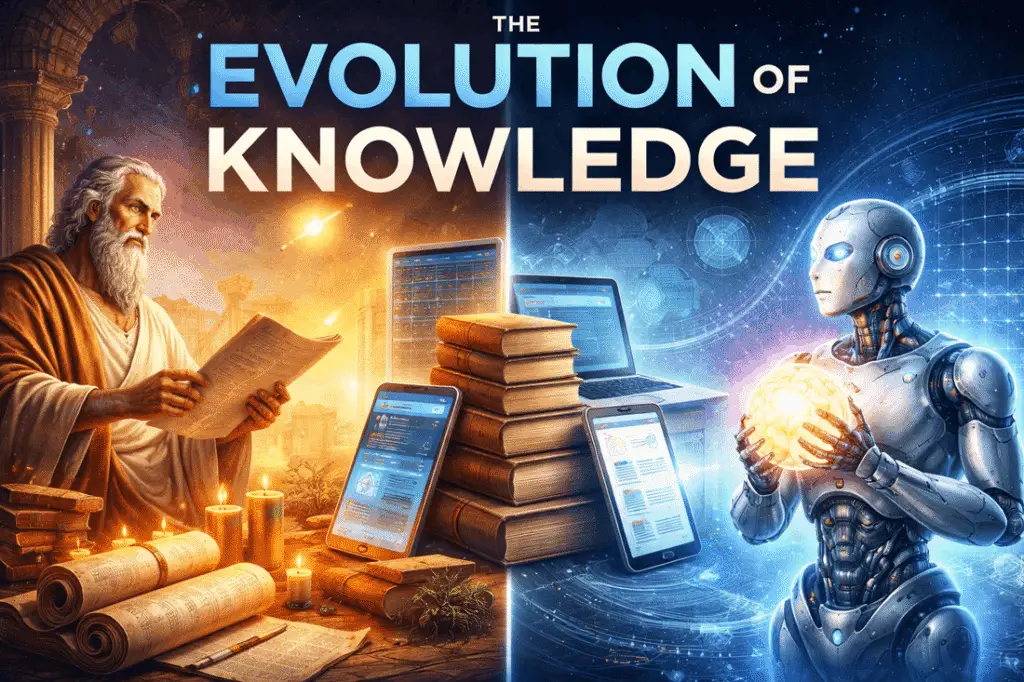
In today’s world, knowledge is no longer limited by geography, wealth, or institutions. With just a smartphone and an internet connection, anyone can learn almost anything within minutes. We are living in an age shaped by the evolution of knowledge, where information is abundant and learning opportunities are limitless.
Yet, despite this abundance, many people feel more confused than ever.
Degrees are increasing. Courses are multiplying. Content is infinite.
But clarity is rare.
This paradox exists because knowledge itself has evolved — and most of us were never taught how to evolve with it. To think clearly in the modern world, we must understand how knowledge has transformed and how it shapes learning in the digital age.
To fully grasp this transformation, we must also explore the evolution of human thinking, which reveals how our minds adapted alongside changing knowledge systems.
Let us explore this journey.
1. The Ancient Era: Knowledge as Wisdom
In ancient societies, knowledge was not stored in books or devices. It lived within people. Learning occurred through observation, dialogue, mentorship, and lived experience.
Students often lived with their teachers and learned by observing daily life. Knowledge was deeply connected to character, discipline, ethics, and responsibility. A knowledgeable person was not someone who knew many facts, but someone who lived wisely.
Ancient learning traditions emphasized questioning and reflective dialogue, similar to the Socratic method, which encouraged critical thinking and self-inquiry.
Education was life-centered. Children learned how to work, behave, think, and contribute to society. Hard experiences became teachers. Mistakes became lessons.
This period produced individuals with strong values and inner stability. However, progress was slow and scientific understanding limited. Still, it reminds us that knowledge without character is incomplete — a truth still relevant in the evolution of knowledge today.
2. The Scientific & Book Era: Knowledge as Information
With the invention of printing and the rise of science, knowledge transformed. Information could now be recorded, copied, and distributed widely. Knowledge moved from memory to books.
Scientific thinking introduced experiments, measurement, and evidence-based truth. Formal education systems emerged, and academic intelligence began to be measured through marks, degrees, and rankings.
Knowledge became something one could possess. Memorization and logic became symbols of intelligence.
This era enabled extraordinary scientific progress and technological foundations that shaped the modern world. However, it also created pressure and competition, narrowing the definition of intelligence.
The evolution of knowledge during this period turned learning into structured information systems.
3. The Industrial Era: Knowledge as Skill
As industries expanded, knowledge evolved further. Knowing facts was no longer enough; the ability to apply them became essential.
Education shifted toward job preparation. Subjects were chosen based on earning potential rather than curiosity. Productivity became the primary goal, and ideal workers were efficient, obedient, and consistent.
Creativity often mattered less than output. People learned how to perform tasks rather than how to think independently.
This stage of the evolution of knowledge created economic stability and technical expertise, but it also reduced curiosity and encouraged mechanical learning.
Knowledge became a tool for earning rather than understanding life.
4. The Digital Age Learning Revolution
The internet transformed learning forever. Knowledge became global, free, and instantly accessible. Videos, courses, tutorials, and books became available to anyone with connectivity.
This digital age learning revolution democratized education. Anyone could develop skills and explore interests at their own pace.
However, easy access created a new illusion: people began confusing exposure with understanding.
Watching became mistaken for learning.
Reading became mistaken for mastery.
Scrolling became mistaken for growth.
At the same time, information overload emerged. Too many sources, opinions, and experts flood the mind. Instead of clarity, people experience confusion.
Knowledge became cheap. Attention became expensive — a defining feature of learning in the digital age.
5. The AI Era: Instant Intelligence
We now live in the AI era, where tools can explain concepts, summarize books, generate notes, and solve problems within seconds. What once required years can now be done in minutes.
This shift changes the fundamental question. Earlier, people asked, “What do you know?” Today, the more relevant question is, “How do you use what you know?”
AI can provide information but not wisdom. It cannot determine what is ethical, meaningful, or right for your life. Judgment remains a human responsibility.
Artificial intelligence in education offers speed, efficiency, and accessibility. However, it also carries risks: mental dependency, reduced effort, and superficial thinking.
If we outsource thinking completely, we risk losing it.
6. The Modern Crisis: Knowing More, Understanding Less
Despite unprecedented access to information, many people feel overwhelmed. They consume content daily yet feel mentally exhausted and uncertain.
This happens because we collect facts but fail to build frameworks. We know about many topics but master none.
Symptoms include low confidence, poor decision-making, fear of being wrong, and constant doubt.
Modern knowledge is fragmented. Without structure, knowledge becomes noise — one of the biggest challenges in the evolution of knowledge.
7. Integrated Knowledge: The Future of Learning
The future belongs not to those who know the most, but to those who understand the best.
Integrated knowledge combines:
Ancient wisdom
Scientific logic
Digital speed
AI efficiency
Human judgment
Integrated learners filter information, connect ideas, and apply knowledge wisely. They build mastery instead of chasing trends.
For example, an integrated learner may use videos for basics, books for depth, AI for revision, and reflection for clarity. This balanced method defines effective learning in the digital age.
8. How to Build Real Knowledge Today
Choose fewer sources. One excellent teacher is better than ten average ones. Depth creates clarity.
Practice active learning. Ask yourself what you understood and whether you can explain it clearly.
Build mental frameworks by connecting subjects. History connects with economics. Psychology connects with careers. Technology connects with ethics.
Revise and reflect. Revision strengthens memory, while reflection develops wisdom.
Use artificial intelligence in education as an assistant, not a replacement for thinking.
9. Conclusion: From Information to Insight
Humanity has never lacked knowledge — only clarity about how to use it. From oral traditions to printed books, from industrial skills to digital access, and now to artificial intelligence, the evolution of knowledge continues to reshape how we learn.
Today, knowledge is abundant, but wisdom is rare.
The future will not belong to those who know everything. It will belong to those who understand what truly matters and can think clearly in an age of unlimited information. That is the true evolution of knowledge.
10. Evolution of Human Thinking Series
This article is part of the Evolution of Human Thinking series exploring how human thought, learning, and behavior continue to evolve in the modern world.
👉 Start here:
Evolution of Human Thinking: From Survival to AI (pillar post)
👉 Continue exploring:
- Evolution of Decision Making
- Evolution of Attention
- Evolution of Education
***
11. Frequently Asked Questions (FAQs)
Q1. What is the evolution of knowledge?
The evolution of knowledge refers to how human understanding has transformed from ancient wisdom traditions to scientific thinking, digital learning, and artificial intelligence.
Q2. Why is information overload a problem today?
Because digital platforms provide unlimited content, the brain receives more information than it can process, leading to confusion, stress, and reduced clarity.
Q3. How has AI changed learning?
Artificial intelligence enables instant explanations, summaries, and personalized learning support, making education faster and more accessible than ever before.
Q4. What is the best way to learn in the digital age?
Focus on fewer sources, practice active learning, build mental frameworks, revise regularly, and use AI as a support tool rather than a replacement for thinking.
Q5. What skills are essential in the AI era?
Critical thinking, decision-making, information filtering, adaptability, and ethical judgment are essential skills for success.