
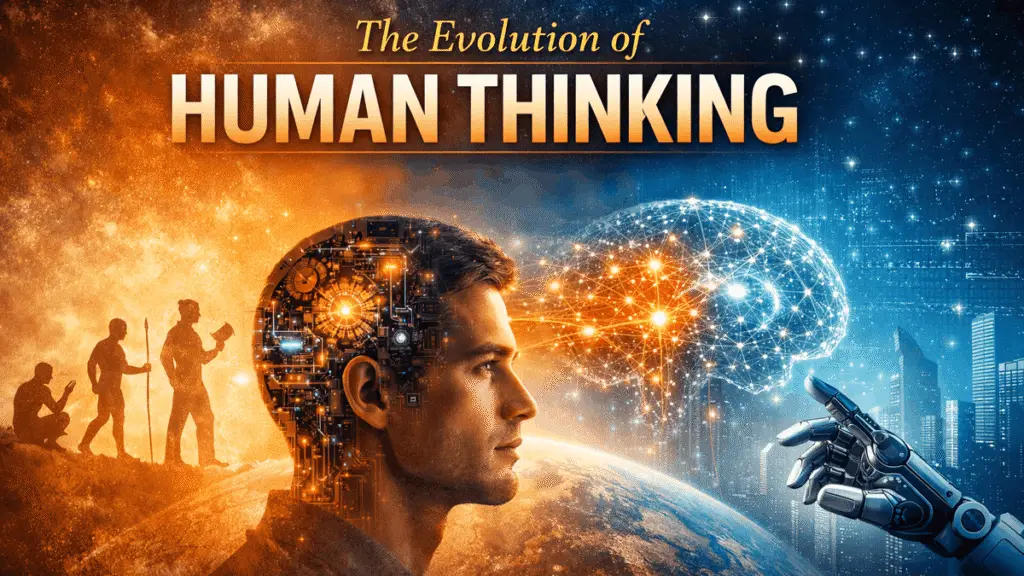
In every era of history, humans have faced different challenges.
In the beginning, the challenge was survival.
Finding food. Escaping danger. Protecting family.
Later, it became understanding.
Trying to make sense of life, morality, and purpose.
Then it became progress.
Building machines. Creating systems. Expanding knowledge.
Now, it is “Clarity”.
Learning how to think in a world overflowing with information.
Today, we live in a strange and powerful time.
We can access almost any information in seconds.
We can communicate across continents instantly.
We can learn skills from global experts sitting in our rooms.
We can use artificial intelligence to solve complex problems.
From the outside, this looks like the best era in human history. Yet, many people feel confused, anxious, and directionless. Students feel lost despite endless study material. Professionals feel insecure despite stable jobs. Young people feel pressured despite unlimited opportunities.
Why does this happen?
Because our tools evolved faster than our thinking. Technology upgraded itself every year. Human awareness did not.
We learned how to use machines.
We forgot how to understand ourselves.
We collect information faster than we can process it.
We consume more than we can reflect on.
We react more than we reason.
As a result, modern life feels noisy, rushed, and mentally exhausting.
To truly understand our careers, relationships, decisions, and mental health, we must understand one fundamental journey:
How human thinking evolved from survival instincts to artificial intelligence.
This is not just a story of history.
It is a mirror of our present struggles.
And a map for our future growth.
This journey explains why we think the way we do today — and how we can learn to think better tomorrow.
1. The Evolution of Human Thinking in the Survival Era
For nearly 95% of human history, life was dangerous and uncertain.
There were no hospitals.
No supermarkets.
No police.
No internet.
No emergency helplines.
If you were injured, you might die.
If you fail to find food, you might starve.
If you trusted the wrong person, you might be attacked.
Every day was a test of survival.
Early humans had to constantly think about:
- Finding food
- Escaping predators
- Protecting family
- Surviving extreme weather
- Avoiding enemies and rival groups
In such conditions, slow thinking was risky. Only fast thinkers survived. As a result, the human brain evolved to prioritize speed over accuracy.
In this era, thinking was:
✔ Fast
✔ Instinctive
✔ Emotional
✔ Reactive
People did not analyze situations deeply.
They reacted immediately.
If you heard a noise, you ran.
If you saw danger, you attacked or escaped.
There was no time for overthinking.
If you hesitated, you died.
The Survival Brain: Why We Still Think This Way
During this era, the most important part of the brain was the fear system. Its job was simple:
Detect threat → Trigger action → Save life.
This system helped humans survive for thousands of years. But it never disappeared. It still operates inside us today. Even in safe environments.
How This Survival System Affects Us Today
Modern life is mostly safe.
We have food.
Shelter.
Medicine.
Law and order.
Yet, our brain behaves as if danger is everywhere.
That’s why:
- We panic before exams
- We fear interviews
- We overreact to small criticism
- We feel stressed over deadlines
- We feel insecure on social media
Our mind unconsciously thinks: “Danger = Survival Threat.”
Even when danger is just:
- A presentation
- A meeting
- A test
- A comment
- A mistake
The brain cannot easily distinguish between:
“A tiger in the forest” and “A failure in life”.
To the survival system, both feel threatening. So it activates fear.
Heart beats faster.
Breathing changes.
Mind becomes restless.
This is the same mechanism that once saved lives. Today, it often creates anxiety.
Why Understanding This Matters
Many people think:
“I am weak.”
“I am too emotional.”
“I overreact.”
But that is not true. You are not weak. You are human. You are carrying a brain designed for survival in a world designed for complexity.
When you understand this, you stop blaming yourself. Instead, you start managing yourself.
You learn to calm your fear.
Control your reactions.
Think before responding.
This is the first step in upgrading human thinking.
2. The Spiritual & Philosophical Era: When Humans Searched for Meaning
As societies became more stable, humans slowly moved beyond constant survival.
Food became available.
Shelter became reliable.
Communities became organized.
For the first time in history, people had mental space. And when humans get mental space, they start asking deeper questions.
Not about “How do I survive?”
But about “Why am I alive?”
They began wondering:
“Why are we here?”
“What is right and wrong?”
“What is happiness?”
“What gives life meaning?”
“What happens after death?”
These questions gave birth to:
- Religion
- Philosophy
- Ethics
- Meditation
- Moral systems
Different civilizations answered them differently, but the intention was the same:
To understand life beyond material survival.
Thinking became:
✔ Reflective
✔ Moral
✔ Community-focused
✔ Purpose-driven
People were encouraged to look inward. Instead of only improving the outside world, they tried to improve themselves.
The Rise of Wisdom-Based Thinking
During this era, society respected those who had inner clarity.
People looked up to:
- Teachers
- Monks
- Sages
- Philosophers
A “smart person” was not someone who earned the most.
It was someone who controlled the mind.
Someone with:
- Self-control
- Discipline
- Compassion
- Awareness
Wisdom mattered more than wealth.
Character mattered more than status.
Knowledge was incomplete without values.
How This Era Shaped Education and Leadership
Education was not only about information. It was about transformation.
Students were taught:
How to behave.
How to think ethically.
How to serve society.
How to manage desires.
Leadership was also value-driven. Leaders were expected to:
- Be fair
- Be humble
- Be responsible
- Protect the weak
Power was linked with duty. Not privilege.
Life in This Era: Simplicity and Balance
Life moved at a slower pace. People lived simply and thought deeply.
They had fewer possessions, but stronger relationships.
Less entertainment, but more reflection.
Less competition, but more cooperation.
Happiness was connected to contentment. Success was connected to peace.
People tried to balance:
- Body and mind
- Work and rest
- Desire and discipline
- Individual and society
What We Lost and What We Still Need
Modern society often looks at this era as “old-fashioned.” But it had something we are slowly losing:
Inner stability.
Today, we have comfort without being calm.
Speed without direction.
Freedom without discipline.
That is why practices like meditation, mindfulness, and ethical thinking are returning in modern life.
We are rediscovering what our ancestors already knew: Without inner balance, outer success feels empty.
This era reminds us that true intelligence is not only about thinking fast. It is about thinking wisely.
3. The Scientific Era: When Logic Took Control
At a certain point in history, humans began questioning what they had always believed.
Instead of blindly accepting traditions, customs, and religious explanations, they started asking:
“Is this true?”
“Can we prove this?”
“Does this work in reality?”
“Can this be tested again and again?”
This mindset marked the beginning of scientific thinking.
For the first time, truth was not decided by authority.
It was decided by evidence.
The Foundations of Scientific Thinking
Scientific thinking was built on four core principles:
- Observation — carefully watching how things happen
- Experiment — testing ideas in controlled conditions
- Measurement — using numbers and tools to improve accuracy
- Verification — repeating results to ensure reliability
Anything that could not be tested was considered doubtful.
Anything that could be proven became accepted knowledge.
This approach transformed human understanding of nature, health, and technology.
How Scientific Thinking Changed Education
Education became systematic and organized.
- Schools were structured.
- Subjects were standardized.
- Syllabi were designed.
- Examinations were introduced.
Students were trained to:
- Memorize facts
- Solve logical problems
- Apply formulas
- Follow procedures
Memory and reasoning became the main indicators of intelligence. Those who performed well academically were considered “smart.” Those who struggled were often ignored. This system produced brilliant professionals. But it also created intense competition.
How It Changed Careers and Social Status
With the rise of science and technology, new professions gained respect.
Doctors, Engineers, Scientists, Researchers, Technologists.
Knowledge became power. Education became the gateway to social mobility. Families began investing heavily in education. Degrees became symbols of success.
A good career meant:
- Stability.
- Respect.
- Security.
- Status.
Society started ranking people based on their qualifications.
The Hidden Cost: When Numbers Replaced Humanity
While scientific thinking brought incredible progress, it also had a downside.
- Emotions were often ignored.
- Creativity was undervalued.
- Intuition was dismissed.
- Human complexity was simplified.
People slowly became numbers.
Marks = Worth
Rank = Identity
Salary = Success
Students began feeling pressure from childhood. Professionals began defining themselves by income. Failure became shameful. Rest became guilt. Mental health was rarely discussed.
Why This Era Still Shapes Us Today
Even today, we are deeply influenced by this mindset. We still ask:
“What degree do you have?”
“How much do you earn?”
“Which college did you attend?”
We still judge intelligence through scores and certificates. We still believe logic is superior to emotion.
But modern life is showing us something important:
- Logic alone is not enough.
- Data cannot replace empathy.
- Formulas cannot replace judgment.
- Degrees cannot replace wisdom.
The scientific era taught us how to think correctly. Now we must learn how to think completely.
4. The Industrial Era: When Efficiency Ruled the Mind
With the rise of factories, machines, and large corporations, human thinking shifted once again. Society entered the age of mass production. Goods were no longer made by individuals. They were produced by systems. Speed, scale, and efficiency became the new priorities.
The main goal was simple:
- Productivity.
- More output.
- Less time.
- Lower cost.
To achieve this, people were trained to:
- Follow rules
- Meet targets
- Repeat tasks
- Obey systems
- Stick to schedules
Work became standardized. Processes were fixed. Creativity was often seen as a disturbance.
The Rise of Mechanical Thinking
In this era, organizations functioned like machines. And humans became parts of those machines.
Thinking became:
✔ Mechanical
✔ Routine-based
✔ Hierarchical
Workers were expected to:
- Do their assigned task.
- Not question the process.
- Not suggest changes.
- Not slow down.
People were no longer valued for ideas. They were valued for efficiency. That is why workers were often called “resources.”
“Human Resource. Not Human Being”.
Life Inside the Industrial System
For many people, life followed a predictable pattern:
- Wake up.
- Go to work.
- Follow orders.
- Return home tired.
- Repeat.
Day after day. Year after year.
Jobs provided stability. But they also reduced individuality.
Dreams were postponed. Passions were ignored. Survival was replaced by routine.
Effects on Mental Health and Identity
Over time, this lifestyle created psychological pressure.
- Burnout increased.
- Job dissatisfaction grew.
- Creativity declined.
- Purpose reduced.
Many people began living on autopilot.
They worked without enthusiasm.
They rested without fulfillment.
They lived without excitement.
Their identity became their job title. When work suffered, self-worth suffered.
Why This Era Still Matters Today
Even today, many workplaces follow industrial thinking.
- Fixed hours.
- Rigid hierarchies.
- Target obsession.
- Micromanagement.
People are still rewarded for obedience more than originality. That is why many professionals feel trapped.
“They are busy, but not fulfilled.
Productive, but not passionate.
Stable, but not satisfied.”
Understanding this era helps us realize:
Efficiency is important. But without meaning, it becomes exhaustion.
This realization prepares us for the next transformation — the digital age.
5. The Digital Era: When Information Exploded
The arrival of the internet changed human thinking more than any invention in history. Suddenly, knowledge was no longer limited to libraries or classrooms. It was everywhere.
In our phones.
In our laptops.
In our pockets.
Within seconds, anyone could access:
- Free books
- Online courses
- Expert lectures
- Tutorials
- Research papers
Teachers were everywhere.
Courses were unlimited.
Anyone could learn anything.
This was supposed to create the smartest generation in history. In many ways, it did. But it also created a new problem.
When Quantity Replaced Quality
As information became easy to access, it also became overwhelming.
Instead of asking: “What is the best source?”
We started asking: “How many sources can I consume?”
- Quantity replaced quality.
- Speed replaced depth.
- Skimming replaced understanding.
People began jumping from one video to another, from one article to the next, without truly absorbing anything.
The Problem of Information Overload
Today, we consume content constantly.
- Social media.
- News.
- Videos.
- Podcasts.
- Messages.
- Notifications.
From morning to night. Our brain rarely gets rest. It is always processing something.
This continuous stimulation leads to:
- Poor concentration
- Short attention span
- Shallow learning
- Mental fatigue
- Decision paralysis
We know many things. But we understand very little.
How Digital Overload Affects Daily Life
In studies, work, and personal life, this overload creates confusion.
Students feel lost despite endless material.
Professionals feel distracted despite digital tools.
Entrepreneurs feel overwhelmed despite online resources.
People start many things. They finish very few. Focus becomes rare. Clarity becomes precious.
The Hidden Cost of Constant Connectivity
Being connected all the time feels productive. But it often reduces thinking quality.
When the mind never rests:
Creativity declines. Memory weakens. Judgment suffers. Patience disappears.
We react quickly. But think poorly. We scroll more. But understand less.
The Lesson of the Digital Era
The digital age teaches us an important truth:
- Access does not guarantee mastery.
- Information does not guarantee intelligence.
- Connectivity does not guarantee clarity.
To think well in the digital era, we must learn to:
- Choose carefully.
- Consume selectively.
- Reflect regularly.
- Disconnect intentionally.
Only then can technology become a tool instead of a trap.
6. The AI Era: When Machines Became Thinking Partners
We have now entered one of the most important phases in human history. The age of Artificial Intelligence. For the first time, machines are not just helping humans work. They are helping humans think.
AI can now:
- Write essays and reports
- Generate computer code
- Analyze massive data
- Teach complex concepts
- Create designs and artwork
- Predict trends and patterns
Tasks that once required years of education and experience can now be completed in seconds. What seemed impossible a decade ago is normal today. This is not just a technological change. It is a mental revolution.
What AI Really Replaces (And What It Doesn’t)
Many people fear: “AI will take our jobs.” “Humans will become useless.”
But this fear is only half true. AI does not replace humans. It replaces routines.
It replaces:
- Repetitive work
- Predictable processes
- Rule-based tasks
- Mechanical thinking
Jobs that depend only on fixed patterns are at risk. Jobs that require human judgment are not.
AI is excellent at calculation. But weak at meaning.
It can process information. But cannot understand life.
How AI Is Changing Careers and Skills
In the AI era, traditional career paths are changing fast.
Earlier, success meant:
Get degree → Get job → Work for 30 years → Retire.
Today, that model is breaking.
According to MIT Sloan’s research on how AI is changing work, professionals who adapt to new technologies gain long-term advantages in the job market.
Skills are becoming more important than certificates. Adaptability is becoming more important than experience.
Learning speed is becoming more important than memory. Professionals who learn to use AI become more powerful. Those who ignore it become vulnerable. AI is not a competitor. It is a multiplier.
What Humans Must Develop Now
To stay relevant, humans must strengthen what machines cannot copy.
The most valuable human abilities today are:
✔ Creativity — producing original ideas
✔ Judgment — making wise decisions
✔ Ethics — choosing what is right
✔ Strategy — seeing long-term impact
✔ Empathy — understanding emotions
These skills come from experience, reflection, and awareness. Not from algorithms.
From “Human vs AI” to “Human + AI”
The biggest mistake is thinking in terms of competition.
It is not: Human vs AI.
It is: Human + AI.
The future belongs to people who know how to:
- Ask the right questions.
- Use AI wisely.
- Verify results.
- Apply insights.
- Add human perspective.
AI gives speed. Humans give direction.
AI gives answers. Humans give meaning.
The Opportunity Hidden in the AI Era
Every major technological shift created fear.
- Printing press.
- Electricity.
- Computers.
- Internet.
Each time, people feared job loss. Each time, new opportunities emerged.
AI is no different. It will remove old roles. But it will create new ones. The winners will not be the smartest. They will be the most adaptable. Those who upgrade their thinking will upgrade their lives.
7. The Crisis of Modern Thinking
Today’s biggest problem is not lack of intelligence. It is a lack of direction. Never in history have humans been so educated, so connected, and so informed. Yet, never have they been so confused.
People today suffer from:
- Overthinking
- Constant comparison
- Fear of missing out (FOMO)
- Low self-esteem
- Decision fatigue
- Mental exhaustion
We think a lot. But we don’t think clearly.
Why Modern Minds Feel Overloaded
The modern brain faces more choices than any previous generation.
- Which career?
- Which course?
- Which relationship?
- Which lifestyle?
- Which investment?
- Which belief system?
Every decision feels heavy. Every choice feels risky. At the same time, social media constantly shows us “better” lives.
- Better jobs.
- Better houses.
- Better bodies.
- Better relationships.
- Better vacations.
This creates silent pressure. We start measuring our life using someone else’s highlights.
When Thinking Becomes a Trap
Thinking is supposed to help us. But without direction, it becomes a burden.
Many people replay the same thoughts again and again:
“What if I fail?”
“What will people think?”
“Am I behind others?”
“Did I choose wrong?”
“What if I regret this?”
This mental loop wastes energy. It does not produce solutions. It produces stress.
The Root Cause: Thinking Without Purpose
The main reason for this crisis is simple:
We think too much — without purpose.
We consume more than we process.
We react more than we reflect.
We scroll more than we contemplate.
Our mind becomes a crowded room.
Too many voices.
Too many opinions.
Too many expectations.
No clear direction.
How the Evolution of Human Thinking Shapes Modern Life
This mental confusion affects every area of life.
In careers, people keep switching paths without clarity.
In relationships, people doubt constantly.
In studies, students lose confidence.
In personal life, people feel empty.
They are busy. But not peaceful.
Active. But not fulfilled.
Why This Crisis Is Also an Opportunity
Every crisis carries a hidden message.
This mental crisis is telling us:
It is time to upgrade our thinking. Not by learning more facts. But by developing clarity.
Not by consuming more content. But by understanding ourselves.
This realization prepares us for the next stage of human thinking.
8. Case Story: From Overload to Clarity
Rohit (name changed) was a graduate preparing for competitive government exams. Like millions of young people, he had big dreams.
- A stable job.
- Respect in society.
- Security for his family.
He was hardworking and sincere. Every day, he studied for nearly 10 hours. From the outside, he looked serious and dedicated. But inside, he was confused.
The Trap of “More Is Better”
Rohit believed that success required maximum information.
So he followed:
- 20 YouTube channels
- 15 Telegram groups
- 5 different coaching notes
- Multiple test series
Every teacher said something different.
Every group shared new material.
Every video promised “guaranteed success.”
Rohit tried to consume everything. He was always studying. But rarely understanding.
When Hard Work Was Not Enough
Despite his effort, results did not improve.
He failed mock tests.
He forgot concepts.
He panicked in exams.
Slowly, self-doubt entered.
“Am I not intelligent enough?”
“Why am I not improving?”
“What am I doing wrong?”
He felt tired. Not physically. Mentally.
The Turning Point: Learning to Simplify
One day, a senior advised him:
“Reduce your sources. Increase your focus.”
At first, Rohit resisted. It felt risky.
“What if I miss something important?”
But he decided to try. He chose:
- Two reliable teachers.
- One main set of notes.
- One test series.
He stopped jumping. He started revising.
From Consumption to Reflection
Instead of watching more videos, he began:
- Reviewing mistakes.
- Writing short notes.
- Solving problems deeply.
- Reflecting on weak areas.
He started thinking about how he studied. Not just how much he studied. His confidence slowly returned.
The Result: When Thinking Changes, Life Changes
After months of focused preparation, something shifted.
- His mock scores improved.
- His concepts became clear.
- His anxiety reduced.
When the exam came, he was calm. He cleared it. More importantly, he understood why. It was not because he studied more. It was because he thought better. His thinking changed. And his life changed with it.
The Lesson Behind the Story
Rohit’s story is not unique. It is the story of millions.
We live in a world that teaches us to collect information. But not to organize it.
Success today does not come from knowing everything. It comes from knowing what matters.
9. The Integrated Mind: The Next Stage of Evolution
Every era of history has added something valuable to human thinking.
The survival era gave us courage.
The spiritual era gave us awareness.
The scientific era gave us logic.
The digital era gave us speed.
The AI era is giving us strategy.
The future does not belong to people who master only one of these. It belongs to those who can integrate all of them. These people are called integrated thinkers.
What Is an Integrated Mind?
An integrated mind is balanced. It does not reject the past. It does not blindly follow the future. It learns from every stage of evolution.
Integrated thinkers combine:
🧬 Survival → Courage to face uncertainty
🕉️ Spiritual → Awareness of self and values
🔬 Scientific → Logical reasoning
💻 Digital → Speed and adaptability
🤖 AI → Strategic use of technology
They can shift their thinking based on situations.
- They know when to act fast.
- They know when to pause.
- They know when to analyze.
- They know when to trust intuition.
How Integrated Thinkers Perform in Real Life
Such people stand out in every field.
In careers, they use data and intuition together.
In leadership, they balance authority with empathy.
In relationships, they mix logic with compassion.
In crises, they stay calm and solution-focused.
They do not panic easily.
They do not follow crowds blindly.
They do not get stuck in one mindset.
They remain flexible.
Technology as a Tool, Not a Master
Integrated thinkers do not depend blindly on technology. They master it.
- They use AI to save time.
- They use data to improve decisions.
- They use digital tools to learn faster.
But they never outsource their judgment.
They verify.
They question.
They reflect.
They remain mentally independent.
Why This Mindset Will Dominate the Future
The future will be uncertain.
Jobs will change.
Skills will expire.
Industries will evolve.
Challenges will increase.
Only one thing will remain valuable: The ability to think clearly in chaos.
Integrated thinkers can:
- Stay calm under pressure.
- Learn continuously.
- Decide wisely.
- Adapt quickly.
- Live meaningfully.
They are not afraid of change. They grow with it.
Becoming an Integrated Thinker Is a Choice
No one is born with an integrated mind. It is developed.
Through reflection.
Through learning.
Through experience.
Through humility.
Every challenge is a training ground. Every mistake is a lesson. Every success is a reminder to stay grounded.
The future is not waiting for perfect people. It is waiting for evolved thinkers.
10. Seven Powerful Daily Skills to Upgrade Your Thinking in the Digital and AI Age
Upgrading your thinking does not require high IQ or expensive courses. It requires simple daily habits practiced consistently. Here are seven powerful ways to strengthen your thinking in the modern world:
1. Build Silence into Your Life
- Spend at least 10 minutes daily without your phone, music, or notifications.
- Sit quietly.
- Let your thoughts settle.
- Silence helps your brain organize information and restore clarity.
2. Read Less, Understand More
- Do not chase endless articles and videos.
- One good article deeply understood is better than ten random ones.
- Quality builds wisdom.
- Quantity creates noise.
3. Connect Ideas Across Fields
Try linking different areas of life:
- Career with psychology.
- Money with mindset.
- Technology with ethics.
- Success with health.
This habit creates deeper understanding and original thinking.
4. Practice Conscious Decision-Making
Do not let life run on autopilot. Practice making small decisions intentionally.
Ask yourself: “Why am I choosing this?”
This builds confidence and mental discipline.
5. Write Your Thoughts Regularly
Journaling is one of the fastest ways to improve clarity.
Write about:
- What you learned.
- What confused you.
- What you felt.
- What you decided.
Writing converts vague thoughts into clear ideas.
6. Learn Meta-Skills: Learn How to Learn
Instead of memorizing everything, master learning itself.
Understand:
- How you remember.
- How you forget.
- How you revise.
- How you practice.
People who learn how to learn never become outdated.
7. Protect Your Attention
Your attention is your most valuable mental asset.
- Reduce unnecessary notifications.
- Limit social media time.
- Avoid constant multitasking.
A focused mind thinks better than a busy mind.
11. Frequently Asked Questions (FAQ)
i. Is AI making humans lazy?
AI does not make humans lazy by default. It makes humans comfortable.
If people use AI only to avoid thinking, their mental skills weaken. But if they use AI to save time and focus on creativity, learning, and strategy, they become stronger.
AI is a tool. Whether it makes you lazy or powerful depends on how you use it.
ii. Can humans really compete with AI?
Humans do not need to compete with AI. They need to complement it.
AI is excellent at:
- Calculations
- Data processing
- Pattern recognition
Humans are better at:
- Creativity
- Ethics
- Emotional understanding
- Moral judgment
- Long-term vision
In these areas, humans will always remain superior. The future belongs to collaboration, not competition.
iii. Why do people overthink so much today?
Overthinking is mainly caused by:
- Information overload
- Too many choices
- Fear of failure
- Social comparison
- Lack of clarity
When the mind receives too many inputs and no direction, it starts looping. It repeats the same thoughts again and again.
This creates stress instead of solutions. Clarity reduces overthinking more than intelligence.
iv. How can I improve my thinking ability?
Improving thinking does not require a high IQ. It requires good habits.
You can start by:
- Reducing unnecessary content
- Creating daily quiet time
- Writing your thoughts
- Reviewing your decisions
- Learning deeply, not widely
Reflection is more important than consumption.
v. Is intelligence mostly genetic?
Genes play a role. But habits matter more. Research shows that mindset, environment, and practice shape intelligence over time.
People who:
- Read regularly
- Think critically
- Question assumptions
- Learn continuously
Often outperform naturally “gifted” people. Consistency beats talent.
vi. Can anyone become a better thinker?
Yes. Thinking is a skill. Like fitness, it improves with training.
Anyone who is willing to:
- Observe themselves
- Learn from mistakes
- Stay curious
- Remain humble
Can upgrade their thinking. Growth is a choice, not a privilege.
12. About the Evolution Series
This article is the foundation of The Evolution Series on Beyond the Syllabus.
It is not just a collection of posts. It is an ongoing exploration of how human thinking, behavior, and systems are changing in the modern world.
In this series, we go beyond textbooks, trends, and surface-level advice. We study how history, psychology, technology, and society shape the way we live today. And how they will shape our future.
What This Series Will Cover
Upcoming topics in this series include:
Each article will explore one important area of life.
- Not just what has changed.
- But why did it change?
- And how you can adapt intelligently.
Why This Series Exists
Most content today focuses on shortcuts.
“Quick hacks”.
“Instant success”.
“Temporary motivation”.
This series is different. It focuses on:
- Deep thinking.
- Long-term growth.
- Mental clarity.
- Practical wisdom.
The goal is not to impress. It is to empower.
An Invitation to the Reader
If you are someone who likes to think deeply, question assumptions, and grow consciously, this series is for you. You are not here just to pass exams. Or chase salaries. Or follow trends.
You are here to build a meaningful life. And this series is designed to support that journey.
13. Conclusion: From Instinct to Insight
Human thinking has traveled a long and fascinating journey.
From fear to faith.
From belief to logic.
From logic to systems.
From systems to data.
From data to intelligence.
In simple terms, it has evolved from:
Instinct → Belief → Logic → System → Data → Intelligence.
Each stage helped humanity survive, grow, and progress. None was useless. None was a mistake.
But the final and most important stage is still unfolding. It is called:
Insight.
What Is Insight?
Insight is the ability to see clearly.
To understand situations beyond emotions.
To think independently instead of blindly following.
To choose consciously instead of reacting automatically.
To live intentionally instead of mechanically.
It is not about knowing more. It is about understanding better.
Why Insight Matters in the Modern World
Today, we live in a world full of answers.
- Search engines answer questions.
- AI generates solutions.
- Social media offers opinions.
- Experts give advice.
Information is everywhere. Clarity is rare.
That is why confusion is common.
Anxiety is increasing.
Confidence is declining.
Without insight, even the smartest people feel lost.
The Real Power of the Future
In a world full of answers, clarity is the real power.
In a world full of noise, calm thinking is the real strength.
In a world full of shortcuts, conscious choices are the real success.
The future does not belong to those who know everything.
It belongs to those who understand what truly matters.
A Final Thought
Human evolution is not finished. According to research on human evolution, it is still shaping who we are today — and it is happening inside you.
Every day, through your choices.
Through your habits.
Through your thinking.
You can remain a consumer of information. Or you can become a creator of insight.
You can follow trends. Or you can set direction. And that choice will define your future.
That is the true evolution of human thinking.
***